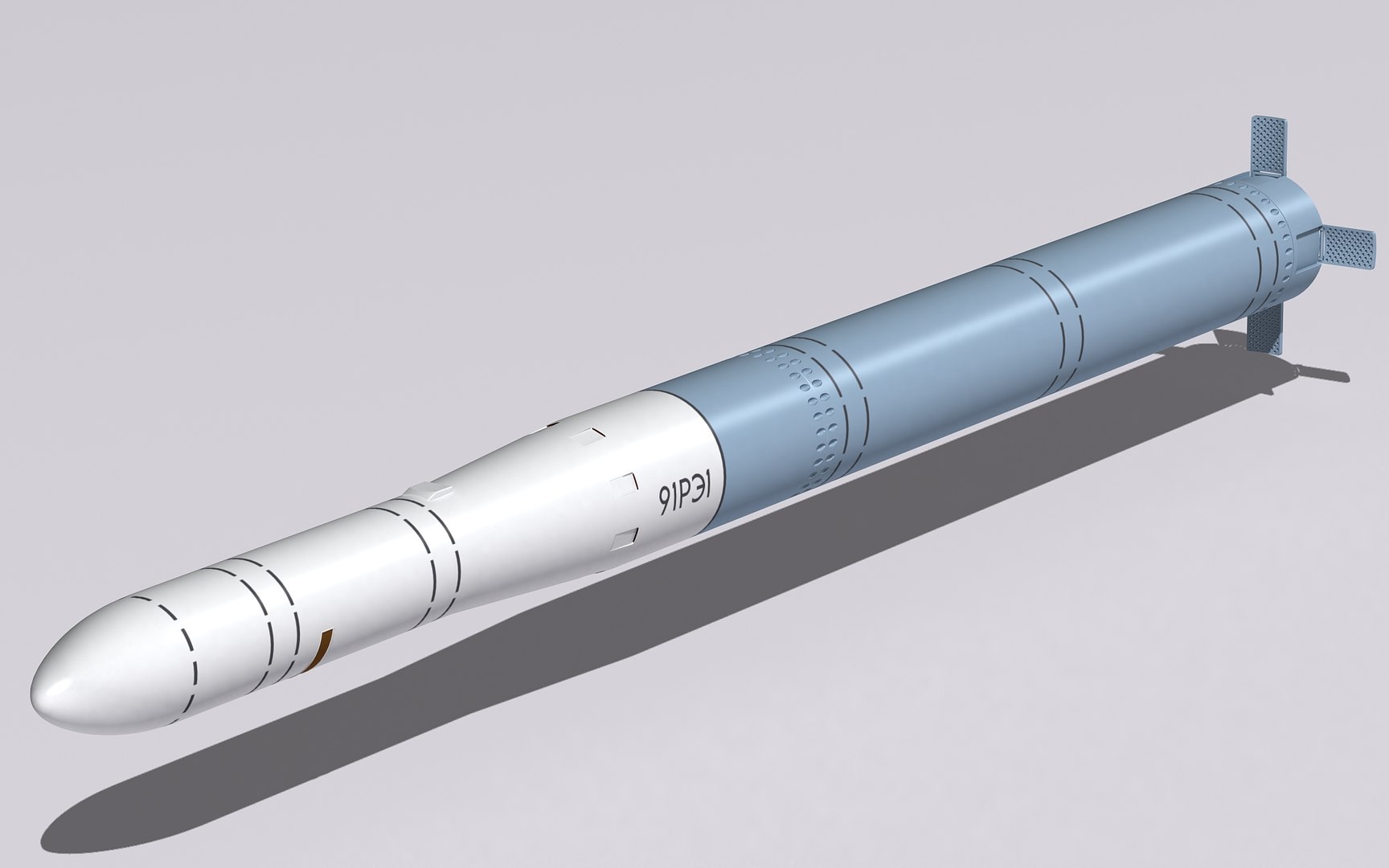
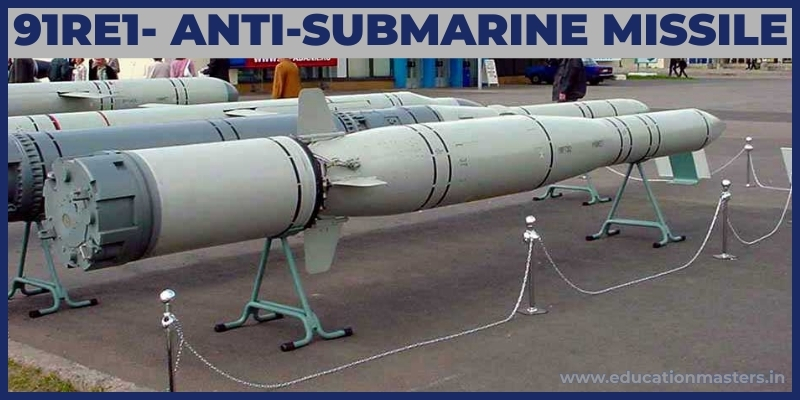
The 91RE1 Missile is a highly specialized anti-submarine missile–torpedo delivery system from Russia’s renowned 3M-54E Klub missile family, and is an important ASW asset operated by the Indian Navy. Engineered to counter modern, stealth-equipped submarines—one of the most challenging threats in naval warfare—the 91RE1 Missile equips Indian warships with a long-range, rapid-reaction anti-submarine capability that far exceeds the reach of conventional underwater weapons.
Unlike traditional torpedoes that move slowly and are limited by underwater drag, the 91RE1 Missile employs a high-speed airborne missile to transport a lightweight torpedo deep into the target zone. This quick-delivery method prevents hostile submarines from escaping, diving deeper, or repositioning. By enabling fast, accurate, and distant engagement, the 91RE1 Missile significantly strengthens India’s maritime security posture, enhances the protection of carrier battle groups and fleet assets, and reinforces India’s strategic advantage across the Indian Ocean Region.
Overview of 91RE1 Missile
|
Feature
|
Details
|
|
Missile Type
|
Anti-Submarine Missile (ASW) – Torpedo Delivery System
|
|
Family
|
Klub / 3M-54E / Russian-origin
|
|
Operator
|
Indian Navy
|
|
Launch Platform
|
Surface ships (vertical launch systems)
|
|
Range
|
Approx. 40–50 km
|
|
Payload
|
Lightweight anti-submarine torpedo
|
|
Guidance
|
INS + terminal torpedo sonar homing
|
|
Speed
|
High-subsonic during missile flight
|
|
Role
|
Rapid delivery of torpedo to distant submarine targets
|
Importance of the 91RE1 Missile for India
-
Provides India with a long-range ASW strike capability, a critical requirement against stealthy diesel-electric submarines.
-
Allows warships to proactively neutralize submarine threats long before they reach torpedo-launch distance.
-
Strengthens multi-layered ASW defence, protecting carrier battle groups, ballistic missile submarines, and major fleet assets.
-
Enhances India’s maritime dominance in the Indian Ocean Region (IOR), a region increasingly contested by foreign submarine activity.
-
Acts as a crucial tool for sea-lane protection, especially in choke points such as the Arabian Sea and Bay of Bengal.
-
Increases operational flexibility by working in both deep-sea and littoral environments, where submarines often hide.
Purpose of the 91RE1 Missile
1. To deliver a torpedo quickly and accurately to a submarine’s suspected location
The 91RE1 is designed to transport a lightweight torpedo at high speed through the air, allowing it to reach the target zone far faster than a conventional underwater torpedo. This rapid, precise delivery greatly increases the chances of detecting and destroying hostile submarines before they can evade.
2. To provide a stand-off ASW strike option, avoiding the limitations of short-range torpedoes
Traditional torpedoes are restricted by short engagement ranges and slow underwater travel. The 91RE1 overcomes these constraints by enabling ships to attack submarines from much greater distances, offering a true stand-off anti-submarine capability.
3. To improve the safety and survivability of Indian naval platforms by keeping them away from enemy torpedo ranges
By allowing warships to engage underwater threats without closing in, the 91RE1 reduces exposure to submarine-launched torpedoes and ambush tactics. This safeguards frontline vessels, especially high-value assets like destroyers, frigates, and carrier groups.
4. To serve as a rapid-response ASW weapon during submarine intrusion, forward patrols, and fleet escort missions
The missile’s speed and precision make it ideal for urgent scenarios such as suspected submarine intrusions, escort duties for fleet formations, or safeguarding maritime choke points. Its quick deployment capability is crucial during high-threat encounters.
5. To enhance India’s ability to counter advanced submarines equipped with quieting technologies and modern acoustic stealth
Modern submarines are increasingly difficult to track due to sophisticated noise-reduction systems. By delivering a torpedo directly into the submarine’s likely zone of operation, the 91RE1 significantly improves India’s chances of neutralizing stealthy, next-generation underwater threats.
Operational Role of the 91RE1 Missile
1. Threat Detection
Sonar, maritime patrol aircraft, helicopters, or satellites detect and track enemy submarines, providing initial coordinates for engagement.
2. Missile Launch from Surface Ship
The missile is vertically launched from VLS cells on Indian warships, transitioning into horizontal flight toward the target zone.
3. Rapid Airborne Transit
At high-subsonic speeds, the missile covers long distances quickly—much faster than any underwater torpedo—closing in on the target before the submarine can escape.
4. Torpedo Deployment
Once it reaches the designated area, the missile releases a lightweight torpedo using a stabilized parachute system for controlled water entry.
5. Torpedo Search & Homing Phase
The torpedo activates active/passive sonar, scanning the underwater environment and identifying the hostile submarine.
6. Neutralization
The torpedo homes in on the detected submarine, closing the distance and detonating upon impact or proximity.
Advantages of 91RE1 Missile
1. Extends ASW engagement far beyond torpedo range
Traditional torpedoes have limited range, but the 91RE1 Missile allows Indian ships to engage submarines at 4–5 times the distance, dramatically widening the defensive perimeter.
2. Rapid reaction capability
Because the missile flies through the air rather than water, it reaches the target much faster, giving the submarine little time to evade.
3. High accuracy and kill probability
The missile delivers the torpedo close to the estimated submarine position, allowing the sonar-guided torpedo to acquire the target reliably.
4. Improves platform survivability
Indian ships can strike without venturing into risky zones, staying beyond the range of enemy submarine torpedoes.
5. Excellent fleet protection asset
Especially valuable for defending carrier groups, frigates, oil tankers, and supply convoys from underwater threats.
6. Versatile ASW tool
Suitable for both deep-sea combat and coastal ASW, where submarines often hide in complex underwater terrain.
Limitations of 91RE1 Missile
1. Requires precise submarine coordinates
Missile-based torpedo delivery demands accurate target detection; poor initial data may reduce effectiveness.
2. Torpedo speed limits the terminal chase
Although delivered quickly, the torpedo still moves underwater at moderate speeds, giving some submarines a chance to maneuver.
3. Vulnerability to countermeasures
Submarines equipped with decoys, acoustic jammers, and stealth technologies may complicate torpedo tracking.
4. Shorter range compared to advanced ASW missiles (e.g., SMART)
SMART offers hundreds of kilometers of range, making 91RE1 Missile shorter-ranged by comparison.
5. Weather and sea conditions can affect final accuracy
High winds, storms, or rough seas can influence missile trajectory or torpedo entry.
Conclusion
The 91RE1 Missile (Klub ASW missile) stands as a pivotal component of India’s modern anti-submarine warfare network. Its capability to deliver a torpedo swiftly, precisely, and over significantly longer ranges makes it far more effective than traditional torpedo-only systems. By allowing Indian warships to neutralize underwater threats from stand-off distances, the 91RE1 Missile greatly enhances fleet survivability and reduces vulnerability to enemy submarine attacks.
Its rapid-response delivery, combined with long-range reach, provides India with a powerful area-denial tool, denying hostile submarines the ability to operate freely around vital sea lanes, naval bases, and carrier battle groups. This strengthens the overall security framework of India’s maritime operations in both coastal waters and deep-sea environments.Even with certain operational limitations, the 91RE1 Missile remains an indispensable pillar of India’s layered ASW architecture, significantly boosting the Navy’s preparedness, operational flexibility, and strategic advantage in the Indian Ocean Region. For more information about missiles visit Education Masters.
सरकारी नौकरियों, जीके अपडेट्स और करेंट अफेयर्स की ताज़ा जानकारी सबसे पहले पाने के लिए:






.png)
.jpg)
.jpg)