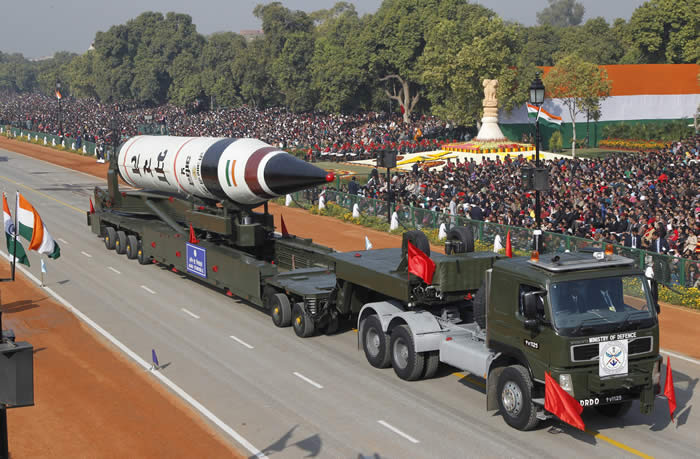
Agni-5 Missile is one of India’s most advanced Intercontinental Ballistic Missiles (ICBMs), developed by the Defence Research and Development Organisation (DRDO). Designed to strengthen India’s strategic deterrence capabilities, Agni-5 Missile features a range of over 5,000 km, Agni-5 Missile is capable of hitting faraway targets with great precision and was created to improve India's strategic deterrent capacity. It is a three-stage, solid-fuelled missile known for its reliability, long-range capability, and advanced guidance systems. The Agni-5 Missile represents a major milestone in India’s missile development program, elevating the country’s status in long-range strategic warfare technology.
Agni-5 Missile Overview
|
Feature
|
Details
|
|
Type
|
Intercontinental-Ballistic Missile (ICBM)
|
|
Developed By
|
Defence Research & Development Organisation of India (DRDO)
|
|
Range
|
5,000 – 5,500 km (approx.)
|
|
Fuel type
|
Solid-fuel with three-stage rocket
|
|
Launch Platform
|
canisterized launcher that is Road-mobile
|
|
Warhead Capacity
|
1,500 kilograms (nuclear or conventional)
|
|
Accuracy
|
High precision with advanced navigation and guidance
|
|
Speed
|
Hypersonic (re-entry speed > Mach 20)
|
|
Status
|
Operational / Under enhancement trials
|
|
Notable Features
|
Canister launch, MIRV-ready, high survivability, quick launch capability
|
Development Background Of Agni-5 Missile:
Agni-5 Missile was developed by India’s DRDO as a next-generation long-range ballistic missile to strengthen India’s nuclear deterrence strategy. Its design incorporates modern composite materials, advanced electronics, and improved propulsion systems to achieve higher range and mobility.
Guidance & Navigation System Of Agni-5 Missile:
The missile uses ring-laser gyros, micro-navigation systems, and sophisticated computer algorithms for high accuracy. It also includes advanced inertial navigation combined with satellite guidance support for precise target engagement.
Stealth & Survivability Features Of Agni-5 Missile:
The missile includes features like:
-
Lowered radar cross-section
-
Highly mobile launcher
-
Underground storage and high mobility
These ensure concealment, survivability, and secure deployment during crises.
Strategic Role for India of Agni-5 Missile:
Agni-5 Missile is a key component of India’s credible minimum deterrence and plays a vital role in the nuclear triad. The missile’s long range ensures coverage of distant strategic targets, strengthening national security and geopolitical influence.
Test History Of Agni-5 Missile:
Agni-5 Missile has undergone multiple successful tests, including:
-
Development trials
-
Canisterized test launch
-
Night trials
-
User/evaluation tests
Each test demonstrated improved accuracy, reliability, and readiness for operational deployment
Operational Status Of Agni-5 Missile:
The Agni-5 Missile is now in the advanced stages of induction, with strategic forces gaining operational proficiency. Continued trials focus on enhancing MIRV capability and maximizing deterrence strength.
Introduction to Agni-6 Missile :
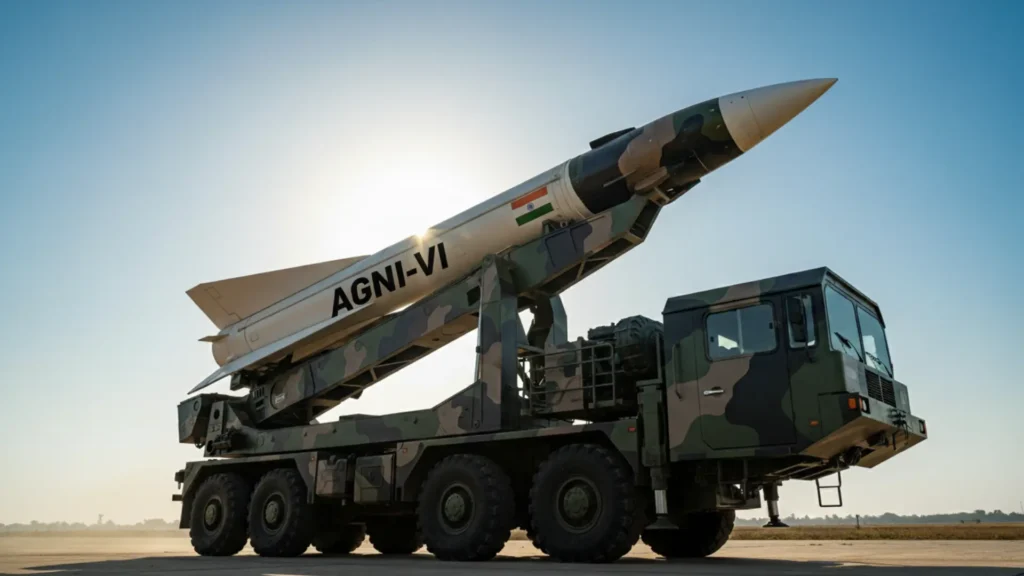
Agni-6 Missile is India’s next-generation intercontinental ballistic missile (ICBM) under advanced development, envisioned to significantly enhance the country’s strategic deterrence capabilities. Considered the most powerful missile in the Agni series, Agni-6 Missile is expected to feature an extended range, improved survivability, and cutting-edge technologies such as multiple independently targetable re-entry vehicles (MIRVs) and possibly manoeuvrable re-entry vehicles (MaRVs). Designed for greater flexibility and global reach, the missile is likely to be deployed in canisterised form, ensuring rapid launch readiness, mobility, and long-term storage capability.
Agni-6 Missile represents a major step forward in India’s nuclear triad, offering deeper penetration, higher accuracy, and stronger second-strike capabilities, aligning with India’s evolving security environment and long-term strategic goals.
Agni-6 Missile Overview
|
Category
|
Details
|
|
Missile Name
|
Agni-6
|
|
Type
|
Intercontinental-Ballistic Missile (ICBM )
|
|
Developer
|
Defence Research and Development Organisation of India (DRDO)
|
|
Status
|
Under advanced development / conceptual stage (not yet test-fired)
|
|
Estimated Range
|
8,000 – 12,000 km (expected)
|
|
Propulsion
|
Solid-fuel with Three-stage
|
|
Warhead Capability
|
MIRV (Multiple Independently Targetable Re-entry Vehicles) expected; possible MaRV integration
|
|
Launch Platform
|
Canisterized launcher that is Road-mobile
|
|
Guidance System
|
Advanced inertial navigation system + possible satellite navigation support
|
|
Primary Role
|
Long-range nuclear deterrence & global strike capability
|
|
Key Objective
|
Enhancing India’s second-strike and survivable deterrent capabilities
|
Development History Of Agni-6 Missile:
Agni-6 Missile is the next-generation ICBM under India’s long-term strategic missile roadmap. Designed by DRDO, it aims to significantly expand India’s global strike range and strengthen the nuclear triad. Although not yet test-fired, it represents one of India's most advanced strategic weapon concepts.
Warhead & Payload Technology Of Agni-6 Missile:
-
Expected to carry MIRVs (3–10 warheads)
-
Potential for MaRV (manoeuvrable re-entry vehicles)
-
Multiple warheads increase the missile’s penetration ability against missile shields
Accuracy & Guidance Of Agni-6 Missile:
-
The Advanced INS (Inertial Navigation System)
-
Possible integration of Ring Laser Gyros (RLG) and Micro Navigation Systems
-
Satellite navigation support (NavIC/GPS) may enhance accuracy
Strategic Role of Agni-6 Missile:
-
Acts as a backbone for India’s credible lower deterrence
-
Expands India’s ability to perform second-strike nuclear operations
-
Strengthens nuclear posture against long-distance adversaries
Technological Innovations of Agni-6 Missile:
-
Advanced composite missile casing
-
Solid boosters with High-performance
-
Cold-launch system in a canister
-
Improved heat shielding for re-entry
Expected Advantages of Agni-6 Missile:
-
Longest-range missile in Indian arsenal (once developed)
-
High survivability due to mobility and canisterisation
-
Ability to strike multiple targets with MIRVs
-
Enhanced deterrence and strategic autonomy
Expected Limitations of Agni-6 Missile:
-
Still under development and untested publicly
-
High complexity may lead to extended development timelines
-
Strategic deployment depends on political and doctrinal decisions
Future Prospects of Agni-6 Missile:
-
Possible integration into India’s strategic nuclear command
-
May support next-generation naval versions in the future
-
Could be India’s stepping stone toward advanced space & missile technologies
Conclusion:
Agni-5 Missile and Agni-6 Missile together represent the pinnacle of India’s long-range strategic missile capabilities, reflecting the country’s steady progress toward a more robust and credible nuclear deterrent. While Agni-5 Missile has already established India as an intercontinental-range missile power with assured second-strike capability, Agni-6 Missile aims to push these boundaries even further with extended range, MIRV technology, enhanced survivability, and global reach.
The two missiles complement each other: Agni-5 Missile provides proven, operational long-range capability, while Agni-6 Missile is poised to become India’s most advanced ICBM, designed to strengthen strategic stability and counter emerging missile-defence systems. Together, they symbolize India’s commitment to maintaining a secure, reliable, and modern nuclear deterrent aligned with its doctrine of “credible minimum deterrence” and long-term geopolitical security needs. To know more about missiles visit Education Masters.
सरकारी नौकरियों, जीके अपडेट्स और करेंट अफेयर्स की ताज़ा जानकारी सबसे पहले पाने के लिए:






.png)
.jpg)
.jpg)