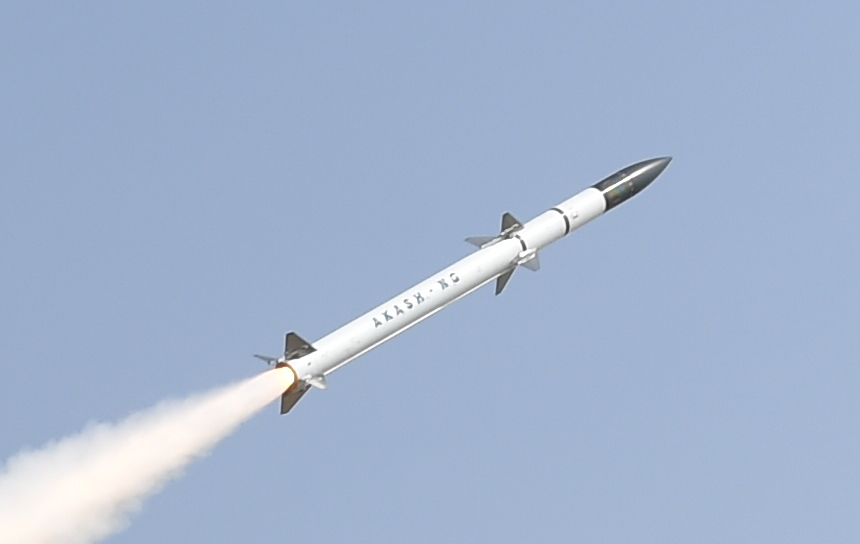
Akash-NG (Next Generation) is a cutting-edge indigenous Surface-to-Air Missile (SAM) system being developed by the Defence Research and Development Organisation (DRDO) to substantially strengthen India’s air-defence capability. Conceived as the successor to the Akash SAM, Akash-NG incorporates modern technologies to deliver a longer engagement range, much faster reaction time, higher interception accuracy, and improved survivability. It is planned as a modern medium-range air-defence solution for the Indian Army and Indian Air Force, capable of protecting large areas and high-value assets.
Unlike the original Akash, Akash-NG features an active radar homing seeker, a lighter and more agile missile airframe, and network-centric command-and-control integration, enabling true fire-and-forget engagements and rapid response to complex threat environments. These upgrades significantly enhance its effectiveness against fighter aircraft, UAVs/drone swarms, cruise missiles, and precision-guided munitions, even in electronic-warfare-intensive, high-tempo operations. Once inducted, Akash-NG is expected to become a key pillar of India’s layered air-defence architecture, reinforcing self-reliance under Atmanirbhar Bharat while delivering future-ready airspace security.
Overview of Akash-NG
|
Aspect
|
Details
|
|
System Name
|
Akash-NG (Next Generation)
|
|
Category
|
Medium-Range Surface-to-Air Missile
|
|
Developer
|
DRDO (India)
|
|
Users
|
Indian Army, Indian Air Force
|
|
Primary Role
|
Area & strategic air defence
|
|
Guidance
|
Active Radar Homing
|
|
Expected Range
|
50–70 km
|
|
Targets
|
Aircraft, UAVs, cruise missiles, PGMs
|
|
Reaction Time
|
Very fast
|
|
Operational Capability
|
All-weather, day & night
|
|
Mobility
|
Mobile / network-centric
|
|
Role in Layered AD
|
Core medium-range layer
|
|
Strategic Value
|
Indigenous, future-ready AD system
|
Development Background of Akash-NG
The Akash-NG (Next Generation) programme was initiated to overcome the operational limitations of the legacy Akash system, particularly in areas such as engagement range, reaction time, mobility, and guidance technology. As aerial threats evolved to include high-speed aircraft, UAV swarms, and precision-guided cruise missiles, the need arose for a more agile, accurate, and future-ready air-defence system capable of operating in network-centric and electronic-warfare-intensive environments.
To meet these requirements, Akash-NG has been developed with a strong emphasis on indigenous technologies, including an active radar seeker, advanced propulsion, lightweight airframe, modern radar integration, and secure command-and-control (C2) interfaces. The programme aligns closely with India’s Atmanirbhar Bharat initiative by reducing dependence on foreign systems and strengthening domestic defence manufacturing. Designed for seamless integration into India’s layered air-defence architecture, Akash-NG will operate in coordination with Short-Range SAMs (SR-SAMs) and Long-Range SAMs (LR-SAMs), forming a critical medium-range defence layer for comprehensive airspace protection.
Operational Role of Akash-NG (Next Generation)
Akash-NG is a next-generation medium-range air-defence missile system designed to counter aircraft, cruise missiles, and drones. With improved range, faster response, and advanced guidance, it strengthens layered air defence and protects critical assets.
-
Medium-Range Air Defence: Akash-NG provides effective medium-range protection against a wide spectrum of aerial threats within defended airspace.
-
Neutralization of Enemy Aircraft: Designed to intercept and destroy fighter jets, strike aircraft, and surveillance platforms before they can deliver weapons.
-
Cruise Missile Defence: Highly effective against low-flying and sea-skimming cruise missiles, which are difficult to detect and intercept.
-
UAV & Drone Interception: Plays a key role in countering UAVs, loitering munitions, and drone swarms, which are increasingly used in modern warfare.
-
Protection of Critical Assets: Deployed to safeguard airbases, command centers, radar sites, cities, industrial areas, and strategic infrastructure.
-
Support to Field Formations: Provides area air defence cover to moving and static Army formations during offensive and defensive operations.
-
All-Weather, All-Direction Defence: Capable of operating day/night and in adverse weather, engaging targets from any direction.
-
Network-Centric Warfare Role: Integrates with advanced radars, command-and-control systems, and other air-defence layers for coordinated threat response.
-
Enhanced Reaction Capability: Faster response time improves survivability against high-speed, maneuvering aerial threats.
-
Deterrence & Airspace Denial: Strengthens airspace denial capability, limiting enemy freedom of action and contributing to strategic deterrence.
How Akash-NG Works (Basic Operating Principle)
Akash-NG detects a threat early, tracks and prioritizes it through automated C2, launches a fast interceptor, and uses its active radar seeker to independently home in and destroy the target—making it highly effective against modern, fast, and low-flying aerial threats.
-
Surveillance & Early Detection: Long-range surveillance radars continuously scan the airspace to detect incoming threats such as aircraft, UAVs, and cruise missiles, providing early warning.
-
Tracking & Identification (IFF): Fire-control radars track detected targets and determine speed, altitude, and trajectory. Identification Friend or Foe (IFF) checks prevent engagement of friendly aircraft.
-
Threat Evaluation & Assignment: Network-centric Command & Control (C2) systems prioritize threats based on intent, proximity, and danger level, then assign targets to the most suitable launcher.
-
Missile Launch (Quick Reaction): The Akash-NG interceptor is launched rapidly from a mobile launcher toward the selected target, enabling swift response to time-critical threats.
-
Mid-Course Guidance: During the initial flight phase, the missile follows an inertial navigation path, with course updates from ground systems if required.
-
Terminal Homing (Active Radar Seeker): In the final phase, Akash-NG’s active radar seeker locks onto the target independently (fire-and-forget), ensuring high accuracy even against maneuvering targets.
-
Interception & Kill: A proximity-fused high-explosive warhead detonates near the target, destroying or disabling it with a high kill probability.
Advantages of Akash-NG
-
Much higher interception accuracy, enabled by the active radar homing seeker, allowing true fire-and-forget capability and precise terminal guidance.
-
Reduced reaction time, making it highly effective against fast, low-flying, and maneuvering threats such as cruise missiles and UAVs.
-
Greater engagement envelope compared to the legacy Akash system, providing wider area coverage and improved threat interception range.
-
Improved mobility and survivability, achieved through a lighter missile design and modern, network-centric deployment concepts.
-
Fully indigenous system, significantly reducing dependence on imports while strengthening self-reliance under Atmanirbhar Bharat and supporting long-term sustainment and upgrades.
Limitations of Akash-NG
-
Not yet fully operational, as the system is still undergoing development, testing, and evaluation before large-scale induction.
-
Higher cost compared to the legacy Akash, due to advanced technologies such as the active radar seeker and modern propulsion systems.
-
Performance dependence on integrated sensors and C2 networks, which can be challenged in heavy electronic warfare environments.
-
Limited real-world combat validation so far, since the system has not yet seen operational deployment.
-
Induction timeline uncertainty, as final configuration, production scale-up, and deployment schedules depend on successful trials and approvals.
Importance of Akash-NG
-
Strengthens India’s medium-range air-defence capability, filling the critical gap between short- and long-range SAM systems.
-
Highly effective against modern aerial threats, including fighter aircraft, UAV and drone swarms, cruise missiles, and precision-guided munitions.
-
Enhances reaction speed and interception success, which is crucial in high-tempo and electronic-warfare-intensive combat environments.
-
Improves survivability of critical assets, such as cities, airbases, ports, radar installations, and strategic infrastructure.
-
Acts as a core layer in India’s layered air-defence architecture, ensuring continuous, multi-tier protection of airspace.
-
Boosts deterrence and operational confidence, making hostile air operations more costly and risky.
-
Supports Atmanirbhar Bharat, reducing dependence on foreign air-defence systems through indigenous design and production.
Conclusion
Akash-NG (Next Generation) represents a major leap forward in India’s indigenous air-defence capability, combining advanced guidance, extended range, faster reaction time, and network-centric operations into a single, modern system. Designed to counter evolving threats such as fighter aircraft, UAVs, drone swarms, and cruise missiles, Akash-NG overcomes the limitations of the legacy Akash and delivers a far more agile and accurate medium-range air-defence solution.
As a core layer of India’s layered air-defence architecture, Akash-NG significantly enhances the protection of critical assets, population centers, and military formations. Its indigenous development under Atmanirbhar Bharat not only strengthens national security and deterrence but also ensures long-term self-reliance and technological sovereignty, making Akash-NG a cornerstone of India’s future airspace defence. To know more about missiles visit Education Masters.
सरकारी नौकरियों, जीके अपडेट्स और करेंट अफेयर्स की ताज़ा जानकारी सबसे पहले पाने के लिए:







.png)
.png)
.png)
.jpg)
.jpg)