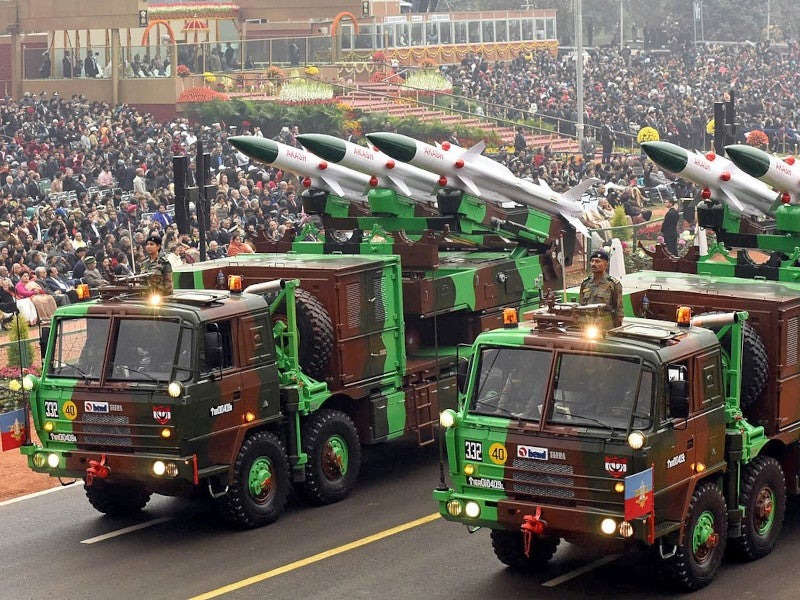
Akash Missile is a fully indigenous Surface-to-Air Missile (SAM) system developed by the Defence Research and Development Organisation (DRDO) and successfully inducted into operational service with the Indian Army and the Indian Air Force. While Akash Missile is officially categorized as a medium-range air-defence system, its design flexibility and strong engagement capability allow it to be effectively employed in short-range and close-area air-defence roles. In these roles, Akash Missile is widely used for point defence and tactical protection of critical military and strategic assets, such as airbases, radar stations, command centers, and vital infrastructure. During short-range engagements, Akash Missile functions as a powerful SR-SAM, effectively bridging the gap between VSHORAD systems and longer-range air-defence layers.
Designed to counter low- to medium-altitude aerial threats, Akash Missile offers a combination of high accuracy, sustained firepower, and operational reliability. In short-range configurations, it provides rapid reaction capability against a broad threat spectrum, including fighter aircraft, attack helicopters, UAVs and drone swarms, and low-flying cruise missiles that exploit terrain masking and reduced detection time. Supported by indigenous surveillance and fire-control radars, Akash Missile enables simultaneous multi-target engagement, strong resistance to electronic countermeasures, and all-weather, day-and-night operations. Its proven performance, cost-effectiveness, and seamless integration with India’s command-and-control networks make Akash Missile a cornerstone of India’s layered, integrated, and self-reliant air-defence architecture, significantly enhancing national airspace security and battlefield survivability.
Overview of Akash Missile (Short-Range Engagements)
|
Aspect
|
Details
|
|
System Name
|
Akash Missile (Surface-to-Air Missile-SAM)
|
|
Category
|
MR-SAM (used in SR-SAM role)
|
|
Developer
|
DRDO (India)
|
|
Users
|
Indian Air Force, Indian Army
|
|
Primary Role
|
Point & short-range air defence
|
|
Typical Short-Range Engagement
|
10–25 km (role-based)
|
|
Targets
|
Aircraft, helicopters, UAVs, cruise missiles
|
|
Guidance
|
Command guidance with radar tracking
|
|
Radar
|
Rajendra fire-control radar
|
|
Mobility
|
Mobile / semi-mobile
|
|
Operational Capability
|
All-weather, day & night
|
|
Role in Layered AD
|
Bridges VSHORAD and MR/LR systems
|
|
Strategic Value
|
Indigenous, cost-effective, reliable
|
Development Background of Akash Missile
The Akash Missile missile programme was initiated to replace ageing legacy air-defence systems and to achieve self-reliance in surface-to-air missile technology. Conceived as part of India’s broader vision for an integrated and layered air-defence architecture, Akash Missile was developed with a strong focus on indigenous design, development, and production.
The system incorporates homegrown radar, missile, and command-and-control technologies, reducing dependence on foreign suppliers while enhancing operational sovereignty. Although primarily designed for medium-range area air defence, Akash Missile ’s adaptable architecture allows it to be effectively employed in short-range and close-area defence roles as well. This flexibility makes it particularly valuable in scenarios requiring rapid response, sustained firepower, and reliable protection of critical assets, strengthening India’s overall air-defence capability.
Operational Role of Akash Missile
In short-range engagements, the Akash Missile SAM system plays a crucial operational role by delivering reliable and high-firepower air defence for critical assets and field formations. Its ability to counter low-altitude aircraft, helicopters, and UAV threats while supporting layered air-defence networks makes Akash Missile a dependable and versatile component of India’s tactical and area air-defence strategy.
-
Point defence of critical assets, including airbases, radar installations, ammunition depots, command centers, and other strategic facilities.
-
Short-range air defence against low-flying aircraft and attack helicopters attempting surprise or terrain-masking attacks.
-
Counter-UAV and anti-drone operations, effectively engaging individual drones as well as saturation and swarm threats.
-
Protection of field formations, especially when Akash Missile units are deployed closer to frontline areas to provide tactical air-defence cover.
-
Integral part of layered air-defence networks, working in coordination with VSHORAD systems and MR-SAM units to close coverage gaps and enhance interception success.
Importance of Akash Missile
-
Strengthens India’s point and tactical air-defence capability, especially for protection of airbases and strategic assets.
-
Effectively counters modern low-altitude threats, including aircraft, helicopters, UAVs, and drones.
-
Plays a vital role in layered air defence, bridging VSHORAD systems and medium-range SAMs.
-
Enhances self-reliance under Atmanirbhar Bharat, reducing dependence on foreign air-defence systems.
-
Improves battlefield survivability and asset security, ensuring continuous air-defence coverage in both peace and conflict scenarios.
Advantages of Akash Missile
-
Cost-effective indigenous system, offering reliable air-defence capability at a lower cost compared to many imported SAM systems.
-
High engagement accuracy, achieved through integrated surveillance and fire-control radar guidance.
-
Multi-target engagement capability, allowing simultaneous interception of multiple aerial threats.
-
Proven operational reliability, with successful induction and sustained service in the Indian Army and Indian Air Force.
-
Seamless integration with Indian C2 and air-defence networks, enabling coordinated and layered defence operations.
Limitations of Akash Missile
-
Less mobile than dedicated SR-SAM systems, making rapid redeployment more challenging in highly dynamic battlefield conditions.
-
Radar command-guided system, which requires continuous target tracking and guidance, increasing dependence on radar availability.
-
Larger system footprint, limiting flexibility when compared to compact and highly mobile short-range systems like QRSAM.
-
Lower effectiveness against very low-altitude or highly maneuverable targets when compared to systems with active radar or infrared seekers.
-
Primarily optimized for fixed or semi-mobile defence, reducing its suitability for on-the-move air-defence operations.
Conclusion
When employed for short-range engagements, the Akash Missile Surface-to-Air Missile (SAM) system proves to be a powerful, reliable, and cost-effective tactical air-defence solution. Its ability to deliver quick response, sustained firepower, and accurate interception ensures dependable protection of high-value assets such as airbases, radar installations, ammunition depots, and critical infrastructure. Akash Missile ’s proven operational reliability and seamless integration with Indian command-and-control networks further enhance its effectiveness in real-world deployment scenarios.
Although Akash Missile is primarily designed as a medium-range air-defence system, its adaptability and performance in short-range and close-area defence roles make it an essential component of India’s layered and integrated air-defence architecture. By effectively bridging the gap between VSHORAD systems and longer-range air-defence layers, Akash Missile strengthens overall airspace security, enhances battlefield survivability, and reinforces India’s commitment to self-reliance (Atmanirbhar Bharat) in defence technology. To know more about missiles visit Education Masters.
सरकारी नौकरियों, जीके अपडेट्स और करेंट अफेयर्स की ताज़ा जानकारी सबसे पहले पाने के लिए:

.jpg)



.png)
.png)
.png)
.jpg)
.jpg)