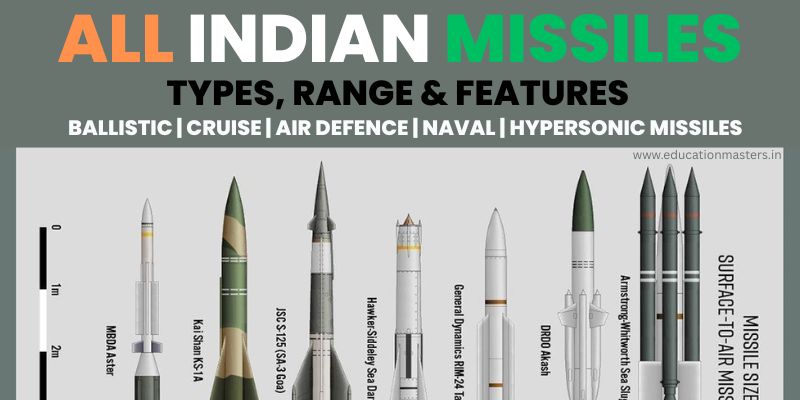
India has developed one of the most advanced and diverse missile programs in the world to ensure national security, strategic deterrence, and technological self-reliance. The Indian missile programme is largely driven by the Defence Research and Development Organisation (DRDO), along with support from ISRO, Bharat Dynamics Limited (BDL), and private defence manufacturers. Indian missiles are designed to serve multiple purposes including strategic nuclear deterrence, battlefield support, air defence, naval warfare, and precision strikes. These missiles can be launched from land, air, sea, and submarines, giving India a credible nuclear triad capability.
This article provides a complete overview of all major Indian missiles, their types, ranges, launch platforms, guidance systems, and strategic roles, presented in a detailed table format for easy understanding.
Classification of Indian Missiles
Indian missiles can broadly be classified into:
-
Ballistic Missiles
-
Cruise Missiles
-
Air-to-Air Missiles
-
Surface-to-Air Missiles
-
Anti-Tank Missiles
-
Naval Missiles
-
Air Defence Systems
-
Experimental and Hypersonic Missiles
All Types of Indian Missiles – Complete Classification
1. Ballistic Missiles
Ballistic missiles are long-range weapon systems that follow a high, curved trajectory after launch and are mainly used for strategic deterrence. Once propelled by rocket engines, they travel outside or near the edge of the atmosphere before descending at extremely high speeds toward their targets. In India, ballistic missiles form the core of the country’s nuclear deterrence strategy and are developed primarily by the Defence Research and Development Organisation (DRDO). The Prithvi and Agni series cover short-, medium-, and long-range roles and can be launched from land-based platforms and submarines. Advanced guidance systems, solid-fuel propulsion, and canisterised launches enhance their accuracy, mobility, and survivability, ensuring credible national defence and strategic stability.
Ballistic missiles follow a parabolic trajectory and are mainly used for strategic and nuclear deterrence.
Types of Ballistic Missiles
| Type |
Full Form |
Range |
Indian Examples |
| SRBM |
Short Range Ballistic Missile |
< 1,000 km |
Prithvi-I, Prithvi-II |
| MRBM |
Medium Range Ballistic Missile |
1,000–3,000 km |
Agni-I, Agni-P |
| IRBM |
Intermediate Range Ballistic Missile |
3,000–5,500 km |
Agni-III, Agni-IV |
| ICBM |
Intercontinental Ballistic Missile |
> 5,500 km |
Agni-V |
| SLBM |
Submarine-Launched Ballistic Missile |
Varies |
K-15, K-4 |
| Tactical Ballistic Missile |
Battlefield use |
< 500 km |
Prithvi-I |
| Canister-Launched Ballistic Missile |
Stored & launched from canister |
— |
Agni-V, Agni-P |
👉See More: Indian Ballistic Missiles: Complete Explained Guide
2. Cruise Missiles
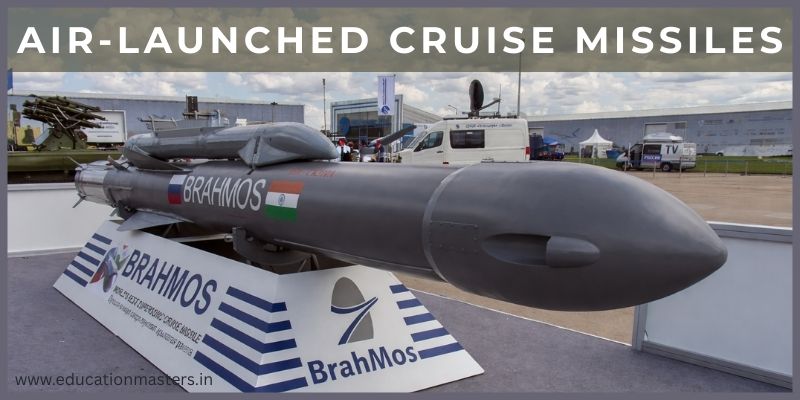
Cruise missiles are precision-guided weapon systems designed to fly at low altitudes and maintain a relatively flat trajectory, allowing them to evade enemy radar and air defence systems. Unlike ballistic missiles, cruise missiles remain within the atmosphere throughout their flight and are powered by jet or turbofan engines. In India, cruise missiles are developed mainly by the Defence Research and Development Organisation (DRDO) in collaboration with strategic partners. The BrahMos missile represents a supersonic strike capability, while Nirbhay offers long-range, subsonic, terrain-hugging precision attack. These missiles can be launched from land, air, sea, and submarine platforms, making them highly versatile. Their high accuracy, flexible deployment, and rapid response capability make cruise missiles vital for both conventional warfare and strategic deterrence.
Cruise missiles fly at low altitude, use jet engines, and are highly accurate.
Types of Cruise Missiles
👉See More: Indian Cruise Missiles: Complete Explained Guide
3. Air-to-Air Missiles (AAM)
Air-to-Air Missiles (AAMs) are weapons launched from fighter aircraft to destroy or neutralize enemy aircraft during aerial combat. These missiles are designed for high speed, accuracy, and maneuverability, enabling pilots to engage targets at both short and long distances. Indian AAM development is led by the Defence Research and Development Organisation (DRDO), focusing on reducing import dependence and strengthening air combat capability. Missiles like Astra provide beyond-visual-range (BVR) engagement, while short-range missiles are used for close dogfights. AAMs use infrared or radar guidance systems to track targets and can be integrated with modern fighter jets. These missiles significantly enhance the Indian Air Force’s air superiority, quick response, and combat effectiveness.
Used by fighter aircraft to destroy enemy aircraft.
Types of Air-to-Air Missiles
| Type |
Range |
Guidance |
Indian Examples |
| SRAAM |
Short Range |
IR |
Astra (SR), R-73 |
| WVR |
Within Visual Range |
IR |
Python-5 |
| BVR |
Beyond Visual Range |
Radar |
Astra Mk-1 |
| LRAAM |
Long Range |
Active Radar |
Astra Mk-2 |
| Dogfight Missiles |
Close combat |
Heat-seeking |
R-73 |
👉 See More: Indian Air-to-Air Missiles (AAMs): Complete Explained Guide
4. Surface-to-Air Missiles (SAM)
Surface-to-Air Missiles (SAMs) are defensive weapon systems designed to detect, track, and destroy enemy aircraft, drones, and incoming missiles from the ground or naval platforms. They form a critical layer of India’s air defence network, protecting strategic assets, cities, and military installations. In India, SAM systems are developed and deployed under the leadership of the Defence Research and Development Organisation (DRDO), along with global collaborations. Missiles such as Akash and Barak-8 provide short- to medium-range air defence, while long-range systems strengthen high-altitude interception. Modern SAMs use radar guidance, network-centric control, and high mobility, enabling quick reaction and multi-target engagement. These systems significantly enhance India’s capability to counter aerial threats and maintain airspace security.
Used for air defence against aircraft, drones, and missiles.
Types of Surface-to-Air Missiles
| Type |
Range |
Indian Examples |
| VSHORAD |
Very Short Range |
VSHORAD (DRDO) |
| SHORAD |
Short Range |
QRSAM, Trishul |
| MR-SAM |
Medium Range |
Akash, Barak-8 |
| LR-SAM |
Long Range |
S-400 |
| Naval SAM |
Ship-based defence |
Barak-8 |
| Mobile SAM |
Vehicle-mounted |
Akash |
| Point Defence SAM |
Protects single asset |
Barak-1 |
👉 See More: Indian Surface-to-Air Missile (SAM): Complete Explained Guide
5. Anti-Tank Guided Missiles (ATGM)
Anti-Tank Guided Missiles (ATGMs) are precision weapon systems designed to destroy enemy tanks and heavily armoured vehicles with high accuracy. They play a crucial role in modern ground warfare by countering armoured threats at short to medium ranges. In India, ATGMs are developed mainly by the Defence Research and Development Organisation (DRDO) to strengthen indigenous combat capabilities. Missiles such as Nag, HELINA, and MPATGM use advanced infrared and fire-and-forget guidance systems, allowing operators to engage targets with minimal exposure. ATGMs can be launched from ground platforms, vehicles, or helicopters, offering tactical flexibility. Their high penetration power and precision significantly enhance the Indian Army’s anti-armour defence and battlefield effectiveness.
Designed to destroy tanks and armored vehicles.
Types of ATGMs
| Type |
Guidance |
Indian Examples |
| Fire-and-Forget ATGM |
IR / Imaging |
Nag |
| Helicopter-Launched ATGM |
IR |
HELINA |
| Man-Portable ATGM |
Shoulder-fired |
MPATGM |
| Top-Attack ATGM |
Attacks from above |
Nag |
| SACLOS ATGM |
Wire/laser guided |
Milan |
| Vehicle-Launched ATGM |
Mounted on vehicles |
Nag |
👉 See More: Indian Anti-Tank Guided Missiles: Complete Explained Guide
6. Naval Missiles
Naval missiles are advanced weapon systems designed to strengthen maritime strike, defence, and deterrence capabilities of a nation. In India, naval missiles play a vital role in protecting sea lanes, safeguarding warships, and countering surface and aerial threats in the maritime domain. These missiles are developed and deployed with significant contributions from the Defence Research and Development Organisation (DRDO) and strategic partners. Systems such as BrahMos provide powerful anti-ship and land-attack capabilities, while naval air defence missiles protect fleets from enemy aircraft and missiles. Naval missiles can be launched from surface warships, submarines, and naval aircraft, ensuring operational flexibility. Their long range, high accuracy, and rapid response significantly enhance the Indian Navy’s combat readiness and maritime security.
Used for sea warfare and maritime defence.
Types of Naval Missiles
| Type |
Role |
Indian Examples |
| Anti-Ship Missile |
Destroy warships |
BrahMos |
| Naval Ballistic Missile |
Strategic deterrence |
Dhanush |
| Ship-Launched Cruise Missile |
Precision strike |
BrahMos |
| Submarine-Launched Missile |
Second strike |
K-15, K-4 |
| Naval Air Defence Missile |
Fleet defence |
Barak-8 |
7. Strategic Nuclear Missiles
Strategic nuclear missiles form the core of India’s nuclear deterrence strategy, ensuring national security through credible and survivable strike capability. These missiles are designed to deliver nuclear warheads over long distances and deter adversaries from initiating large-scale conflict. Developed primarily by the Defence Research and Development Organisation (DRDO), India’s strategic missile force includes land-based, sea-based, and air-based systems, collectively forming the nuclear triad. Missiles from the Agni series provide long-range strike capability, while submarine-launched systems ensure a second-strike advantage. Advanced features such as solid-fuel propulsion, canisterised launch, and high accuracy enhance readiness and survivability. Together, these missiles reinforce India’s doctrine of credible minimum deterrence and long-term strategic stability.
Form the backbone of India’s nuclear doctrine.
Types of Nuclear Missiles
| Type |
Launch Platform |
Indian Examples |
| Land-Based Nuclear Missile |
Road/Rail |
Agni Series |
| Sea-Based Nuclear Missile |
Submarine |
K-Series |
| Air-Based Nuclear Missile |
Aircraft |
Nuclear-capable bombs |
| MIRV Missile |
Multiple warheads |
Agni-V (capable) |
| Second-Strike Missile |
Submarine-based |
K-4 |
8. Air Defence Interceptor Missiles
Air Defence Interceptor Missiles are specialized systems designed to detect, track, and destroy incoming enemy missiles, especially ballistic missiles, before they reach their targets. These missiles form the backbone of India’s Ballistic Missile Defence (BMD) programme, aimed at protecting critical cities and strategic installations. Developed primarily by the Defence Research and Development Organisation (DRDO), interceptor missiles operate at high and low altitudes to provide layered defence. High-altitude interceptors engage threats outside the atmosphere, while low-altitude interceptors neutralize targets within the atmosphere. Equipped with advanced radar, guidance, and tracking systems, these missiles enhance India’s defensive preparedness and significantly reduce the impact of potential missile attacks, strengthening overall national security.
Used to intercept incoming missiles.
Types of Interceptor Missiles
| Type |
Role |
Indian Examples |
| High-Altitude Interceptor |
Exo-atmospheric |
PAD |
| Low-Altitude Interceptor |
Endo-atmospheric |
AAD |
| Ballistic Missile Defence (BMD) |
Missile shield |
PAD + AAD |
| Anti-Aircraft Interceptor |
Aircraft interception |
Akash |
9. Hypersonic Missiles
Hypersonic missiles represent the next generation of advanced weapon systems, capable of travelling at speeds exceeding Mach 5 with exceptional maneuverability and precision. These missiles can evade most existing air defence systems due to their high velocity, low reaction time, and unpredictable flight paths. In India, hypersonic missile research and development is led by the Defence Research and Development Organisation (DRDO) under advanced technology programmes. Platforms such as the Hypersonic Technology Demonstrator Vehicle (HSTDV) focus on scramjet propulsion and sustained hypersonic flight. Hypersonic missiles are designed for rapid precision strikes against high-value targets and are expected to significantly enhance India’s future deterrence and strategic strike capabilities, placing the country among the leading nations in hypersonic weapon development.
Next-generation missiles with extreme speed and maneuverability.
Types of Hypersonic Missiles
| Type |
Speed |
Indian Examples |
| Hypersonic Glide Vehicle (HGV) |
Mach 5+ |
HSTDV |
| Hypersonic Cruise Missile |
Mach 6–7 |
BrahMos-II |
| Boost-Glide Missile |
Rocket + glide |
HSTDV-based |
10. Experimental & Future Missiles
Experimental and future missiles represent India’s continuous efforts to develop next-generation, high-precision, and advanced warfare technologies. These missile systems are currently under testing or development and aim to enhance speed, accuracy, survivability, and versatility. Research in this area is primarily led by the Defence Research and Development Organisation (DRDO), focusing on emerging domains such as hypersonic propulsion, precision strike, and network-centric warfare. Projects like advanced tactical missiles, next-generation anti-tank systems, and hypersonic platforms are designed to meet future battlefield requirements. These missiles are expected to be lighter, smarter, and faster, with improved guidance and multi-platform launch capability. Together, they highlight India’s long-term vision for defence self-reliance and technological superiority.
Under testing or development.
Types of Experimental Missiles
| Type |
Purpose |
Indian Projects |
| Scramjet Missile |
Hypersonic propulsion |
HSTDV |
| Precision Strike Missile |
High accuracy |
Pralay |
| Next-Gen ATGM |
Lightweight |
MPATGM |
| UAV-Launched Missile |
Drone warfare |
Under development |
Conclusion
India’s missile arsenal reflects India’s steady and focused progress in defence technology, strategic foresight, and operational preparedness. From short-range battlefield missiles designed for tactical dominance to long-range strategic systems and emerging hypersonic technologies, India has developed a well-balanced, multi-layered missile framework capable of addressing diverse security challenges across land, air, sea, and space-based domains. This comprehensive capability strengthens deterrence while ensuring flexibility and rapid response in modern warfare scenarios.
Driven largely by indigenous innovation under institutions like Defence Research and Development Organisation (DRDO), supported by timely upgrades and selective international cooperation, India continues to improve accuracy, range, survivability, mobility, and reaction time of its missile systems. This continuously modernised missile force not only safeguards national sovereignty but also reinforces India’s role as a responsible regional power, contributing to long-term peace, stability, and strategic balance.
For more such detailed defence and exam-oriented content, aspirants can explore Education Masters for reliable study material and updates.
सरकारी नौकरियों, जीके अपडेट्स और करेंट अफेयर्स की ताज़ा जानकारी सबसे पहले पाने के लिए:




.png)
.jpg)
.jpg)