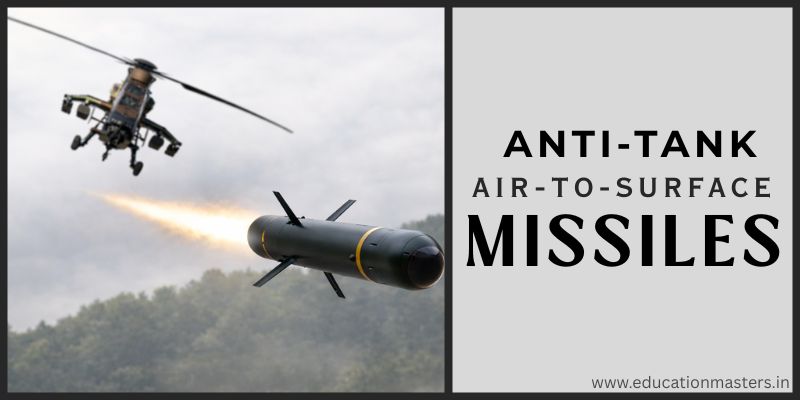
India’s Anti-Tank Air-to-Surface Missiles form a critical component of its modern aerial strike and battlefield dominance strategy. These precision-guided weapons are designed to be launched from attack helicopters, allowing Indian forces to engage and destroy enemy main battle tanks, armored vehicles, and fortified ground targets from safe stand-off ranges. Unlike ground-based anti-tank systems, air-launched missiles provide superior mobility, rapid target acquisition, and the ability to operate effectively across deserts, forests, high-altitude regions and plains. Equipped with advanced guidance technologies, top-attack engagement modes, and high-penetration warheads, India’s Anti-Tank Air-to-Surface Missiles significantly enhance the survivability and combat effectiveness of aerial platforms in high-threat environments.
Driven by the push for indigenous defence capabilities, India has developed advanced anti-tank air-launched systems such as HELINA and Dhruvastra, tailored specifically for Indian operational requirements. Integrated with modern platforms like the HAL Light Combat Helicopter, these missiles combine fire-and-forget guidance, all-weather performance, and precision strike capability against both moving and stationary armored targets. Together, they reduce reliance on imported weapon systems while strengthening India’s ability to counter evolving armored threats, making Anti-Tank Air-to-Surface Missiles a cornerstone of India’s air-launched anti-armor warfare doctrine.
Overview of Anti-Tank Air to Surface Missiles of India
|
Category
|
Details
|
|
Purpose
|
Destruction of enemy main battle tanks, armored vehicles, and hardened ground targets
|
|
Engagement Type
|
Air-to-Surface precision strike from attack helicopters
|
|
Primary Guidance
|
Imaging Infrared (IIR) seeker with fire-and-forget capability
|
|
Combat role
|
Stand-off anti-armor attack without entering enemy air-defense envelope
|
|
Key Strength
|
Top-attack profile + high penetration against modern tanks with ERA
|
|
Launch Platforms
|
Attack helicopters
|
|
Platforms Equipped
|
HAL Rudra, HAL Light Combat Helicopter
|
|
Core Missiles
|
HELINA, Dhruvastra
|
|
Attack Mode
|
Top-attack and direct-attack (selectable based on target)
|
|
Targeting Ability
|
Capable of engaging moving and stationary armored targets
|
|
Operational Range
|
Approx. 7–8 km stand-off engagement distance
|
|
Countermeasure Resistance
|
Advanced IIR seekers resistant to decoys and battlefield clutter
|
|
Combat Advantage
|
High accuracy, minimal pilot exposure, rapid kill probability
|
|
Terrain Capability
|
Effective in deserts, plains, forests, and high-altitude regions
|
|
Strategic Importance
|
Critical airborne anti-armor layer for battlefield dominance and deterrence
|
Development Background Of Anti-Tank (ASM)
India’s anti-tank air-to-surface missile (ASM) development was initiated to provide the armed forces with a precision strike capability against modern armored vehicles. Led by the Defence Research and Development Organisation, these programs gained momentum in the 2000s to meet the Indian Army and Air Force’s requirement for helicopter- and ground-launched fire-and-forget weapons capable of operating in all-weather and day-night conditions.
Indigenous systems such as HELINA, Dhruvastra, and MPATGM were designed with imaging infrared seekers, top-attack flight profiles, and high-penetration tandem warheads to defeat explosive reactive armor. Continuous trials, user feedback, and integration with Indian platforms have shaped these missiles into reliable anti-armor ASMs, strengthening India’s battlefield strike capability under the Atmanirbhar Bharat and Make in India defense initiatives.
Operational Role of India’s Anti-Tank Air-to-Surface Missiles
India’s Anti-Tank Air-to-Surface Missiles are designed to deliver rapid, precise, and lethal anti-armor firepower from airborne platforms. Deployed on attack helicopters, these missiles play a crucial role in neutralizing enemy armored forces, halting mechanized advances, and supporting ground troops in high-intensity battlefield environments.
1. Destruction of Enemy Main Battle Tanks
Its primary role is to destroy modern main battle tanks and armored fighting vehicles.
Uses top-attack profiles to strike the weakest armor zones, ensuring high kill probability.
2. Anti-Armor Ambush Operations
Ideal for surprise attacks against advancing armored columns.
Helicopters can launch missiles from concealed positions and disengage immediately.
3. Close Air Support (CAS) for Ground Forces
Provides direct fire support to infantry and mechanized units during combat.
Neutralizes armored threats that ground troops cannot engage effectively.
4. Stand-Off Precision Strike
Engages targets from 7–8 km, outside most short-range air defense systems.
Enhances helicopter survivability in hostile airspace.
5. Battlefield Interdiction
Disrupts enemy reinforcements, supply routes, and armored movements behind front lines.
Prevents enemy armor from regrouping or counterattacking.
6. High-Altitude and Difficult Terrain Operations
Optimized for operations in mountains, deserts, forests, and plains.
Critical for armored threat neutralization in high-altitude regions.
7. Rapid Reaction Anti-Tank Response
Allows quick deployment against sudden armored breakthroughs.
Provides commanders with immediate aerial anti-armor capability.
8. Force Multiplier in Offensive and Defensive Operations
Amplifies combat effectiveness of helicopter units.
Strengthens battlefield deterrence by imposing heavy losses on enemy armored forces.

Types of Anti-Tank Anti-Tank Air to Surface Missiles of India
|
Missile
|
Type
|
Notes
|
|
HELINA
|
Helicopter-launched fire-and-forget ATGM
|
Indigenous air-launched Nag variant; imaging infrared (IIR) seeker; top-attack capability
|
|
Dhruvastra
|
Anti-tank ASM
|
Indian Air Force designation of HELINA; integrated on ALH Rudra and LCH Prachand
|
|
SANT
|
Standoff anti-tank ASM
|
Long-range air-launched missile allowing helicopter attacks from safe distances
|
|
HMM (Helicopter-Mounted Missile)
|
Precision anti-tank ASM
|
Developed by Defence Research and Development Organisation; optimized for accuracy and survivability
|
Advantages of India’s Anti-Tank Air-to-Surface Missiles
India’s Anti-Tank Air-to-Surface Missiles provide a decisive technological and operational edge in modern ground combat by combining precision, mobility, and survivability. Designed for helicopter-launched warfare, these missiles significantly enhance the Indian Armed Forces’ ability to counter armored threats across diverse battle environments.
1. Stand-Off Engagement Capability
Allows helicopters to destroy armored targets from 7–8 km away.
Keeps aircrew outside the effective range of most enemy air defense systems.
2. Fire-and-Forget Operation
Imaging Infrared guidance enables autonomous target tracking after launch.
Pilots can immediately maneuver, re-position, or disengage after firing.
3. High Kill Probability Against Modern Tanks
Top-attack profiles strike the weakest armor on enemy tanks.
Tandem warheads can defeat tanks equipped with Explosive Reactive Armor (ERA).
4. Superior Battlefield Mobility
Air-launched deployment enables rapid response to armored threats.
Far more flexible than ground-based anti-tank missile units.
5. Day-Night Capability, All-Weather
Advanced seekers allow operations in low visibility and adverse weather.
Effective in deserts, plains, forests, and high-altitude terrain.
6. Reduced Pilot Exposure and Risk
Short engagement time and stand-off range improve helicopter survivability.
Minimizes exposure to small arms fire and short-range air defenses.
7. Effective Against Moving Targets
Capable of engaging fast-moving armored vehicles.
Maintains lock even during evasive maneuvers.
8. Indigenous Technology Advantage
Developed and produced within India.
Reduces dependence on foreign suppliers and ensures long-term sustainment.
Limitations of India’s Anti-Tank Air-to-Surface Missiles
Despite their advanced capabilities, India’s Anti-Tank Air-to-Surface Missiles also face certain operational and technical limitations. These constraints are common to helicopter-launched anti-tank systems and must be managed through tactics, support assets, and combined-arms operations.
1. Limited Engagement Range Compared to Fixed-Wing Weapons
The typical effective range is around 7–8 km.
Shorter reach compared to long-range air-to-ground missiles launched from fighter aircraft.
2. Dependence on Helicopter Survivability
Missile effectiveness is tied to the survivability of the launch helicopter.
Helicopters remain vulnerable to enemy air defenses and fighter aircraft.
3. Reduced Effectiveness in Heavy Air Defense Environments
Dense enemy air defense networks can restrict helicopter operations.
Requires SEAD or escort support in high-threat zones.
Target detection may be degraded in highly cluttered environments.
4. Limited Target Set
Optimized primarily for armored vehicles and hardened ground targets.
Less suitable for engaging dispersed infantry or soft targets compared to rockets or guns.
5. Finite Missile Loadout
Attack helicopters can carry only a limited number of missiles per sortie.
Sustained anti-armor operations require frequent rearming and logistics support.
6. Higher Cost Compared to Unguided Weapons
Precision-guided anti-tank missiles are more expensive than unguided rockets.
Not ideal for use against low-value or lightly armored targets.
7. Line-of-Sight Dependency
Requires clear line-of-sight between helicopter and target area.
Terrain masking and obstacles can restrict engagement opportunities.
Importance of India’s Anti-Tank Air-to-Surface Missiles
India’s Anti-Tank Air-to-Surface Missiles hold critical importance in modern warfare by providing the Indian Armed Forces with a fast, precise, and survivable means to counter enemy armored threats. In an era of high-mobility armored warfare, these missiles form a key pillar of India’s battlefield strike and deterrence capability.
1. Core Capability Against Armored Warfare
Provides a dedicated airborne solution to destroy enemy tanks and armored vehicles.
Essential for countering mechanized and armored offensives.
2. Enhances Battlefield Survivability
Stand-off engagement reduces exposure of pilots and helicopters.
Improves survivability in hostile and contested combat zones.
3. Rapid Response to Armored Breakthroughs
Enables quick reaction against sudden enemy armored advances.
Critical for sealing gaps and stabilizing frontline defenses.
4. Force Multiplier for Ground Forces
Amplifies the effectiveness of infantry and armored units.
Allows ground troops to advance without facing overwhelming armored threats.
5. Dominance in Difficult Terrain
Provides decisive anti-armor capability in mountains, forests, deserts, and high-altitude regions.
Where ground-based anti-tank systems face mobility limitations.
6. Precision Warfare Capability
Minimizes collateral damage through accurate target engagement.
Suitable for modern, limited, and high-intensity conflict scenarios.
7. Strengthens Close Air Support (CAS)
Plays a vital role in close coordination with ground forces.
Neutralizes high-value armored targets threatening friendly units.
8. Indigenous Defence Self-Reliance
Reduces dependence on imported anti-tank missile systems.
Strengthens India’s domestic missile and seeker technology ecosystem.
9. Battlefield Deterrence
Acts as a strong deterrent against enemy armored formations.
Forces adversaries to reconsider large-scale armored deployments.
10. Future-Ready Combat Capability
Forms the foundation for next-generation air-launched anti-armor weapons.
Supports evolving doctrines centered on mobility, precision, and survivability.
CONCLUSION
India’s Anti-Tank Air-to-Surface Missiles represent a decisive leap in the country’s modern battlefield strike capability, enabling attack helicopters to neutralize enemy armored formations with precision, speed, and survivability. Systems such as HELINA, Dhruvastra, and SANT provide stand-off engagement, fire-and-forget guidance, and top-attack profiles that are highly effective against modern main battle tanks equipped with advanced armor and countermeasures. By allowing helicopters to operate beyond hostile air-defense envelopes, these missiles significantly enhance operational flexibility across deserts, forests, high-altitude battlefields and plains.
Driven by indigenous development under the Make in India and Atmanirbhar Bharat initiatives, India’s Anti-Tank Air-to-Surface Missiles reduce reliance on foreign weapon systems while strengthening long-term combat readiness. As armored warfare continues to evolve, these air-launched anti-armor weapons will remain a cornerstone of India’s close air support and battlefield interdiction doctrine, ensuring rapid response, deterrence against mechanized threats, and sustained dominance in future high-intensity conflicts. Fore more information about missiles you can visit our site Education Masters.
सरकारी नौकरियों, जीके अपडेट्स और करेंट अफेयर्स की ताज़ा जानकारी सबसे पहले पाने के लिए:



.png)
.png)
.png)
.jpg)
.jpg)