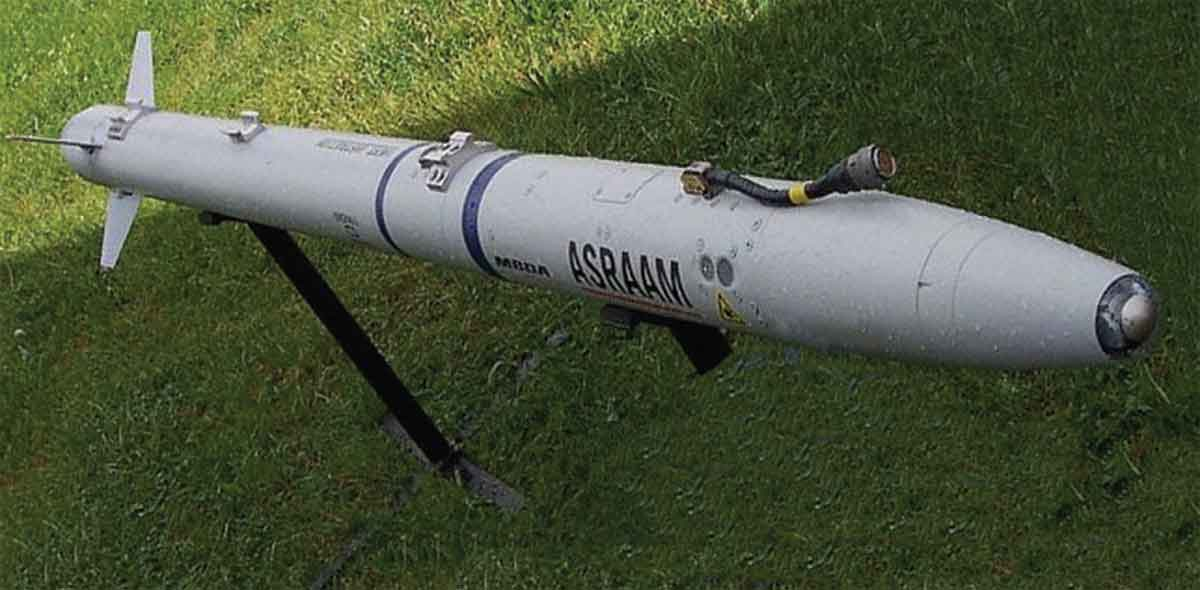
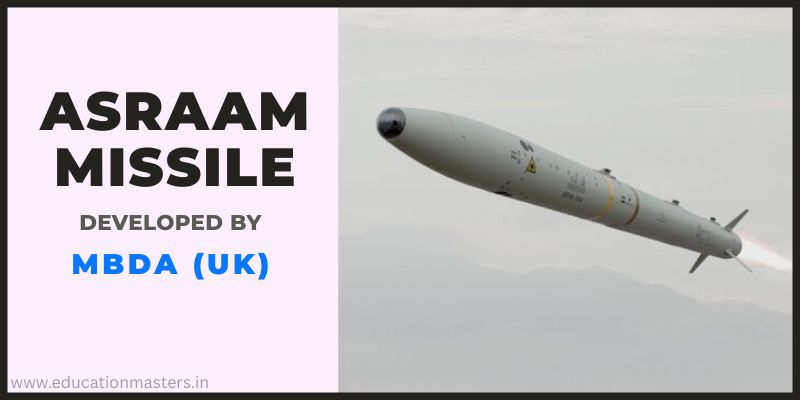
The ASRAAM (Advanced Short range air to air missiles) is a cutting-edge, next-generation close-combat missile that significantly strengthens India’s Short range aerial warfare capabilities. Designed for high-speed interception, exceptional agility, and rapid target acquisition, the ASRAAM enables Indian fighter jets to dominate dogfights with unmatched precision. Equipped with an Imaging Infrared (IIR) seeker, the missile can detect, lock onto, and engage enemy aircraft from any direction offering true “fire-and-forget” capability.India’s adoption and integration of ASRAAM into aircraft like the Jaguar DARIN III, with planned integration for Su-30MKI and Tejas Mk1A, marks a major step toward modernizing the Air Force’s Short range missile inventory. With its extended engagement range of nearly 25 km, powerful rocket motor, and high countermeasure resistance, the ASRAAM outperforms many traditional dogfight missiles in both speed and end-game maneuverability.
As India focuses on building a stronger and technologically advanced air-combat ecosystem, the ASRAAM plays a pivotal role in enhancing air superiority missions, close-range defense, pilot survivability, and precision kill effectiveness. Its combination of speed, accuracy, seeker intelligence, and platform flexibility makes it one of the most reliable Short range air to air missiles in service today.
ASRAAM Missile Overview
|
Category
|
Details
|
|
Full Name
|
Advanced Short range air to air missiles (ASRAAM)
|
|
Type
|
Infrared-guided Short range AAM
|
|
Country Using It
|
India (IAF) – Integrated on Jaguar DARIN III & being considered for other fighters
|
|
Developed By
|
MBDA (UK)
|
|
Role in India
|
Replaces older Matra R550 Magic & Russian R-60 missiles on Jaguar fleet
|
|
Guidance System
|
Imaging Infrared (IIR) seeker with high resistance to flares & countermeasures
|
|
Range
|
Approx. 25 km+ (Short range dogfight weapon)
|
|
Speed
|
Mach 3+
|
|
Maneuverability
|
High-G agility for extreme dogfight turns
|
|
Launch Capability
|
Lock-on before launch (LOBL) & Lock-on after launch (LOAL)
|
Key Features of ASRAAM Missile (India)
The ASRAAM (Advanced Short range air to air missiles) is one of the world’s fastest and most agile dogfight missiles, designed for close-range aerial combat. It uses advanced infrared guidance, high maneuverability, and rapid lock-on speed to defeat modern fighter jets in tight visual-range engagements. India uses ASRAAM mainly on Jaguar DARIN-III aircraft, with potential future integration on other platforms.
1. High Off-Boresight Targeting Capability
ASRAAM can lock onto enemy aircraft even when they are far off the nose of the aircraft.
This allows pilots to:
• Instantly lock with helmet-mounted sights
• Fire during sharp turning dogfights
It gives a massive advantage in fast, unpredictable close combat.
2. Advanced Imaging Infrared (IIR) Seeker
ASRAAM uses a high-resolution IIR seeker that captures thermal images of the target.
It easily can differentiate between:
• Real aircraft heat
• Flares
• Decoys
• Hot background surfaces
This ensures the missile stays locked even when the enemy uses defensive countermeasures.
3. Fire-and-Forget Engagement
Once fired, ASRAAM becomes fully autonomous.
The pilot can immediately:
• Break away
• Defend
• Re-engage
• Target another enemy
This enhances survival and provides more tactical options in close-range air combat.
4. High Agility With Extreme High-G Maneuvering
ASRAAM is built for close combat and can withstand very high G-forces.
Its design allows:
• Sharp high-G turns
• Rapid angle changes
• Tight pursuit of agile fighters
This makes it extremely effective in intense, quick dogfights.
5. Mach 3+ Speed With Powerful Rocket Motor
ASRAAM’s high-energy solid rocket motor accelerates it to over Mach 3.
This rapid speed reduces the enemy’s reaction time and increases kill probability.
6. All-Aspect, 360-Degree Attack Capability
The missile can engage targets:
• Rear aspect
• Side aspect
• Head-on
This gives pilots total firing freedom in complex dogfight merges.
7. LOBL & LOAL Modes (Flexible Target Engagement)
ASRAAM supports:
• Lock-On Before Launch (LOBL) – seeker locks target before firing
• Lock-On After Launch (LOAL) – missile launches first and locks during flight
This flexibility helps in firing from off-angles, cluttered airspace, or when the target is not directly visible.
8. Strong Counter-Countermeasure (CCM) Resistance
ASRAAM is engineered to defeat modern defensive techniques such as:
• Infrared flares
• Jamming
• Heat-based decoys
Its advanced seeker ensures continuous tracking of the real target.
9. Lightweight, Aerodynamic Design
ASRAAM’s sleek and lightweight design enhances:
• Maneuverability
• Acceleration
• Platform integration
This makes it ideal for multirole and strike fighters.
10. High-Explosive Warhead With Proximity Fuse
Carries a powerful fragmentation warhead.
The smart proximity fuse detonates at the optimal distance for maximum damage—even without a direct hit.
Advantages of ASRAAM Missile
ASRAAM is engineered for close-range air combat supremacy. Its high-agility aerodynamic design and advanced thrust performance allow it to counter high-speed, high-maneuvering enemy aircraft in tight dogfights where reaction time is extremely limited.
1. Advanced Imaging Infrared (IIR) Seeker
The missile uses a modern IIR seeker that forms a thermal “image” of the target. This allows it to:
-
Identify aircraft even in cluttered or hot environments
-
Ignore flares and decoys more effectively
-
Maintain lock during sharp enemy maneuvers
This gives pilots a massive advantage in counter-countermeasure combat.
2. High Off-Boresight Capability
ASRAAM can lock onto targets at large angles relative to the aircraft’s nose. With Helmet-Mounted Displays (HMDs), the pilot can simply look at the target, and ASRAAM can lock on—enabling faster kill times and reducing the need for full aircraft turns.
3. Extremely Fast Reaction & Engagement Time
The missile is designed to launch and accelerate instantly, giving very little escape time to enemy pilots. This quickness is critical in high-intensity dogfights where milliseconds matter.
4. High Speed (Mach 3+)
Its powerful motor propels it to Mach 3+, letting it close the distance rapidly and making evasive actions less effective for opponents.
5. Flexible Launch Modes (LOBL & LOAL)
This gives pilots flexibility in varied combat geometries, improving survivability and success rate.
6. Major Upgrade for IAF Jaguar Fleet
ASRAAM significantly improves the Jaguar’s outdated close-combat capability by replacing old R-60 and Magic II missiles, modernizing India’s strike fleet.
Limitations of ASRAAM Missile
The ASRAAM missile is limited to within-visual-range (WVR) combat and cannot engage BVR targets. Its infrared guidance depends on target heat, making it vulnerable to flares and IR jamming. It also requires close-range engagement, increasing pilot risk, and therefore must be supported by medium- and long-range air-to-air missiles for complete air combat effectiveness.
1. Designed Only for Short Range
ASRAAM cannot replace BVR missiles like Astra, Derby, or Meteor. Its range (approx 25 km) confines it to visual-range combat, meaning it cannot perform long-distance engagements.
2. Higher Cost Compared to Legacy Missiles
Modern technology and imported components make ASRAAM more expensive than older Russian or French SR-AAMs. Cost becomes a major factor in fleet-wide integration.
3. Limited Platform Integration in India
As of now:
-
Fully integrated only on Jaguar DARIN-III aircraft
-
Under evaluation for other platforms, but not widely deployed
This restricts its presence across the Indian Air Force.
4. Import Dependency on MBDA UK
Because ASRAAM is not indigenous, India depends on a foreign supplier for:
-
Missile production
-
Spare parts
-
Software upgrades
Dependence can become a vulnerability during geopolitical tensions.
5. IR-Only Guidance Limitation
While extremely effective in visual-range combat, ASRAAM does not have a radar-guided version.
This limits performance in:
CONCLUSION
The ASRAAM missile (Advanced Short range air to air missiles) is a game-changing addition to India’s Short range air combat arsenal. With its Mach 3+ speed, advanced Imaging Infrared seeker, high off-boresight targeting, and fire-and-forget accuracy, ASRAAM delivers superior performance in close-range dogfights where speed and reaction time are critical. Its ability to execute extreme high-G maneuvers, defeat modern countermeasures, and engage targets from any direction makes it one of the most advanced SRAAMs currently deployed by the Indian Air Force.
By integrating ASRAAM on platforms like the Jaguar DARIN III, and planning future deployment on Su-30MKI and Tejas Mk1A, India is taking a major step toward modernizing its Air to air missile inventory. Although it remains limited to Short range engagements and relies on imports, ASRAAM’s unmatched agility, seeker intelligence, and rapid lock-on speed make it a highly reliable and effective weapon system.
Overall, ASRAAM significantly enhances India’s air superiority, pilot survivability, and close-combat strike capability, positioning it as one of the most powerful Short range air to air missiles in service today. If you want to know more about missiles you can visist our site Education Masters.
सरकारी नौकरियों, जीके अपडेट्स और करेंट अफेयर्स की ताज़ा जानकारी सबसे पहले पाने के लिए:



.png)
.png)
.png)
.jpg)
.jpg)