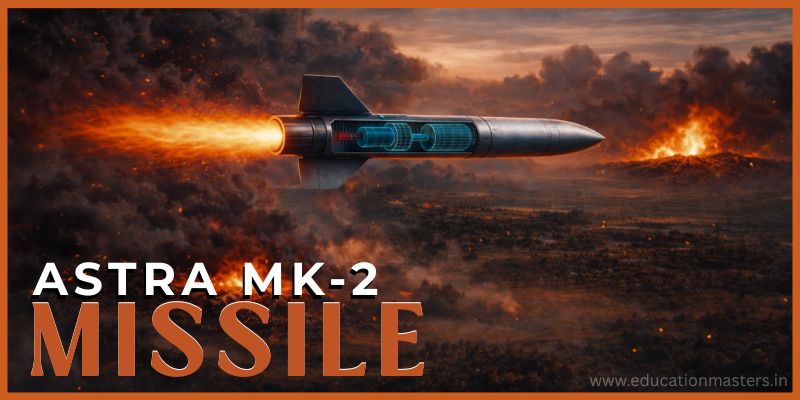
The Astra Mk-2 is India’s advanced Beyond Visual Range (BVR) air to air missile, developed to significantly enhance the long range combat capability. Building upon the operational experience of Astra Mk-1, Astra Mk-2 is designed to deliver longer engagement range, higher energy retention, and improved effectiveness against modern, agile, and electronically protected aerial targets. The missile represents a crucial step in strengthening India’s indigenous air-to-air missile ecosystem and achieving greater self-reliance in advanced defence technologies.
Optimized for modern network-centric aerial warfare, Astra Mk-2 features upgraded propulsion, refined inertial navigation with mid-course data-link guidance, and an advanced active radar homing seeker for precise terminal interception. Its enhanced electronic counter-countermeasure resistance and expanded no-escape zone improve kill probability in highly contested airspace. Once operational, Astra Mk-2 is expected to provide Indian fighter aircraft with a decisive first-shot advantage, reduced reliance on foreign BVR missiles, and a strong foundation for future long-range air-to-air weapon development.
Overview of Astra Mk-2 Missile of India
|
Category
|
Details
|
|
Missile Name
|
Astra Mk-2
|
|
Country of Origin
|
India
|
|
Developer
|
DRDO
|
|
Type
|
Beyond Visual Range - Air to Air Missile
|
|
Role
|
Long-range aerial combat and air superiority
|
|
Target Types
|
Enemy fighter aircraft, high-speed and maneuverable aerial threats
|
|
Engagement Range
|
Extended long-range BVR (greater than Astra Mk-1 class)
|
|
Guidance System
|
Inertial navigation with enhanced mid-course data-link updates and terminal active radar homing
|
|
Propulsion
|
Upgraded high-energy solid-fuel rocket motor
|
|
Speed Class
|
High supersonic
|
|
No-Escape Zone
|
Larger than Astra Mk-1
|
|
Launch Platforms
|
Future integration with Indian Air Force fighter aircraft
|
|
Combat Capability
|
All-weather, day & night operations with advanced ECCM
|
|
Key Strength
|
Extended range, improved energy retention, higher kill probability
|
|
Strategic Purpose
|
Strengthen India’s long-range air combat and deterrence capability
|
|
Indigenous Focus
|
Advanced indigenous BVR missile development
|
|
Current Status
|
Under development / advanced testing phase
|
Key Features of Astra Mk-2 Missile Of India
Astra Mk-2 is the advanced and upgraded variant of the Astra missile family, developed to overcome the limitations of Astra Mk-1. It is designed to deliver longer range, higher energy retention, and improved kill probability against modern fighter aircraft in intense beyond-visual-range combat environments.
1. Extended Beyond Visual Range (BVR) Engagement Capability
Astra Mk-2 is designed for significantly longer engagement distances compared to Astra Mk-1.
This allows Indian fighter aircraft to strike adversaries from safer stand-off ranges and compete with modern global BVR missiles.
2. Improved Propulsion System for Higher Energy Retention
The missile features an upgraded high-energy propulsion system.
This enables better speed sustainment during the mid and terminal phases, increasing effectiveness at long ranges.
3. Advanced Active Radar Homing Seeker
Astra Mk-2 uses an improved active radar seeker with enhanced detection and tracking capability.
This improves target acquisition accuracy against fast, low-observable, and electronically protected aircraft.
4. Larger No-Escape Zone (NEZ)
The enhanced propulsion and guidance significantly expand the missile’s no-escape zone.
Enemy aircraft have fewer chances to evade once Astra Mk-2 is launched within engagement range.
5. Inertial Navigation with Enhanced Mid-Course Data-Link
The missile relies on inertial navigation supported by improved real-time data-link updates.
This allows accurate course correction even during high-speed target maneuvers or changing combat conditions.
Development Background of the Astra Mk-2 Missile
The Astra Mk-2 missile was developed by DRDO as an advanced follow-on to the Astra Mk-1 to meet the Indian Air Force’s need for greater range, improved accuracy, and higher kill probability against modern enemy aircraft. Operational experience from Astra Mk-1 guided the redesign, focusing on enhanced performance in long-range BVR combat.
The missile incorporates a dual-pulse solid rocket motor, upgraded active radar seeker, and improved mid-course data-link, significantly expanding its no-escape zone and effectiveness in electronic warfare environments. Astra Mk-2 represents a major step in India’s indigenous air-to-air missile development and self-reliance.
Operational Roles Of The Astra Mk-2 Missile
The Astra Mk-2 missile is designed for long-range beyond-visual-range (BVR) air combat. It supports air superiority missions, first-shot interception, and multi-target engagements using fire-and-forget capability, while remaining effective in electronic warfare and all-weather conditions.
-
Long-Range Beyond Visual Range (BVR) Combat
Astra Mk-2 is designed for extended-range BVR engagements, allowing Indian fighters to strike enemy aircraft well before visual contact.
-
Air Dominance and Superiority
Provides the Indian Air Force with enhanced first-shot capability to dominate contested airspace against advanced enemy fighters.
-
Extended-Range Interception Role
Used to intercept hostile fighters, bombers, AEW&C aircraft, and high-value aerial assets at longer distances.
-
First-Shot, First-Kill Capability
Improved range, seeker performance, and energy management increase kill probability in long-range engagements.
-
Fire-and-Forget Operations
Active radar homing enables pilots to launch and maneuver immediately, improving survivability in high-threat environments.
-
Operations Against Advanced Threats
Optimized to counter fast, maneuvering, and partially stealthy targets with improved ECCM and seeker resistance.

Advantages of Astra Mk-2 Missile
Astra Mk-2 offers a major leap in India’s beyond-visual-range air combat capability by delivering longer reach, higher energy, and improved effectiveness against modern aerial threats. It is designed to meet the demands of next-generation aerial warfare and strengthen India’s air dominance.
1. Longer Engagement Range for Safer Combat
Astra Mk-2 allows fighter aircraft to engage enemy targets from significantly greater distances.
This improves pilot survivability by keeping launch platforms outside enemy weapon ranges.
2. Higher Kill Probability at Extended Distances
Improved propulsion and guidance ensure better energy retention throughout flight.
This increases interception success against fast, maneuvering targets even at long ranges.
3. Larger No-Escape Zone (NEZ)
The expanded NEZ limits the enemy’s ability to evade once the missile is launched.
Targets have fewer escape options, increasing combat effectiveness.
4. Reduced Enemy Reaction Time
Sustained high supersonic speed shortens the engagement timeline.
This forces adversaries into defensive actions earlier, reducing their tactical options.
5. Superior Performance in Electronic Warfare Environments
Enhanced ECCM capabilities allow Astra Mk-2 to operate reliably under heavy jamming.
This ensures consistent performance against electronically protected aircraft.
6. Improved First-Shot, First-Kill Advantage
Extended range and improved guidance allow Indian fighters to strike earlier than opponents.
This provides a decisive advantage in beyond-visual-range engagements.
7. Supports Multi-Target Engagements
Aircraft can engage multiple hostile targets during a single combat mission.
This enhances effectiveness in complex, large-scale aerial battles.
8. Reduced Dependence on Foreign BVR Missiles
As an indigenous system, Astra Mk-2 improves supply security and upgrade flexibility.
It strengthens India’s self-reliance in advanced air-to-air weapon systems.
9. Future-Ready Missile Design
Astra Mk-2 bridges the gap between current BVR systems and next-generation long-range missiles.
It prepares the Indian Air Force for evolving aerial threats and future warfare requirements.
Limitations of Astra Mk-2 Missile
While Astra Mk-2 significantly improves upon Astra Mk-1 with extended range and better performance, it still faces certain limitations when compared with the most advanced next-generation air-to-air missiles globally. These limitations are typical of a transitional BVR missile designed to bridge current and future systems.
1. Not Yet Operationally Deployed
Astra Mk-2 is still under development and testing.
Until full induction, its real-world combat performance remains unproven compared to operational foreign BVR missiles.
2. Range Still Below Ultra-Long-Range Missiles
Although its range is extended, Astra Mk-2 may still fall short of ultra-long-range AAMs designed specifically to target AWACS and tanker aircraft.
This limits its role against high-value support aircraft at extreme distances.
3. Solid-Fuel Propulsion Constraints
Astra Mk-2 continues to rely on a high-energy solid rocket motor.
Compared to ramjet or dual-pulse systems, sustained propulsion and end-game energy may still be limited.
4. Dependence on Launch Aircraft for Mid-Course Updates
The missile relies on data-link guidance from the launching aircraft during mid-flight.
If the launch aircraft is forced to disengage early, guidance effectiveness may reduce.
5. Limited Cooperative Engagement Capability
Astra Mk-2 primarily depends on the launch platform’s sensors.
It lacks full third-party targeting or cooperative engagement capability using multiple sensor platforms.
6. Performance Affected by Heavy Electronic Warfare
Despite improved ECCM, extremely advanced jamming and deception environments can still challenge seeker performance.
This remains a general limitation for radar-guided BVR missiles.
7. Platform Integration Takes Time
Integration with multiple fighter aircraft requires extensive testing and certification.
This can delay widespread deployment across all Indian Air Force platforms.
8. Smaller No-Escape Zone Compared to Future Ramjet Missiles
While improved over Mk-1, the NEZ may still be smaller than that of next-generation ramjet-powered BVR missiles.
This gives agile targets some evasion margin at extreme ranges.
9. Transitional Design Between Generations
Astra Mk-2 serves as a bridge between current BVR missiles and future long-range systems.
It is not the final evolution of India’s long-range air-to-air missile capability.
10. Upgrade Dependency on Future Programs
Further enhancements in range, propulsion, and seeker technology depend on future missile programs.
This places Astra Mk-2 as a steppingstone rather than an end-state solution.
CONCLUSION
The Astra Mk-2 marks a significant advancement in India’s indigenous Beyond Visual Range (BVR) air to air missile capability, addressing key limitations of earlier systems through extended range, improved propulsion, and enhanced guidance technology. Designed for modern aerial warfare, Astra Mk-2 strengthens the Indian Air Force’s ability to engage fast, maneuverable, and electronically protected targets at greater stand-off distances, providing a decisive first-shot advantage in long-range air combat.
As India moves toward self-reliance in advanced missile systems, Astra Mk-2 plays a crucial role in bridging the gap between current operational BVR missiles and future long-range air to air weapons. Its development enhances India’s strategic air power, reduces dependence on foreign missile imports, and ensures long-term readiness against evolving aerial threats. Once fully operational, Astra Mk-2 is expected to become a key pillar of India’s air dominance and network-centric combat capability. For more information about missile you can visit our site Education Masters.
सरकारी नौकरियों, जीके अपडेट्स और करेंट अफेयर्स की ताज़ा जानकारी सबसे पहले पाने के लिए:





.png)
.png)
.png)
.jpg)
.jpg)