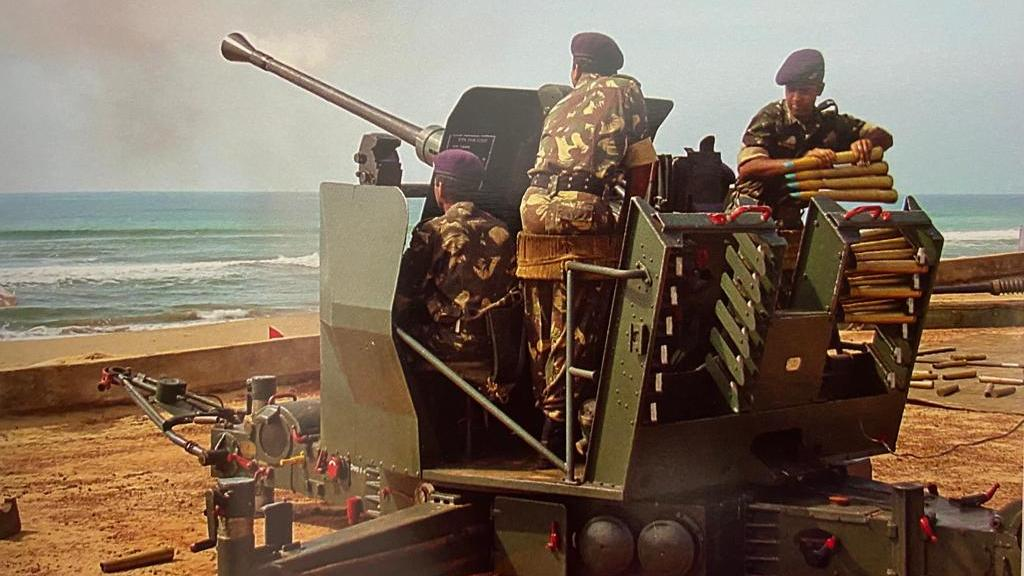
The L-70 Air Defence Gun, integrated with a modern Fire Control System (FCS), is a proven gun-based Very Short-Range Air Defence (VSHORAD) system designed to counter low-altitude aerial threats. Originally developed by Bofors of Sweden, the 40 mm L-70 has been widely deployed across the world and has undergone extensive modernization in India to remain effective against contemporary air threats. The integration of advanced fire control technologies—such as tracking radar, electro-optical sensors, and digital ballistic computers—has significantly enhanced its target acquisition, tracking accuracy, and engagement effectiveness.
In the VSHORAD role, the L-70 system provides reliable protection against low-flying aircraft, attack helicopters, unmanned aerial vehicles (UAVs), drones, and loitering munitions, particularly in cluttered and low-altitude environments where missile systems may face limitations. Its high rate of fire and rapid reaction capability make it well-suited for point defence of airfields, military bases, convoys, and critical infrastructure. Operating as the innermost layer of a layered air defence architecture, the L-70 complements MANPADS and short-range missile systems, offering a cost-effective and dependable solution for close-range airspace security.
Overview of L-70 + Fire Control System
|
Aspect
|
Details
|
|
System Name
|
L-70 Air Defence Gun
|
|
Category
|
Gun-based Very Short-Range Air Defence (VSHORAD)
|
|
Origin
|
Sweden (Bofors design), extensively upgraded in India
|
|
Calibre
|
40 mm
|
|
Primary Role
|
Close-range air defence against low-altitude threats
|
|
Targets Engaged
|
Low-flying aircraft, attack helicopters, UAVs/drones, loitering munitions
|
|
Effective Range
|
3–4 km (air targets)
|
|
Effective Altitude
|
Up to 3 km
|
|
Rate of Fire
|
240 rounds per minute
|
|
Fire Control System (FCS)
|
Radar and/or Electro-Optical (EO) sensors with ballistic computer
|
|
Guidance Method
|
Radar/EO-assisted gunfire (no missile guidance)
|
|
Ammunition Type
|
High-Explosive, pre-fragmented, proximity-fuze rounds
|
|
Deployment Mode
|
Towed / semi-mobile
|
|
Operational Role
|
Point defence, battlefield air defence, counter-UAS
|
|
Air Defence Layer
|
Innermost layer of layered air defence
|
|
Status in India
|
In service with upgraded Fire Control & EO systems
|
|
Key Strength
|
High firepower and cost-effective defence against drones
|
|
Key Limitation
|
Short range and altitude compared to missile systems
|
System Components
-
40 mm L-70 Gun: High-rate automatic cannon optimized for low-altitude targets.
-
Fire Control System (FCS):
-
Sensors: Tracking radar and EO suite (day camera, thermal imager, laser rangefinder).
-
Ballistic Computer: Calculates lead, fuze setting, and firing solution.
-
Command Console: Enables rapid cueing and engagement.
-
Ammunition: High-Explosive (HE), Pre-fragmented, and proximity-fuze rounds (where fitted).
How the L-70 + Fire Control System Works (Operational Flow)
-
Detection and Cueing
Aerial targets are detected using integrated radar and electro-optical (EO) sensors, or are cued by higher-level air-defence command networks. This enables early awareness of low-flying threats.
-
Target Tracking
Once detected, the Fire Control System (FCS) continuously tracks the target’s speed, altitude, range, and heading, maintaining an accurate real-time track.
-
Fire Control Solution
The system’s digital ballistic computer processes target data to calculate precise lead angles, engagement timing, and fuze settings required for an effective interception.
-
Engagement and Neutralization
The L-70 gun fires controlled, high-rate bursts, releasing 40 mm ammunition to destroy or neutralize the target within short range, providing reliable close-in air defence.
Status in India
India operates upgraded L-70 air defence gun systems equipped with modern Fire Control Systems and electro-optical (EO) suites, significantly extending their service life and enhancing accuracy, reaction time, and night/all-weather capability. These upgrades have improved the L-70’s effectiveness against contemporary low-altitude threats, including drones and attack helicopters. As a result, the L-70 continues to remain operationally relevant, working alongside MANPADS and missile-based VSHORAD systems as part of India’s layered air-defence architecture.
Operational Roles of L-70 + Fire Control System
The L-70 Air Defence Gun integrated with a modern Fire Control System serves as a reliable VSHORAD solution for protecting airfields, bases, convoys, and critical infrastructure from low-flying aircraft, helicopters, and drones. It supports battlefield air defence for frontline units, is highly effective in counter-UAS operations, and operates as the innermost layer of a layered air-defence network, complementing MANPADS and missile-based SHORAD systems.
-
Point Defence
Provides close-range air protection to critical assets such as airfields, headquarters, bridges, ammunition depots, and military convoys against low-altitude aerial threats.
-
Battlefield Air Defence
Supports frontline formations by countering enemy aircraft, helicopters, and drones operating at very low altitudes during combat operations.
-
Counter-UAS Operations
Highly effective against small and slow unmanned aerial systems, including reconnaissance drones and loitering munitions, making it well-suited for modern drone-centric warfare.
-
Layered Air Defence Support
Functions as the innermost layer of a layered air-defence network, complementing MANPADS and SHORAD missile systems by covering close-range and low-altitude engagement gaps.
Advantages of L-70 + Fire Control System
-
High Rate of Fire
The L-70’s rapid firing capability makes it highly effective against swarming drones, loitering munitions, and pop-up low-altitude threats.
-
All-Weather, Day/Night Capability
When equipped with electro-optical (EO) sensors, the system can operate reliably in day and night conditions, as well as in varied weather environments.
-
Cost-Effective Air Defence Solution
Compared to missile-based systems, the L-70 offers a lower per-engagement cost, making it suitable for sustained air defence operations.
-
Network-Enabled Operations
The system can be integrated with modern command and control (C2) networks, allowing faster target cueing and improved situational awareness.
Limitations of L-70 + Fire Control System
-
Limited Range and Altitude Coverage
The L-70 has a shorter engagement range and altitude ceiling compared to missile-based air defence systems.
-
Gun-Only Kill Mechanism
Successful interception depends on accurate target tracking and sustained fire, which may be challenging against highly maneuverable or fast targets.
-
Mobility Constraints
Being a towed or semi-mobile system, the L-70 is less mobile than shoulder-fired MANPADS, limiting rapid repositioning.
Importance of L-70 + Fire Control System (VSHORAD Role)
-
Reliable Close-Range Air Defence: The L-70 provides dependable protection against low-altitude threats such as helicopters, drones, and loitering munitions, especially where missile systems are less effective.
-
Effective Counter-Drone Capability: Its high rate of fire makes it particularly valuable against small, slow, and swarming UAVs, a growing challenge in modern warfare.
-
Cost-Effective Defence Solution: Compared to missile-based air defence, the L-70 offers a lower cost per engagement, enabling sustained air defence operations.
-
Strengthens Layered Air Defence: Operating as the innermost layer, it complements MANPADS and SHORAD systems by covering very low-altitude and close-range gaps.
-
Operational Relevance in India: With modern fire control and EO upgrades, the L-70 continues to play an important role in India’s air-defence network, protecting critical assets and frontline formations.
Conclusion
The L-70 Air Defence Gun integrated with modern Fire Control Systems remains a highly relevant and effective gun-based VSHORAD solution in modern warfare. Its high rate of fire, accuracy, and cost-effectiveness make it especially valuable for countering low-altitude threats, including drones, loitering munitions, and attack helicopters. Despite limitations in range and mobility compared to missile systems, continuous upgrades with radar, electro-optical sensors, and networked command systems have significantly enhanced its operational capability. As part of a layered air-defence architecture, the L-70 complements MANPADS and missile-based systems by securing the closest defensive layer, ensuring reliable protection of critical assets and frontline formations. To know more about missiles visit Education Masters.
सरकारी नौकरियों, जीके अपडेट्स और करेंट अफेयर्स की ताज़ा जानकारी सबसे पहले पाने के लिए:

 (2).jpg)



.png)
.png)
.png)
.jpg)
.jpg)