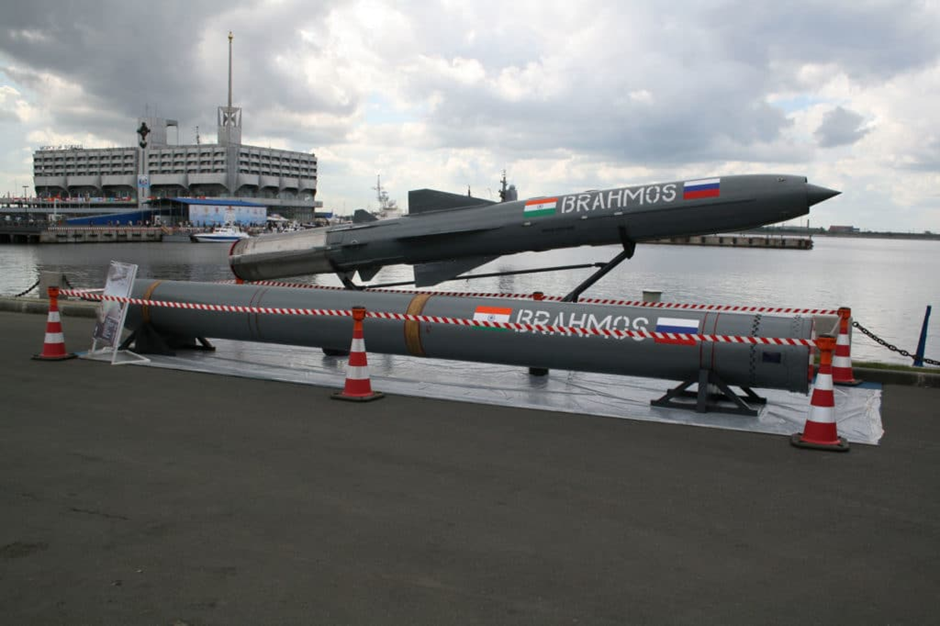
The BrahMos missile is a supersonic cruise missile jointly developed by India’s DRDO and Russia’s NPO Mashinostroyenia, renowned as one of the fastest and most advanced precision-strike missiles in the world. Designed for land, air, sea, and submarine launch, BrahMos missile combines high speed, pinpoint accuracy, and devastating strike power, making it a key asset in India’s offensive and deterrence capabilities.
Powered by a two-stage propulsion system and capable of flying at Mach 2.8 – 3, BrahMos missile can destroy high-value targets such as warships, bunkers, air-defense sites, and strategic installations with exceptional effectiveness. Its versatility, low-altitude sea-skimming flight, and advanced guidance systems make it extremely difficult to detect or intercept. As one of India’s most successful missile programmes, BrahMos missile significantly strengthens the nation’s strike capability across multiple domains.
BrahMos Missile – Overview
|
Category
|
Details
|
|
Name
|
BrahMos Supersonic Cruise Missile
|
|
Developed By
|
DRDO (India) & NPO Mashinostroyenia (Russia)
|
|
Type
|
Supersonic Cruise Missile
|
|
Launch Platforms
|
Land-based, Air-launched, Ship-launched, Submarine-launched
|
|
Range
|
450 km (extended versions up to 800 km in development)
|
|
Speed
|
Mach 2.8 – Mach 3
|
|
Guidance System
|
INS, GPS/GLONASS/GAGAN, Active Radar Homing
|
|
Warhead Type
|
Conventional (High-explosive, semi-armour piercing)
|
|
Warhead Weight
|
200–300 kg
|
|
Flight Profile
|
Sea-skimming / High-low trajectory
|
|
Accuracy
|
1–5 meters (very high precision)
|
|
Role
|
Anti-ship, Land-attack precision strike
|
|
Entered Service
|
2007 (various versions inducted)
|
|
Operators
|
Indian Army, Indian Navy, Indian Air Force
|
Development Background of BrahMos Missile
The BrahMos missile is the result of a landmark defence collaboration between India and Russia through the joint venture BrahMos Aerospace, formed in 1998. Conceived to create a world-class supersonic cruise missile, the program combines Russia’s proven missile design expertise with India’s advancements in guidance systems, navigation, fire control, and propulsion engineering.
The name BrahMos itself reflects this partnership, derived from the Brahmaputra River in India and the Moskva River in Russia, symbolizing the fusion of technological strengths and strategic cooperation between the two nations. Over the years, BrahMos has evolved into one of the fastest and most versatile cruise missiles in the world, with multiple variants for land, sea, submarine, and air platforms.This joint development marks a major milestone in India’s missile capability, significantly boosting indigenous defence production and elevating India’s position in global missile technology.
Key Features of BrahMos Missile
1. Supersonic Speed: Mach 2.8–3, making interception extremely difficult
BrahMos travels nearly three times the speed of sound, drastically reducing the enemy’s detection and reaction time. Its tremendous speed increases its kinetic impact on the target and makes interception by conventional air-defence systems extremely challenging.
2. High Accuracy: CEP of 1–5 meters
With advanced guidance systems—INS, GPS/GLONASS, and active radar seekers—BrahMos achieves a Circular Error Probable (CEP) of just 1–5 meters, meaning it can consistently hit targets with pinpoint precision. This makes it highly effective against hardened or high-value installations.
3. Stealth Features: Low radar cross-section and sea-skimming flight
BrahMos incorporates stealth shaping and materials that reduce its radar visibility. Additionally, it can perform sea-skimming or terrain-hugging flight, staying just a few meters above the surface. This dramatically lowers the chance of early detection and radar tracking.
4. Multi-Platform Capability: Land, sea, air, and submarine launches
One of BrahMos' greatest strengths is its versatility. It can be launched from:
-
Mobile land-based launchers
-
Surface ships
-
Submarines (vertical launch)
-
Fighter aircraft (BrahMos-A)
This multi-platform flexibility allows the missile to be deployed across all branches of the Indian Armed Forces
5. Quick Reaction: Fire-and-forget, with rapid launch readiness
BrahMos requires no further guidance after launch—making it a fire-and-forget weapon. It has fast launch preparation times and can be fired rapidly in high-threat situations, enabling quick and decisive responses during conflicts.
Variants of BrahMos Missile
-
BrahMos Block-I: Standard land-attack version.
-
BrahMos Block-II: Enhanced accuracy for urban and complex targets.
-
BrahMos Block-III: High-altitude and steep-dive capability.
-
BrahMos-A: Air-launched version for Su-30MKI.
-
BrahMos-NG (Next Generation): Lighter, faster variant in development.
-
BrahMos-II (Hypersonic): Planned Mach 6–7 version.
Operational Roles of BrahMos Missile
1. Destroying enemy warships, air bases, command posts, and logistic hubs
BrahMos is designed to strike both land and sea targets with high precision. Its supersonic speed and powerful warhead allow it to neutralize critical enemy assets, including warships, coastal installations, air bases, radar stations, bunkers, and supply depots. This makes BrahMos a versatile weapon for both offensive and defensive missions.
2. Conducting deep strike missions in contested zones
With its long range, high accuracy, and ability to fly at very low altitudes, BrahMos can penetrate heavily defended areas and conduct deep strikes far inside enemy territory. This helps destroy high-value targets in regions protected by strong air-defence systems.
3. Strengthening area denial in maritime regions
At sea, BrahMos plays a major role in Anti-Access/Area Denial (A2/AD) strategies. Its speed and precision help deter or destroy hostile naval vessels, ensuring enemy ships cannot enter or dominate sensitive maritime zones, strategic chokepoints, or coastal waters.
4. Providing India a rapid precision-strike capability
Because BrahMos travels nearly three times the speed of sound, it can reach targets extremely quickly, reducing enemy reaction time. This gives India a rapid, high-precision strike option during emergencies or escalating conflicts, strengthening deterrence and operational flexibility.
Advantages of BrahMos Missile
-
Very fast response time.
-
High survivability due to supersonic speed.
-
Capability to penetrate air-defence systems.
-
Multi-target flexibility.
-
Precision strike with minimal collateral damage.
Operators of BrahMos Missile
-
Indian Army
-
Indian Navy
-
Indian Air Force
India is also promoting BrahMos missile for export to friendly nations.
Limitations of BrahMos Missile
-
High cost due to advanced technology.
-
Heavy weight in the standard version limits aircraft integration.
-
Conventional-only warheads limit the strategic deterrence role.
Future Enhancements of BrahMos Missile
-
Extended range beyond 800 km.
-
Lighter and stealthier BrahMos-NG.
-
Hypersonic BrahMos-II (future capability).
-
More platform integrations, including UAVs and smaller ships.
Some important points about BrahMos Missile
World’s Fastest Operational Supersonic Cruise Missile
BrahMos missile holds the distinction of being the fastest operational cruise missile currently in service globally. Its sustained supersonic speed throughout its flight gives it a major combat advantage over subsonic missiles, reducing enemy reaction time drastically.
Pinpoint Accuracy in Real Combat Scenarios
BrahMos missile has demonstrated precision strike capability in numerous tests conducted under different weather, terrain, and operational conditions, proving its reliability in real-world environments.
Sea-Skimming & Terrain-Following Capability
To evade enemy radars and air-defense systems, BrahMos missile can:
BrahMos Missile tested for Extreme Conditions
BrahMos Missile has been tested under:
Conclusion
This ensures reliable performance across all terrains, crucial for India’s diverse battlefield environments.The BrahMos missile stands as one of India’s most powerful and reliable precision-strike weapons, combining speed, accuracy, and multi-platform versatility in a single system. Its supersonic performance, advanced guidance technology, and ability to penetrate modern air-defence networks make it a formidable asset in land, sea, air, and underwater operations. With growing indigenous content, export potential, and upcoming next-generation variants, BrahMos missile not only strengthens India’s offensive and deterrence capabilities but also represents a major milestone in India’s journey toward self-reliance in advanced defence technologies. For more information about missiles visit Education Masters.
सरकारी नौकरियों, जीके अपडेट्स और करेंट अफेयर्स की ताज़ा जानकारी सबसे पहले पाने के लिए:







.png)
.jpg)
.jpg)