Cruise missiles are sophisticated, precision-guided weapons engineered to deliver destructive payloads with exceptional accuracy over long distances. Unlike ballistic missiles, which follow a high-arcing trajectory through space, cruise missiles remain within the Earth’s atmosphere throughout their flight, traveling like compact, unmanned aircraft. Powered by jet or turbofan engines, they maintain sustained, controlled flight and can perform complex maneuvers to evade enemy defenses.
These cruise missiles fly at low altitudes, often hugging the terrain to stay below radar coverage, making it difficult for them to detect and intercept. Advanced guidance technologies—such as GPS, inertial navigation systems, terrain-contour matching (TERCOM), and digital scene-matching (DSMAC)—enable them to follow pre-planned routes with nearly pinpoint accuracy.Capable of being launched from ground platforms, fighter jets, warships, and submarines, cruise missiles offer unmatched operational flexibility. Their versatility, precision, and stealth make them indispensable in modern warfare for strategic strikes, infrastructure paralysis, and high-value target neutralization. As a result, cruise missiles play a central role in shaping contemporary deterrence and power-projection strategies worldwide.
Cruise Missiles – Overview
|
Aspect
|
Details
|
|
Definition
|
Cruise Missiles are guided missiles that fly like aircraft using jet engines, following a low-altitude, controlled path to hit targets with high accuracy.
|
|
Primary Purpose
|
Precision strikes on land or sea targets while avoiding radar detection.
|
|
Propulsion
|
Turbojet, Turbofan, or Ramjet engines enabling sustained powered flight.
|
|
Speed Category
|
Subsonic (800 km/h), Supersonic (Mach 2–3), Hypersonic (Mach 5+).
|
|
Flight Altitude
|
Extremely low (terrain-hugging or sea-skimming) to evade detection.
|
|
Guidance Systems
|
INS, GPS/GLONASS/NavIC, TERCOM, DSMAC, Radar/IR seeker.
|
|
Range
|
Varies from 50 km to over 3,000 km depending on type.
|
|
Payload Options
|
HE, penetration warhead, cluster, thermobaric, nuclear.
|
|
Launch Platforms
|
Land-based launchers, aircraft, ships, submarines.
|
|
Accuracy
|
Very high (CEP 1–10 m).
|
|
Notable Feat
|
Capable of complex maneuvers and stealthy approach routes.
|
|
Examples (India)
|
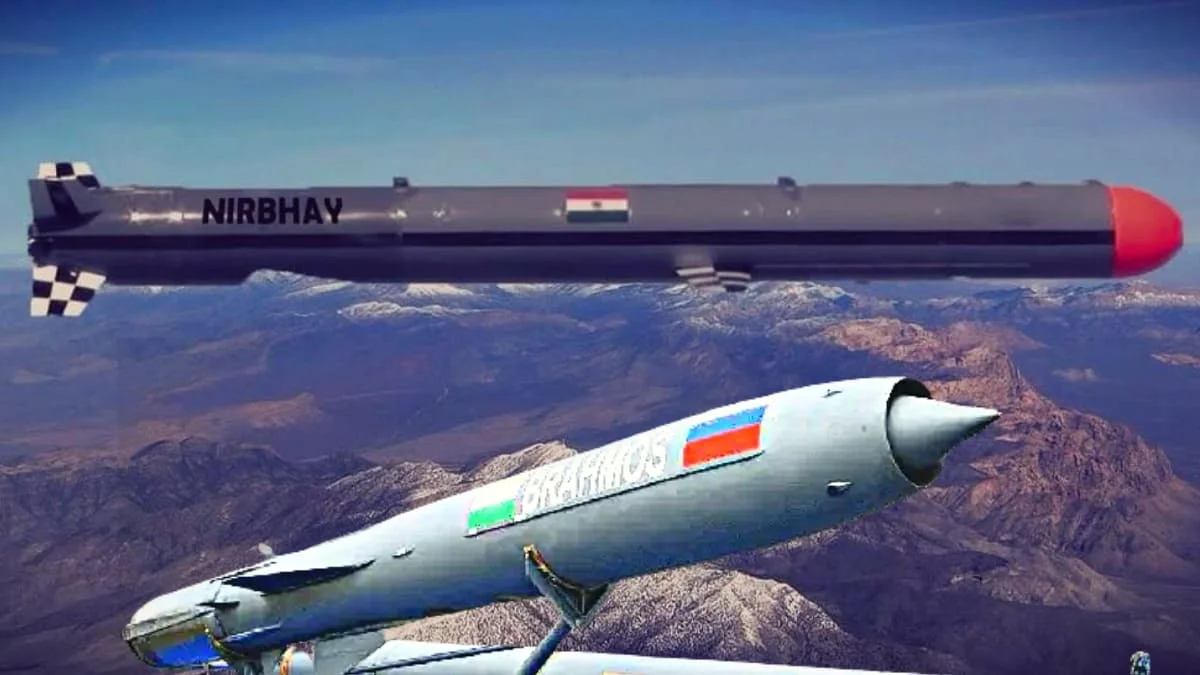
BrahMos missile, Nirbhay missile, ITCM, NASM-SR.
|
How a Cruise Missile Works
A cruise missile works like a small unmanned aircraft that uses engines, wings, and advanced navigation systems to travel long distances at low altitude and strike a target with high precision.
Here’s how the entire process works:
1. Launch Phase
The cruise missile is launched from a platform such as:
At the moment of launch:
-
A booster rocket provides the initial thrust
-
The missile is pushed up and forward into stable flight
-
Wings and control surfaces deploy (if folded)
This phase lasts only a few seconds.
2. Transition to Sustained Flight
Once the booster separates or stops firing:
-
The missile’s turbofan or turbojet engine starts running
-
It shifts from pure rocket thrust to air-breathing propulsion
-
The missile stabilizes its flight altitude and direction
Now it begins travelling like a small autonomous aircraft.
3. Mid-Course Flight Using Navigation Systems
The cruise missile uses multiple navigation technologies to stay on the correct path:
INS (Inertial Navigation System)
GPS / GLONASS / IRNSS
TERCOM (Terrain Contour Matching)
DSMAC (Digital Scene Matching Area Correlation)
These systems work together to allow the missile to fly:
-
At very low altitudes (50–100 m above ground/sea)
-
Through complex routes
-
Around mountains, rivers, and radar zones
This makes detection and interception extremely difficult.
4. Terrain-Hugging / Sea-Skimming Flight
During its cruise phase, the missile:
-
Flies close to the ground or sea surface
-
Uses radar altimeters to maintain very low altitude
-
Avoids enemy detection by staying below radar coverage
This is one of the biggest advantages of cruise missiles.
5. Terminal Phase (Final Attack)
As the missile approaches the target:
Active Radar Seeker / IR Seeker Activates
-
The seeker locks onto the exact target
-
If the target is moving (like a ship), the seeker adjusts course in real time
High Precision Maneuvering
Acceleration or Dive
Depending on design, the missile may:
This makes last-minute interception very difficult.
6. Impact / Detonation
The missile delivers its warhead, which may be:
Depending on mission needs, the missile may strike:
Key Characteristics of Cruise Missiles
-
Low-Altitude Flight (Terrain Hugging): Helps avoid radar detection.
-
High Precision: Often uses GPS, INS, TERCOM, or digital scene-matching systems.
-
Stealth Features: Reduced radar cross-section for minimal detection.
-
Long-Range Capability: Can travel hundreds to thousands of kilometers.
-
Continuous Powered Flight: Uses jet engines throughout the journey.
Operational Advantages of Cruise Missiles
High Accuracy: Cruise missiles offer exceptional precision, making them ideal for striking specific targets with minimal collateral damage. Their advanced guidance systems ensure reliable, pinpoint accuracy.
Low Detectability: Flying at very low altitudes and often following terrain contours, cruise missiles are extremely difficult for enemy radars and air defenses to detect or intercept, giving them a major tactical edge.
Versatility: They can be launched from a wide range of platforms—aircraft, ships, submarines, and ground-based launchers—providing flexibility in mission planning and rapid deployment.
Strategic Impact: With the ability to carry conventional or nuclear warheads, cruise missiles can be used for both tactical battlefield operations and high-value strategic missions, enhancing a nation’s overall strike capability.
Primary Roles in Warfare
Cruise missiles are used to:
-
Destroy strategic enemy structures
-
Hit airbases, command centers, radar stations
-
Target naval vessels far from the coast
-
Support long-range precision operations
-
Conduct pre-emptive strikes
-
Improve stand-off capability (attack without entering danger zones)
Their precision and flexibility make them central to modern military operations.
The restrictions of Cruise Missiles
1. Slower than ballistic missiles (except hypersonic variants)
Most cruise missiles fly at subsonic or low-supersonic speeds, meaning they are much slower than ballistic missiles, which travel at hypersonic speeds during most of their flight.
Because of this slower velocity:
-
Cruise missiles take more time to reach the target
-
The enemy may have more reaction time if the missile is detected
-
They may be less effective against heavily fortified, time-sensitive, or rapidly relocating targets
Only hypersonic cruise missiles (still in development globally) overcome this limitation by traveling at speeds above Mach 5.
2. Vulnerable to advanced air-defense systems if detected
Cruise missiles rely on low-altitude, terrain-following flight to stay hidden. But if modern air-defense systems detect them early, they become vulnerable because:
-
Subsonic missiles can be intercepted by fighter jets, SAM systems, and CIWS
-
Radar advancements make even low-flying missiles detectable
-
Electronic warfare systems can attempt to jam or mislead guidance
Thus, while cruise missiles are stealthy, they are not invincible, especially against advanced integrated air-defense networks.
3. Complex and costly to develop due to advanced guidance technologies
Cruise missiles require sophisticated systems such as:
-
INS (Inertial Navigation System)
-
GPS/GLONASS/NavIC guidance
-
TERCOM (Terrain Contour Matching)
-
DSMAC (Digital Scene Matching)
-
Radar or IR seekers
Integrating these systems demands:
-
Advanced software
-
High-end sensors
-
Extensive mapping data
-
Precision manufacturing
This makes cruise missiles more complex and expensive to develop compared to simpler rocket-based weapons.
Additionally, maintaining accuracy over long distances requires continuous updates and regular testing.
Accuracy (CEP) of Cruise Missiles
Most modern cruise missiles have a Circular Error Probable (CEP) of 1–10 meters, making them extremely accurate.
This is why they are preferred for precision strikes with minimal collateral damage.
Strategic Importance of Cruise Missiles
Force Multiplier: Cruise missiles significantly boost a nation’s strike capability by allowing precision attacks without exposing pilots or manned aircraft to enemy air defenses. Their low-altitude, terrain-hugging flight profile makes them difficult to detect and intercept.
Deterrence Value: Nuclear-capable cruise missiles add a powerful layer to national deterrence. Their ability to deliver strategic payloads with high accuracy gives nations a credible response option and strengthens overall nuclear posture.
First-Strike Capability: Long-range cruise missiles enable a country to neutralize high-value targets early in a conflict, such as command centers, missile sites, or air-defense networks. Their precision and stealth make them ideal for achieving tactical surprise.
Future Trends of Cruise Missiles
-
Hypersonic Cruise Missiles (Mach 5+)
-
Target Identification Based on AI
-
Enhanced Stealth Designs
-
Integrating Network-Centric Warfare
-
Swarm-Enabled UAV-Cruise Missile Hybrids
India’s Major Cruise Missile Programs
Conclusion
Cruise missiles represent some of the most advanced precision-strike weapons in modern warfare, combining stealth, low-altitude flight, and highly accurate guidance systems. Their ability to be launched from multiple platforms—land, air, sea, and submarines—gives nations exceptional operational flexibility and strategic reach. With evolving technologies such as supersonic and hypersonic propulsion, terrain-matching navigation, and enhanced stealth features, cruise missiles continue to redefine long-range strike capability. For countries like India, systems such as BrahMos missile and Nirbhay missile strengthen deterrence, support rapid-response missions, and ensure credible stand-off attack power in complex battlefield environments. For more information visit Education Masters.
सरकारी नौकरियों, जीके अपडेट्स और करेंट अफेयर्स की ताज़ा जानकारी सबसे पहले पाने के लिए:






.png)
.png)
.png)
.jpg)
.jpg)