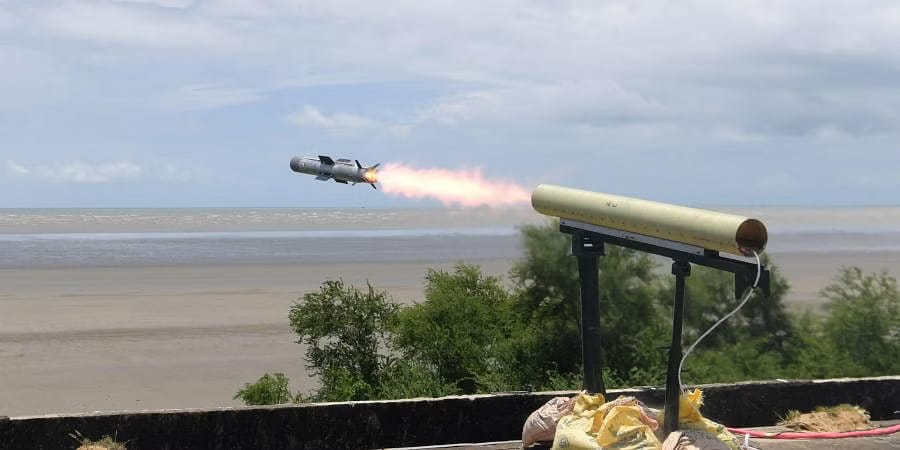
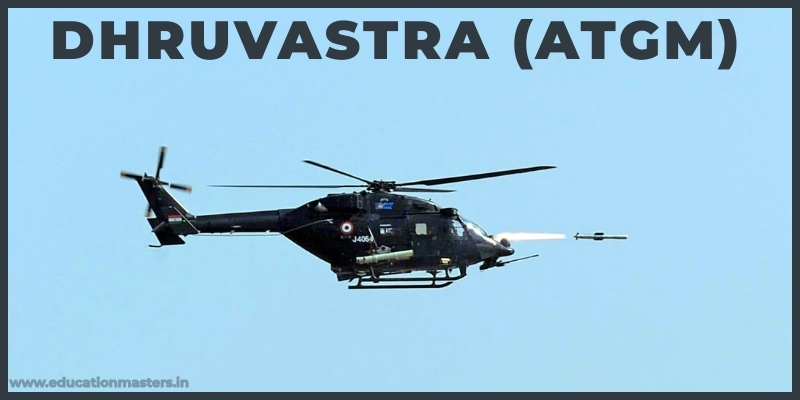
Dhruvastra is an advanced, helicopter-launched, third-generation Anti-Tank Guided Missile (ATGM) developed by India’s Defence Research and Development Organisation (DRDO) under the indigenous missile program of Nag. Designed specifically for deployment from Indian attack helicopters, Dhruvastra provides the Indian Armed Forces with a highly accurate, fire-and-forget air-to-ground anti-armor strike capability.Equipped with an imaging infrared (IIR) seeker, the missile can autonomously lock onto and track targets after launch, allowing the launching helicopter to disengage immediately and enhancing survivability in hostile airspace.
Dhruvastra features top-attack capability, enabling it to strike the thinner upper armor of modern main battle tanks, making it very effective against vehicles protected by composite and reactive armor. Because of its stand-off engagement capability, high accuracy, and strong penetration power, Dhruvastra significantly strengthens India’s aerial anti-armor warfare capability. It is suitable for operations across diverse terrains, including plains, deserts, mountainous regions, and high-altitude areas, and plays a crucial role in both offensive and defensive battlefield operations. Dhruvastra reflects India’s growing self-reliance in advanced missile technologies and enhances joint operations involving air and ground forces.
Overview of Dhruvastra Missile
|
Aspect
|
Details
|
|
Name
|
Dhruvastra
|
|
Type
|
Anti-Tank Guided Missile (ATGM) Helicopter-Launched
|
|
Generation
|
Third Generation
|
|
Direction & Guidance
|
Fire-and-Forget
|
|
Developer
|
DRDO of India
|
|
Missile Program
|
Missile Program of Nag
|
|
Platform to Launch
|
Attack by helicopters
|
|
Seeker Type
|
(IIR) Infrared Imaging
|
|
Attack Mode
|
Top-attack
|
|
Primary Targets
|
Main battle tanks, bunkers, armored vehicles
|
|
Armor Penetration
|
Tandem HEAT warhead (defeats ERA)
|
|
Operational Role
|
Anti-armor strike Air-to-ground
|
|
Key Advantage
|
High precision with reduced operator risk
|
|
Terrain Capability
|
Plains, deserts, mountains, high-altitude areas
|
|
Strategic Value
|
Enhances India’s indigenous anti-armor capability
|
Development Background of Dhruvastra Missile
Dhruvastra is an evolution of the HELINA (Helicopter-Launched Nag) missile, optimized for integration with Indian helicopters such as the Light Combat Helicopter (LCH – Prachand) and Rudra (ALH weaponized variant). Developed to meet the Indian Army’s operational requirements, Dhruvastra reflects India’s push toward self-reliance in advanced missile technology under the initiative of Atmanirbhar Bharat.
Main Features of Dhruvastra Missile
-
Fire-and-Forget Missile of Third-Generation:
Once launched, Dhruvastra autonomously tracks and engages the target, allowing the helicopter to disengage immediately after firing.
-
Imaging Infrared Seeker (IIR):
Uses an advanced IIR seeker for accurate target acquisition and tracking in day, night, and adverse weather conditions.
-
Capability of Top-Attack:
Attacks the weaker upper armor of tanks, ensuring high lethality against modern armored vehicles.
-
Tandem HEAT Warhead:
Designed to defeat Explosive Reactive Armor (ERA) and penetrate modern composite armor.
-
All-Terrain and All-Weather Capability:
Effective across deserts, plains, urban areas, mountainous regions, and high-altitude environments.
Range & Performance of Dhruvastra Missile
-
Operational Range: Approximately 7–8 km
-
Speed: Subsonic
-
Accuracy: Very high due to autonomous guidance
-
Engagement Type: Long-range precision anti-armor combat
-
Launch Mode: Air-launched from attack helicopters
Operational Role of Dhruvastra Missile
-
Destructing Enemy Armored Vehicles and Tanks:
Dhruvastra is primarily deployed to accurately engage and destroy modern main battle tanks and armored vehicles, including those protected by reactive armor and composite.
-
Neutralization of Bunkers and Fortified Positions:
The missile is capable of striking hardened bunkers, defensive fortifications, and enemy strongpoints, supporting ground forces during high-intensity combat.
-
Defensive Ground Operations and Offensive Support:
Dhruvastra enhances the effectiveness of ground operations by providing aerial anti-armor support during both offensive advances and defensive holding actions.
-
Faster Response Against Armored Breakthroughs:
Launched from attack helicopters, Dhruvastra enables quick reaction to enemy armored thrusts, helping to halt or neutralize breakthroughs before they gain momentum.
-
Battlefield Shaping and Close Air Support (CAS):
The missile plays a key role in close air support missions by weakening enemy armor and defences, shaping the battlefield in favor of friendly ground forces.
-
Stand-Off Anti-Armor Strikes:
With its long engagement range, Dhruvastra allows helicopters to conduct precision strikes from stand-off distances, reducing exposure to enemy air defences.
Strategic Importance of Dhruvastra Missile
-
Enhances Air-to-Ground Anti-Armor Capability
Dhruvastra significantly strengthens India’s helicopter-based anti-tank warfare capability by providing a lethal, precise, and reliable air-launched strike option against armored targets.
-
Fire-and-Forget Advantage
Its autonomous guidance system allows pilots to disengage immediately after launch, greatly improving helicopter survivability in highly contested battlefield environments.
-
Effective Against Contemporary Armored Threats
Equipped with a tandem HEAT warhead and top-attack mode, Dhruvastra is highly effective against modern tanks fitted with Explosive Reactive Armor (ERA).
-
Supports Joint and Integrated Operations
The missile enables seamless coordination between air and ground forces, enhancing the effectiveness of combined arms and network-centric warfare operations.
-
Strengthens Indigenous Defence Capability
As a key member of the indigenous Nag missile family, Dhruvastra boosts India’s self-reliance in advanced missile technology and reduces dependence on foreign weapon systems.
-
Critical for High-Intensity and Conventional Conflicts
Dhruvastra provides a decisive operational edge in modern warfare, particularly in conventional conflicts involving rapid armored maneuvers and high-intensity combat scenarios.
Advantages of Dhruvastra Missile
- High Lethality and Precision:
Dhruvastra is equipped with an advanced imaging infrared (IIR) seeker that enables highly accurate target engagement, ensuring maximum lethality against enemy tanks, armored vehicles, and fortified positions.
-
Fire-and-Forget Guidance System:
Once launched, the missile autonomously tracks and destroys the target, allowing the helicopter pilot to disengage immediately. This significantly reduces pilot workload and exposure to enemy fire.
-
Long Stand-Off Engagement Range:
Dhruvastra allows attack helicopters to strike armored targets from safe distances beyond the effective range of enemy air defences and tank-mounted weapons.
-
Successful Against Modern Armored Threats:
Fitted with a tandem HEAT warhead, the missile can defeat explosive reactive armor (ERA) and modern composite armor used by today’s main battle tanks.
-
Enhanced Helicopter Survivability:
Stand-off capability combined with fire-and-forget technology improves helicopter survivability in contested battlefield environments.
-
Indigenous Development:
As a fully indigenous missile developed by DRDO, Dhruvastra strengthens India’s self-reliance in advanced missile and precision-guided weapon technologies.
Limitations of Dhruvastra Missile
-
Dependence on Attack Helicopter Platforms
Dhruvastra can only be deployed from compatible attack helicopters, making its operational availability dependent on helicopter readiness, maintenance status, and trained aircrew deployment.
-
Vulnerability in Highly Contested Airspace
In areas with dense enemy air-defence systems, the survivability of launch helicopters may be reduced, which can limit the missile’s effectiveness during high-intensity combat operations.
-
Limited Payload Size
As an anti-tank guided missile, Dhruvastra carries a relatively smaller warhead compared to strategic or long-range missile systems, restricting its role primarily to tactical battlefield targets.
-
Higher System Cost
Advanced features such as an imaging infrared seeker, fire-and-forget capability, and sophisticated guidance systems increase the missile’s production, maintenance, and deployment costs.
Conclusion
Dhruvastra marks a major leap forward in India’s indigenous anti-tank missile capability, combining advanced guidance technology with high battlefield effectiveness. Its fire-and-forget operation, imaging infrared seeker, and top-attack profile allow it to accurately engage and destroy heavily protected modern main battle tanks, even in complex combat environments. The missile’s extended stand-off range enhances the survivability of launch platforms by allowing engagements from safer distances, while its accuracy reduces collateral damage.
As part of the Nag missile family, Dhruvastra reflects the successful maturation of India’s defence research ecosystem and its ability to develop world-class, next-generation weapon systems. Its integration into the Indian Armed Forces significantly strengthens anti-armor warfare capability, supports rapid-response operations, and improves combat readiness in conventional and high-intensity conflicts. Overall, Dhruvastra not only enhances battlefield dominance but also reinforces India’s strategic objective of defence self-reliance and technological superiority. For more information about missiles visit Education masters.
सरकारी नौकरियों, जीके अपडेट्स और करेंट अफेयर्स की ताज़ा जानकारी सबसे पहले पाने के लिए:






.png)
.png)
.png)
.jpg)
.jpg)