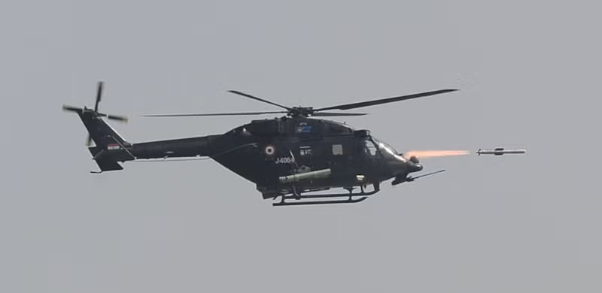
The HMM missile is a next-generation indigenous helicopter-launched precision-guided weapon developed to substantially strengthen India’s rotary-wing combat and anti-armor strike capability. Designed for integration with armed helicopters of the Indian Armed Forces, the Helicopter Mounted Missile (HMM) enables accurate engagement of enemy armored vehicles, light combat platforms, and fortified ground targets from extended stand-off ranges. Its lightweight design, high accuracy, and rapid-response capability make HMM particularly effective for close air support, battlefield interdiction, and fast-moving combat operations in both conventional and asymmetric warfare scenarios.
Developed by the Defence Research and Development Organisation (DRDO), the HMM missile reflects India’s growing emphasis on indigenous, cost-effective, and technologically advanced guided weapon systems. Equipped with modern guidance and control technologies, HMM is optimized for day-night and all-weather operations, allowing helicopters to strike precisely while reducing exposure to hostile air-defense threats. As a key component of India’s defense self-reliance strategy, the HMM missile enhances tactical flexibility, improves platform survivability, and significantly boosts the Indian Armed Forces’ ability to dominate the battlefield across diverse terrain and operational environments.
Overview of HMM Missile of India
|
Category
|
Details
|
|
Missile Name
|
HMM
|
|
Full Form
|
Helicopter Mounted Missile
|
|
Missile Type
|
Helicopter-launched air-to-surface missile
|
|
Developer
|
(DRDO)
|
|
Country of Origin
|
India
|
|
Launch Platform
|
Armed helicopters
|
|
Primary Role
|
Anti-armor and precision ground attack
|
|
Guidance System
|
Advanced precision guidance
|
|
Engagement Range
|
Short-to-medium stand-off range
|
|
Operational Conditions
|
All-weather, day & night
|
|
Target Types
|
Armored vehicles, light combat platforms, bunkers
|
|
Survivability Feature
|
Stand-off launch reducing exposure to air defenses
|
|
Indigenous Status
|
Fully indigenous
|
|
Strategic Importance
|
Enhances rotary-wing strike power and battlefield flexibility
|
Key Features of HMM Missile of India
HMM (Helicopter-launched Missile System), also known as HELINA Mk-II, is India’s next-generation fire-and-forget anti-tank guided missile developed to equip attack helicopters with a highly lethal, stand-off, all-weather precision strike capability. It is optimized for network-centric, high-altitude, and high-threat battlefield environments, significantly enhancing helicopter survivability and anti-armor dominance.
-
Fire-and-Forget Guidance System
Uses an advanced Imaging Infrared (IIR) seeker with lock-on before launch, enabling fully autonomous guidance after firing.
-
Tandem HEAT Warhead
Designed to defeat modern main battle tanks, including those fitted with explosive reactive armor (ERA).
-
Top-Attack and Direct-Attack Modes
-
Top-attack to penetrate weak roof armor of tanks
-
Direct-attack for bunkers, light armor, and fortified targets
-
Stand-Off Engagement Capability
Effective range of approximately 7–8 km, allowing helicopters to engage targets outside enemy tank guns and SHORAD envelopes.
-
All-Weather, Day and Night Operations
Maintains effectiveness in darkness, haze, dust, fog, and adverse weather conditions.
-
High Resistance to Electronic Countermeasures
Passive IIR seeker offers strong immunity against jamming, spoofing, smoke, and battlefield obscurants.
-
Kill Probability and High Accuracy
Advanced guidance logic and optimized attack profiles deliver precise target engagement with minimal miss distance.
-
Shoot-and-Scoot Employment Doctrine
Enables helicopters to fire and immediately reposition or disengage, greatly improving battlefield survivability.
Development Background of HMM Missile of India
The HMM missile was developed by the Defence Research and Development Organisation (DRDO) to provide the Indian Armed Forces with an indigenous, lightweight helicopter-launched precision weapon. The program aims to replace imported systems while enhancing rapid-response and close air support capabilities against armored and ground targets.
Optimized for accuracy, survivability, and all-weather operations, HMM integrates modern guidance technologies to ensure precise engagement from stand-off ranges. Its development supports India’s defense self-reliance goals and significantly boosts rotary-wing strike effectiveness in modern battlefield scenarios.
Operational Roles of HMM Missile of India
HMM (Helicopter-launched Missile System) is designed to provide Indian attack helicopters with a highly survivable, fire-and-forget, stand-off anti-armor strike capability. Optimized for network-centric, all-weather, and high-altitude warfare, HMM plays a critical role in modern combined-arms battlefield operations.
-
Primary Anti-Tank Warfare Role
Engages and destroys modern main battle tanks and armored fighting vehicles, including those protected by explosive reactive armor (ERA).
-
Stand-Off Precision Engagement
Enables helicopters to strike armored targets from 7–8 km, remaining outside enemy tank guns and short-range air-defense envelopes.
-
Fire-and-Forget Combat Employment
Allows helicopters to launch and immediately maneuver or disengage, enhancing survivability in high-threat environments.
-
Top-Attack Armored Neutralization
Executes steep top-attack profiles to penetrate the weakest roof armor of tanks, ensuring high kill probability.
-
Direct-Attack Against Fortifications
Used in direct-attack mode to destroy bunkers, pillboxes, light armor, and hardened battlefield positions.
-
(CAS) Close Air Support
Provides rapid and precise anti-armor and point-target destruction in support of ground forces during offensive and defensive operations.
-
High-Altitude and Mountain Warfare Operations
Supports combat in Himalayan terrain, enabling effective engagements in valleys, ridgelines, and narrow battle spaces.
-
All-Weather, Day and Night Combat
Maintains operational effectiveness in darkness, haze, dust, fog, and adverse weather conditions.
Advantages of HMM Missile of India
HMM (Helicopter-launched Missile System) provides Indian attack helicopters with a modern, survivable, and highly precise anti-armor strike capability. Designed for high-intensity armored warfare, network-centric operations, and high-altitude battlefields, it delivers decisive tactical and strategic advantages.
-
Fire-and-Forget Precision Guidance
Imaging Infrared (IIR) seeker enables autonomous post-launch guidance, allowing immediate evasive maneuvering and rapid re-tasking.
-
High Kill Probability Against Modern Tanks
Tandem HEAT warhead with top-attack profile reliably defeats main battle tanks equipped with explosive reactive armor (ERA).
-
Stand-Off Engagement Superiority
Engagement range of approximately 7–8 km keeps helicopters outside most tank guns and short-range air-defense envelopes.
-
Significantly Enhanced Helicopter Survivability
Shoot-and-scoot employment minimizes exposure to MANPADS, SHORAD systems, and small-arms fire.
-
All-Weather, Day and Night Capability
Maintains consistent operational effectiveness in darkness, haze, dust, fog, and adverse weather.
-
Strong Resistance to Electronic Warfare
Passive IIR guidance offers high immunity to jamming, spoofing, smoke screens, and battlefield countermeasures.
-
Effective Top-Attack Lethality
Steep dive attack angles exploit the weakest roof armor of tanks, maximizing penetration and kill probability.
-
Versatility Against Multiple Ground Targets
Capable of engaging tanks, armored vehicles, bunkers, pillboxes, and fortified enemy positions with precision.
Limitations of HMM Missile of India
HMM (Helicopter-launched Missile System) is a modern and highly capable anti-tank weapon, but its effectiveness is shaped by operational, technical, and tactical limitations that must be managed through proper doctrine and combined-arms support.
-
Limited Engagement Range
With an effective range of around 7–8 km, HMM cannot perform deep-strike missions and has shorter reach than fixed-wing stand-off weapons.
-
Helicopter Platform Vulnerability
Despite stand-off employment, helicopters must still operate within MANPADS, SHORAD, and small-arms threat zones in contested airspace.
-
Line-of-Sight Requirement at Lock-On
Imaging Infrared lock-on before launch requires clear visual access to the target, limiting effectiveness in dense urban or cluttered terrain.
-
Sensitivity to Thermal Contrast
Low temperature differentials between target and background, heavy rain, fog, or dust can degrade seeker performance.
-
Vulnerability to Active Protection Systems (APS)
Modern tanks equipped with hard-kill APS may intercept the missile, reducing single-shot kill probability.
-
Limited Effectiveness Against Fast or Highly Mobile Targets
Optimized for armored and slow-moving ground targets, not suitable for high-speed or evasive targets.
-
Limited Missile Load per Helicopter
Payload constraints restrict the number of missiles carried, reducing sustained engagement capability.
-
Longer Time-to-Target Compared to Guns or Rockets
Missile flight time allows targets limited opportunity to maneuver, take cover, or deploy countermeasures.
CONCLUSION
The HMM missile represents a vital step forward in strengthening India’s indigenous rotary-wing combat and precision strike capability. Designed to meet modern battlefield demands, HMM provides armed helicopters with a highly accurate, lightweight, and responsive weapon for engaging armored vehicles, light combat platforms, and fortified ground targets. Its helicopter-mounted configuration, combined with stand-off engagement capability, allows rotary-wing platforms to conduct close air support and battlefield interdiction missions with reduced exposure to enemy air-defense systems. This significantly improves mission survivability, operational flexibility, and effectiveness in both conventional and asymmetric warfare scenarios across varied terrains.
Developed by the Defence Research and Development Organisation (DRDO), the HMM missile aligns closely with India’s long-term defense modernization and self-reliance objectives. By reducing dependence on imported helicopter-launched weapons, HMM strengthens supply security while fostering domestic expertise in precision-guided missile technology. Its integration enhances the Indian Armed Forces’ ability to conduct rapid-response operations, support ground forces in high-tempo combat, and maintain tactical dominance in contested environments. As part of India’s growing portfolio of indigenous missile systems, the HMM missile not only boosts rotary-wing strike power but also reinforces the nation’s strategic autonomy, ensuring future-ready helicopter combat capability and sustained battlefield superiority. For more Information about missiles you can visit our site Education Masters.
सरकारी नौकरियों, जीके अपडेट्स और करेंट अफेयर्स की ताज़ा जानकारी सबसे पहले पाने के लिए:

.jpg)




.png)
.png)
.png)
.jpg)
.jpg)