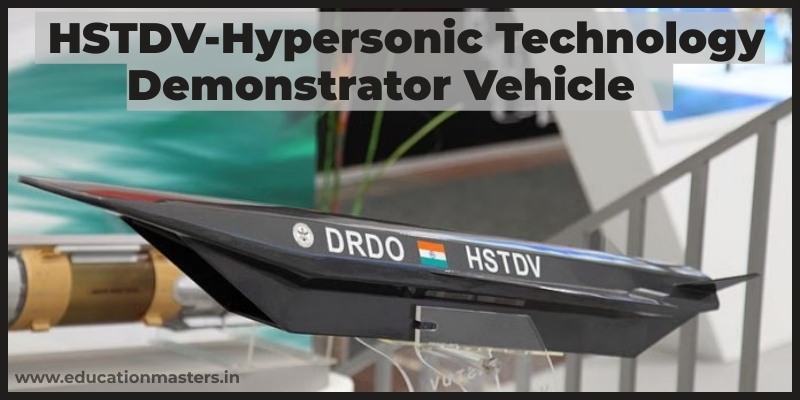
The Hypersonic Technology Demonstrator Vehicle (HSTDV) is an indigenous hypersonic test platform developed by India’s DRDO to demonstrate critical technologies required for future hypersonic cruise missiles and reusable space launch systems. It serves as a foundational stepping stone for India’s ambitions in the hypersonic domain, showcasing advances in scramjet propulsion, high-temperature materials, aerodynamics, and autonomous flight control at extreme speeds.
HSTDV is not a weapon itself but a technology demonstrator, intended to validate India’s capability to sustain hypersonic flight using an air-breathing scramjet engine—a key requirement for the development of next-generation hypersonic cruise missiles like the planned BrahMos-II.
Overview of HSTDV
|
Parameter
|
Details
|
|
Full Name
|
Hypersonic Technology Demonstrator Vehicle
|
|
Developer
|
DRDO, India
|
|
Type
|
Hypersonic flight test platform (technology demonstrator)
|
|
Purpose
|
Validate scramjet propulsion, hypersonic aerodynamics, and high-temperature materials
|
|
Speed Achieved
|
Mach 6
|
|
Propulsion
|
Scramjet engine (air-breathing) + solid rocket booster for launch
|
|
Flight Profile
|
High-altitude, sustained hypersonic cruise during test phase
|
|
Key Technologies Tested
|
Scramjet combustion, thermal protection systems, autonomous flight control
|
|
Launch Method
|
Rocket booster-assisted launch to required speed and altitude
|
|
Significance
|
Foundation for future hypersonic cruise missiles like BrahMos-II
|
|
Applications
|
Hypersonic weapons, reusable launch vehicles, advanced aerospace systems
|
|
Status
|
Successfully tested; ongoing development for further validation
|
Purpose of HSTDV
HSTDV aims to:
-
Prove India’s ability to achieve sustained hypersonic flight using scramjet propulsion.
-
Develop heat-resistant materials and coatings capable of surviving extreme temperatures (2000°C).
-
Validate hypersonic aerodynamics, guidance, navigation, and control systems.
-
Lay the technological groundwork for hypersonic cruise missiles and low-cost, reusable launch vehicles.
-
Enable India to join the elite group of nations mastering hypersonic propulsion (U.S., Russia, China).
Key Features of HSTDV
• Speed: Hypersonic Performance
Demonstrates hypersonic speeds of around Mach 6 during test flights, enabling extremely fast atmospheric travel and validating India’s growing capability in next-generation missile propulsion.
• Engine: Indigenous Scramjet Technology
Powered by an advanced indigenous Scramjet (Supersonic Combustion Ramjet) engine, designed to operate efficiently at hypersonic speeds by compressing incoming air without any moving parts.
• Flight Profile
• Altitude Capability
Operates at an altitude of roughly 30–40 km, where air density and temperature conditions are ideal for scramjet combustion and high-speed aerodynamic testing.
• Materials & Thermal Protection
Constructed with high-strength, heat-resistant alloys and advanced thermal protection systems capable of withstanding intense temperatures generated during hypersonic flight.
Strategic Importance of HSTDV
-
Forms the technological backbone for future Hypersonic Cruise Missiles (HCMs).
-
Key enabler for BrahMos-II, expected to fly at Mach 7–9.
-
Boosts India’s defence self-reliance in cutting-edge missile technology.
-
Offers potential breakthroughs for reusable hypersonic vehicles and spaceplane concepts.
-
Enhances deterrence against technologically advanced adversaries.

How HSTDV Works
1. Solid Rocket Booster Phase
The process begins with a solid rocket booster that provides the necessary initial thrust. It accelerates the HSTDV to extremely high speed and lifts it to the required altitude and Mach conditions essential for scramjet ignition.
2. Booster Separation & Scramjet Activation
Once the booster has completed its job, it separates from the vehicle. At this point, the scramjet (Supersonic Combustion Ramjet) engine activates. Unlike traditional engines, the scramjet has no moving turbines—it compresses incoming air solely through the vehicle’s high-speed forward motion.
3. Hypersonic Combustion Phase
Fuel is injected into the supersonic airflow inside the scramjet chamber. Combustion occurs while the air is moving at hypersonic speeds, a highly complex process that enables extremely efficient propulsion at Mach 6+.
4. Hypersonic Cruise & Data Collection
Once in stable hypersonic flight, the HSTDV cruises autonomously. During this phase, sensors collect critical data on:
This validates India’s ability to build and operate hypersonic platforms for future missiles and aerospace applications.
Major Achievements of HSTDV
-
Successfully tested on 7 September 2020, marking India’s first scramjet-based hypersonic flight.
-
Demonstrated stable combustion in a scramjet engine at hypersonic speeds.
-
Validated India’s ability to conduct long-duration hypersonic flight experiments.
-
Positioned India among global leaders in future hypersonic technologies.
Applications (Future Potential)
-
Hypersonic weapons
-
Rapid-response strike systems
-
Spaceplane-based launch vehicles
-
High-speed reconnaissance platforms
-
Advanced turbine-scramjet combined propulsion research
Limitations of HSTDV
1. Still in early technology demonstration phase
HSTDV is currently a proof-of-concept platform, meaning it is designed mainly to validate hypersonic technologies rather than serve as a deployable weapon. Significant development is still needed before it can support an operational missile system.
2. Extreme thermal and material challenges
Flying at Mach 6+ generates temperatures exceeding 1,000–2,000°C on the vehicle’s surface. Developing materials and thermal protection systems that can survive such conditions for sustained periods remains one of the most difficult engineering challenges.
3. Scramjet ignition and stability remain complex at varying altitudes
Scramjets require precise airflow conditions to ignite and stay stable. Maintaining consistent combustion while the vehicle flies through different atmospheric densities and temperatures is a major technological hurdle.
4. Operational hypersonic weapons based on HSTDV will require extensive testing
Transforming HSTDV technologies into real hypersonic cruise missiles demands many more flight trials, fine-tuning of propulsion, guidance, and thermal systems, and validation under various mission profiles. This means operational deployment is still a long-term goal.
Conclusion
HSTDV represents a major milestone in India’s journey toward mastering hypersonic technology. Its successful demonstration of scramjet-powered hypersonic flight showcases India’s growing capability to develop cutting-edge propulsion systems that operate at extreme speeds and temperatures. While still in the experimental and validation stage, HSTDV serves as a crucial building block for the future development of hypersonic cruise missiles, high-speed strike systems, and reusable space launch platforms. This breakthrough marks not just a technological achievement but a strategic advancement, laying the groundwork for transformative defence and aerospace capabilities that will significantly influence India’s security and technological landscape in the decades ahead. For more information about missiles visit Education Masters.
सरकारी नौकरियों, जीके अपडेट्स और करेंट अफेयर्स की ताज़ा जानकारी सबसे पहले पाने के लिए:





.jpg)
.jpg)