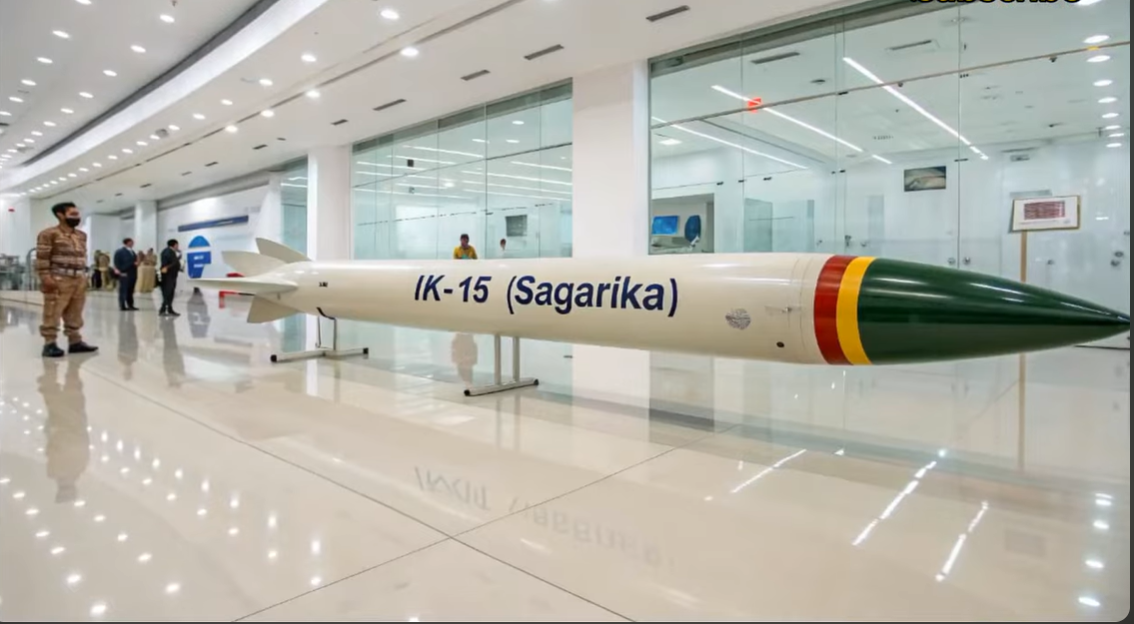
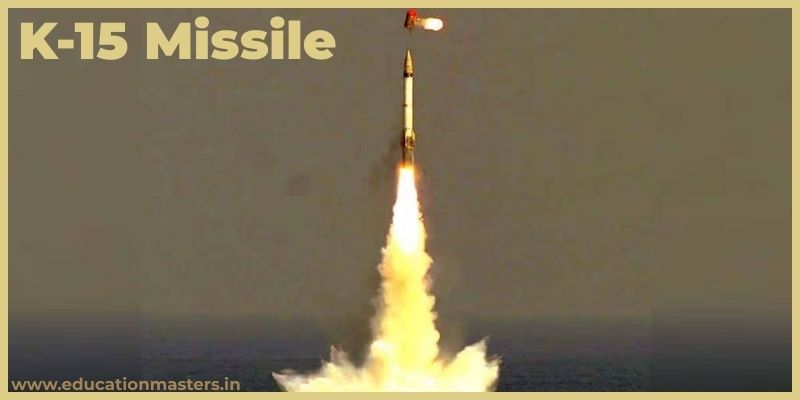
The K-15 missile, also known as Sagarika, is India’s first operational submarine-launched ballistic missile (SLBM), developed by the Defence Research and Development Organisation (DRDO) under the strategic K-series program. Designed for deployment aboard the Arihant-class nuclear ballistic missile submarines (SSBNs), the K-15 missile plays a vital role in providing India with a secure and survivable sea-based nuclear deterrent. With an effective range of around 700 km, the missile offers high accuracy, solid-fueled reliability, and the ability to be launched from beneath the ocean’s surface—ensuring stealth, mobility, and protection from pre-emptive strikes. As the foundational SLBM of India’s underwater nuclear arsenal, the K-15 missile strengthens the nation’s second-strike capability and lays the groundwork for more advanced long-range missiles in the K-series.
Overview of K-15 Missile
|
Parameter
|
Details
|
|
Name
|
Missile K-15 (Sagarika)
|
|
Developer
|
Defence Research and Development Organisation of India (DRDO)
|
|
Type
|
Ballistic Missile Launched from a Submarine (SLBM)
|
|
Series
|
Part of India’s K-series missile program
|
|
Range
|
700 km
|
|
Launch Platform
|
Arihant-class SSBNs
|
|
Propulsion
|
Two-stage, solid-fueled missile
|
|
Warhead
|
Nuclear-capable
|
|
Accuracy
|
High excellent accuracy with advanced guidance systems
|
|
Guidance
|
Inertial navigation + possible satellite-aided correction
|
|
Role
|
Sea-based strategic strike and second-strike capability
|
|
Status
|
Operational
|
Development History of K-15 Missile
The K-15 missile was developed under the secretive K-series program, initiated to provide India with a reliable sea-based nuclear deterrent. DRDO began its development in the late 1990s, and multiple successful tests led to its operational induction on the Arihant-class SSBNs. It marked India’s entry into the elite group of nations with indigenous SLBM capability.
Guidance and Navigation of K-15 Missile
The K-15 missile uses a highly refined inertial navigation system (INS), supported by possible satellite updates. Its guidance package ensures high precision, even during long underwater missions or unpredictable security environments.
Features of K-15 Missile
-
Submarine-Launched: Designed for underwater launch from Arihant-class SSBNs, ensuring stealth and survivability.
-
Solid-Fuel Propulsion: Two-stage solid-fuel motor for faster response and lower maintenance.
-
High Accuracy: Advanced inertial navigation with potential satellite-assisted updates.
-
Compact Design: Smaller dimensions allow multiple missiles to be carried onboard SSBNs.
-
Nuclear-Capable: Designed to deliver strategic nuclear warheads.
-
Sea-Skimming Trajectory: Capable of depressed trajectories to evade enemy missile-defense systems.
-
Quick Launch Preparation: Optimized for rapid response during strategic operations.
Advantages of K-15 Missile
-
Ensures Second-Strike Capability: Guarantees retaliation even after a first strike, strengthening nuclear deterrence.
-
High Survivability: Submarine-based deployment makes it difficult to detect or target.
-
Enhances Maritime Security: Extends India’s strategic reach in the Indian Ocean Region.
-
Reliable Performance: Solid fuel increases stability, reliability, and rapid deployment capability.
-
Foundation for Future Missiles: Serves as a developmental base for advanced K-series missiles like K-4, K-5, and K-6.
Operations of K-15 Missile
1. Underwater Launch Capability
The K-15 missile is designed to be launched from deep underwater using the Arihant-class nuclear ballistic missile submarines (SSBNs). It uses a cold-launch gas booster system, where compressed gas ejects the missile out of the submarine’s vertical launch tube before its rocket motor ignites.
This method ensures:
-
Safe launch from underwater pressure
-
Reduced risk to the submarine
-
Stealth and surprise during missile deployment
This underwater-launch feature makes K-15 a true second-strike nuclear-capable system.
2. Stealth Operations
Arihant-class SSBNs carrying the K-15 missile operate in complete secrecy, remaining submerged for long periods during deterrence patrols.
K-15 supports this by being:
-
Silent in storage and handling
-
Ready for stealthy, undetected launch
-
Optimized for submarines that avoid detection through acoustic quieting
Together, they allow the submarine to remain hidden while retaining nuclear strike capability at all times.
3. Strategic Role
K-15 forms the core of India’s sea-based nuclear deterrent, ensuring:
-
Assured second-strike capability
-
Survival of nuclear forces even after a first strike
-
Compliance with India’s Credible Minimum Deterrence (CMD) and No First Use (NFU) doctrine
By being deployed on SSBNs, K-15 guarantees that India always has a hidden, survivable nuclear option.
4. Operational Deployment
The K-15 missile has been:
-
Fully integrated on INS Arihant
-
Extensively tested through multiple underwater launches
-
Cleared for operational use during deterrence patrols
Its deployment makes INS Arihant a functioning SSBN, giving India the third leg of the nuclear triad: sea-based nuclear capability.
5. Quick Reaction Capability
K-15 is designed for rapid launch during high-alert situations.
This means:
-
The submarine can immediately prepare and fire the missile when ordered
-
Minimal response time is needed during escalating conflict
-
Ensures India can retaliate swiftly and effectively, maintaining deterrence stability
This quick reaction capability is crucial because SSBNs serve as the nation’s last-resort nuclear force.
Role of K-15 Missile in India’s Nuclear Triad
The K-15 missile forms a critical pillar of India’s nuclear triad, representing the sea-based leg that ensures survivability and assured retaliation. Its submarine-based deployment provides strategic depth and complements land-based missiles and air-delivered systems.
Limitations of K-15 Missile
-
Limited Range (700 km): Shorter range compared to K-4, K-5, and K-6 reduces strategic reach.
-
Requires Close Proximity to Targets: Submarines must operate closer to adversary coastlines, increasing detection risk.
-
Lower Payload Capacity: Limited space restricts advanced multi-warhead (MIRV) capability.
-
Dependent on Submarine Platforms: Effective only when deployed on fully operational SSBNs.
Comparison with Global SLBMs
While K-15 missile is shorter in range, its accuracy, stealth, and reliability place it in the category of effective tactical and strategic SLBMs such as:
-
China’s JL-1 (700–1,700 km)
-
France’s M1 (500–2,500 km)
Its development demonstrates India’s growing capability in underwater missile technology.
Conclusion:
The K-15 missile plays a crucial role in strengthening India’s underwater nuclear deterrence by enabling secure and concealed strikes from ballistic missile submarines. Its solid-fuel design, high accuracy, and ability to be launched from significant depths make it both reliable and strategically valuable. As part of the larger K-series missile program, K-15 missile enhances India’s second-strike capability and contributes to a solid and credible nuclear triad as part of the wider K-series missile program.For more information about missiles visit Education Masters.
सरकारी नौकरियों, जीके अपडेट्स और करेंट अफेयर्स की ताज़ा जानकारी सबसे पहले पाने के लिए:






.png)
.jpg)
.jpg)