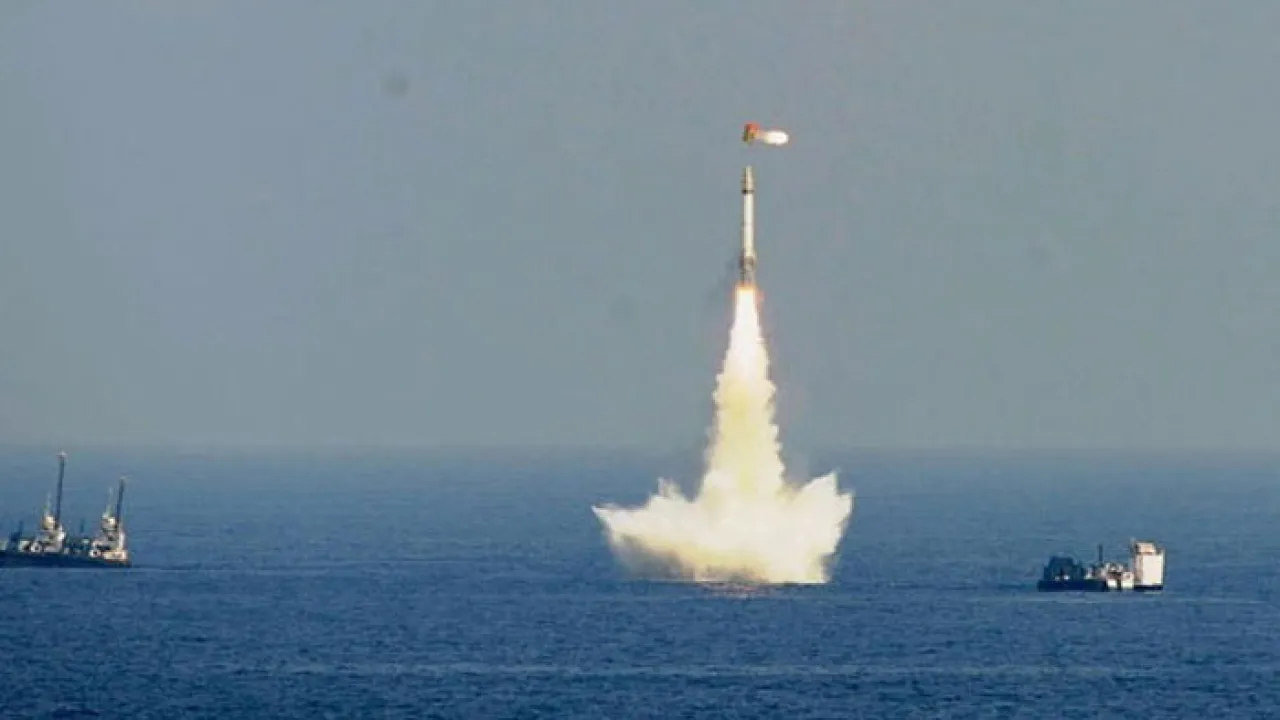
The K-4 missile is an intermediate-range Submarine-Launched Ballistic Missile (SLBM) developed by India’s Defence Research and Development Organisation (DRDO) to strengthen the country’s sea-based nuclear deterrence. Designed as part of India’s advanced K-series missile family, the K-4 bridges the range gap between the shorter-range K-15 and the future long-range K-5 and K-6 SLBMs. With an impressive range of around 3,500 km, the K-4 enables India’s nuclear ballistic missile submarines (SSBNs) — particularly the Arihant-class — to strike strategic targets from safe standoff distances deep in the Indian Ocean. Its high accuracy, strong penetration capability, and stealthy underwater launch capability make the K-4 a vital element in ensuring credible second-strike capability under India’s nuclear doctrine.
Overview of K-4 Missile
|
Parameter
|
Details
|
|
Name
|
K-4 missile SLBM
|
|
Developer
|
(DRDO) Defence Research & Development Organisation of India
|
|
Category
|
Ballistic Missile Launched by Submarine (SLBM)
|
|
Type
|
Intermediate-Range Ballistic Missile
|
|
Range
|
3,500 kilometers
|
|
Launch Platform
|
Arihant-class SSBNs (Nuclear Ballistic Missile Submarines)
|
|
Fuel Type
|
Two-stage solid-fuel rocket
|
|
Guidance System
|
Inertial Navigation System (INS) with advanced accuracy enhancements
|
|
Warhead Capacity
|
Nuclear-capable
|
|
Purpose / Role
|
Strengthening India’s sea-based nuclear deterrence and second-strike capability
|
|
Status
|
Tested and under induction
|
Key Features of K-4 Missile
1. Intermediate Range Capability
2. Two-Stage Solid-Fuel Propulsion
-
Uses solid propellant, ensuring high reliability, reduced maintenance, and quicker launch readiness.
3. High Accuracy
4. Submarine-Launched Design
5. Survivability and Stealth
Operations of K-4 Missile
1. Submarine Launch Operations
2. Strategic Patrol Missions
3. Second-Strike Role
4. Integration with Arihant-Class Fleet
-
Being integrated with:
-
INS Arihant
-
INS Arighat
-
Future SSBNs (S4, S5)
Advantages of K-4 Missile
1. Strengthens India’s Nuclear Triad
2. Larger Strike Radius
3. High Mobility and Concealment
4. High Payload Flexibility
5. Ability to Launch Quickly
Limitations of K-4 Missile
1. Not Fully Deployed Yet
2. Limited Submarine Platforms
3. Range Lower Than Future SLBMs
4. Complex Launch and Navigation Environment
Testing History of K-4 Missile
-
2014: First major underwater test from a submerged pontoon.
-
2016–2017: Multiple tests to validate guidance accuracy and flight stability.
-
January 2020: Two back-to-back successful tests confirming operational readiness.
These tests proved the missile’s reliability and its compatibility with submarine launch systems.
Future Prospects of K-4 Missile
-
K-4 will operate alongside the upcoming K-5 and K-6 SLBMs.
-
Expected upgrades include improved accuracy, better navigation systems, and MIRV-type warhead capability.
Conclusion
The K-4 missile stands as a major milestone in India’s quest for a credible and survivable sea-based nuclear deterrent. With its extended range, high accuracy, and submarine-launched stealth, it significantly enhances India’s second-strike capability and strategic security posture. The missile’s integration with Arihant-class SSBNs ensures that India can conduct secure, concealed, and effective nuclear retaliation even in the harshest conflict scenarios. As part of the evolving K-series, the K-4 missile not only bridges current capability gaps but also lays a strong foundation for future long-range SLBMs like K-5 and K-6, reinforcing India’s long-term maritime and nuclear deterrence strategy. To know more about missiles visit Education Masters.
सरकारी नौकरियों, जीके अपडेट्स और करेंट अफेयर्स की ताज़ा जानकारी सबसे पहले पाने के लिए:

.jpg)





.png)
.jpg)
.jpg)