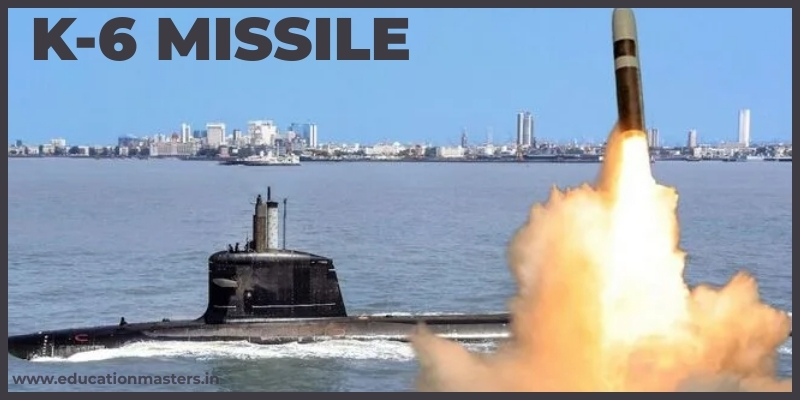
The K-6 missile is an advanced Submarine-Launched Ballistic Missile (SLBM) currently under development by India to significantly enhance its sea-based nuclear deterrence. Designed to be deployed on the future S5-class nuclear submarines, the K-6 missile is expected to offer intercontinental-range capability, Multiple Independently Targetable Re-entry Vehicles (MIRVs), and improved survivability against missile defense systems. As the most ambitious missile in India’s K-Series, the K-6 missile represents a major leap in strategic technology, ensuring a credible, secure, and second-strike nuclear capability for the nation.
K-6 Missile – Overview
|
Parameter
|
Details
|
|
Name
|
K-6 missile Submarine-Launched Ballistic Missile (SLBM)
|
|
Developer
|
India’s Defence Research and Development Organisation of (DRDO)
|
|
Type
|
Intercontinental-Range SLBM
|
|
Launch Platform
|
Future S5-class Nuclear Ballistic Missile Submarines (SSBNs)
|
|
Estimated Range
|
K-6 Missile range is 6,000–8,000+ km (expected)
|
|
Warhead Type
|
Nuclear; MIRV capability (Multiple Independently Targetable Re-entry Vehicles)
|
|
Stages
|
Three-stage, solid-fueled missile
|
|
Guidance System
|
Advanced inertial navigation with potential satellite assistance
|
|
Payload Capacity
|
Expected to carry multiple nuclear warheads
|
|
Purpose
|
Strategic second-strike capability
|
|
Status
|
Under development
|
Development Background of K-6 Missile
The K-6 missile is being developed by the Defence Research and Development Organisation (DRDO) as the next-generation submarine-launched ballistic missile in India’s “K-series.” It follows the K-4 and K-5 missile programs and represents India’s most advanced SLBM project aimed at strengthening long-range nuclear deterrence.
Important Attributes of K-6 Missile
-
Intercontinental Range (K-6 Missile range 6,000–8,000+ km): Enables India to strike strategic targets across continents from deep oceans.
-
MIRV Capability: Can carry multiple independently targetable nuclear warheads, increasing strike efficiency.
-
Three-Stage Solid-Fuel Design: Ensures higher stability, safety, and long-range performance.
-
High Accuracy: Advanced inertial navigation system (INS) with possible satellite guidance support.
-
Stealthy Deployment: Designed for S5-class SSBNs, enhancing survivability underwater.
-
High Payload Capacity: Able to carry several nuclear warheads or a combination of payload types.
-
Deep Ocean Launch: Capable of submerged launches, improving concealment and security.
Operations of K-6 Missile
Platform:
The K-6 will be deployed aboard India’s future S5-class nuclear-powered ballistic missile submarines (SSBNs), which are being built to carry heavier, longer-range SLBMs and provide maximum strategic endurance.
Role:
It is intended for strategic nuclear deterrence, enabling long-range, high-impact second-strike capability against distant adversaries, strengthening India’s sea-based nuclear posture.
Deployment Pattern:
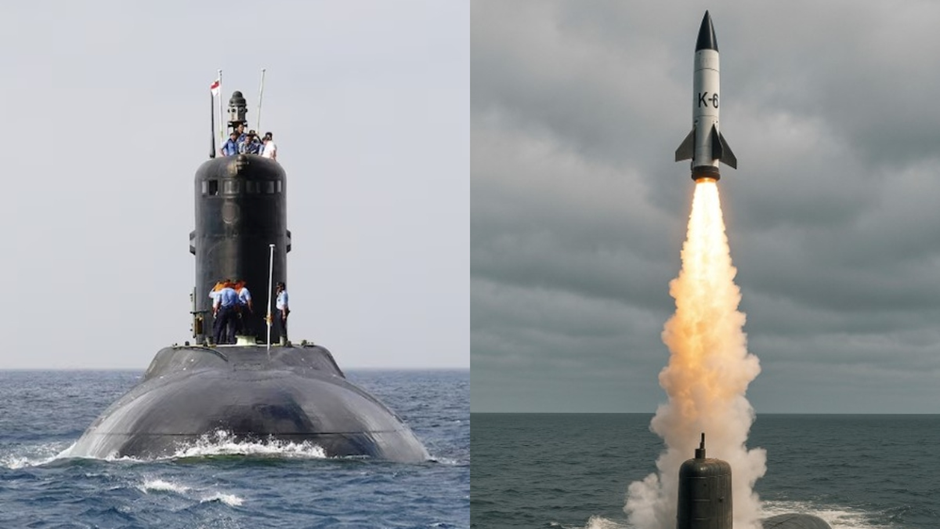
S5-class SSBNs equipped with the K-6 will undertake deep-ocean deterrent patrols, remaining hidden in vast sea areas to ensure unmatched stealth, survivability, and unpredictability.
Launch Capability:
The missile is designed to be launched from a fully submerged submarine, allowing covert firing without revealing the platform’s position.
Mission Profile:
With expected MIRV capability, the K-6 can deliver multiple nuclear warheads to several independent targets across continental distances, maximizing strategic impact.
Operational Strategy:
Its deployment ensures that India retains a credible and assured second-strike capability, guaranteeing retaliation even after a large-scale nuclear attack and reinforcing overall nuclear stability.
Advantages of K-6 Missile
-
Strengthens India’s Nuclear Triad: Ensures a powerful and credible second-strike capability.
-
Hard to Detect: Submarine launch provides stealth, reducing vulnerability to pre-emptive attacks.
-
MIRV Increases Efficiency: A single missile can neutralize multiple targets, boosting deterrence.
-
Extended Strategic Reach: Covers vast global distances, enhancing India’s strategic posture.
-
Enhanced Survivability: Solid-fuel and underwater deployment make it safer and more reliable.
-
Supports Long-Range Deterrence: Helps India counter long-distance threats across entire regions.
Limitations of K-6 Missile
-
Under Development: Still in developmental stages, full operational capability may take years.
-
Requires Advanced Submarine Fleet: Depends on the completion of upcoming S5-class SSBNs.
-
High Cost of Deployment: MIRV technology and long-range systems demand major investment.
-
Complex Technological Requirements: Precision guidance, MIRV integration, and submarine systems are challenging.
-
Strategic Sensitivities: Long-range nuclear systems attract global scrutiny and diplomatic pressure.
Expected Deployment Timeline of K-6 missile
Although no official timeline has been released, defence analysts and open-source assessments suggest the following progression:
-
Development Phase – Ongoing:
The K-6 is currently believed to be in advanced stages of research and development, with work focused on propulsion, MIRV integration, and underwater-launch systems.
-
Testing Phase – Expected in the Coming Years:
Initial developmental trials are anticipated within the next few years, likely starting with ground-based testing before transitioning to underwater and submarine-based trials.
-
Operational Induction – Early 2030s (Likely):
Full operational deployment is expected only after the commissioning of the S5-class SSBNs, which are designed to carry heavier and longer-range ballistic missiles like the K-6.
International Comparison of K-6 Missile
K-6 is comparable to advanced SLBMs like:
This positions India among the top global powers with long-range, MIRV-enabled SLBMs.
Conclusion
The K-6 missile represents a major leap in India’s strategic and technological capabilities. K-6 missile range 6,000–8,000+ kilometres marking the next stage of advancement in the country’s sea-based nuclear deterrent. With its intercontinental range, MIRV-enabled warheads, and deployment on future S5-class SSBNs, the K-6 missile will provide India with a highly survivable and credible second-strike capability. It strengthens India’s position among global nuclear powers and ensures long-term strategic security in the evolving geopolitical landscape. As the most powerful missile in the K-series, the K-6 missile will play a pivotal role in enhancing India’s maritime strength, expanding deterrence reach, and reinforcing national defence for decades to come.To get more information about missile Education Mastres.
सरकारी नौकरियों, जीके अपडेट्स और करेंट अफेयर्स की ताज़ा जानकारी सबसे पहले पाने के लिए:





.png)
.jpg)
.jpg)