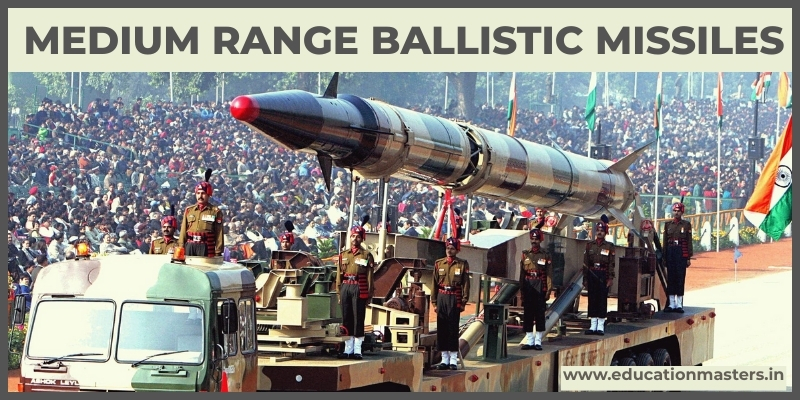
Medium-Range Ballistic Missiles (MRBMs) are missiles with ranges between 1,000 km and 3,500 km, designed for fast, precise strikes on regional targets. Positioned between SRBMs and IRBMs, they can carry conventional, nuclear, or dual-capable warheads, making them highly versatile. MRBMs can be launched from mobile TELs, fixed silos, and sometimes submarines, offering strong operational flexibility and survivability.
Modern MRBMs feature advanced guidance, inertial navigation, and manoeuvrable re-entry vehicles that improve accuracy and help evade missile defences. Their high speed and manoeuvrability enable rapid strikes and reduce enemy reaction time.Strategically, MRBMs play a key role in regional deterrence, allowing countries to address threats over long distances without depending solely on intercontinental systems. Their evolving propulsion, guidance, and warhead technologies enhance precision and survivability, making MRBMs an essential part of modern military planning and defence posture.
Overview of Medium-Range Ballistic Missiles (MRBMs)
|
Parameter
|
Details (Public Information)
|
|
Type
|
Ballistic missile
|
|
Range
|
1,000 km to 3,500 km
|
|
Class
|
Medium-range (between SRBM and IRBM)
|
|
Warhead Type
|
Conventional, nuclear, or dual-capable
|
|
Propulsion
|
Solid-fuel, liquid-fuel, or hybrid (varies by missile)
|
|
Launch Platforms
|
Mobile transporter-erector-launchers (TELs), fixed silos, submarine-launched (some variants)
|
|
Guidance System
|
Inertial navigation, satellite-assisted, and sometimes terminal guidance
|
|
Flight Profile
|
Quasi-ballistic or ballistic with high-altitude trajectory; some with manoeuvrable re-entry vehicles
|
|
Speed
|
High (hypersonic or near-hypersonic in modern missiles)
|
|
Accuracy
|
Medium to high (depends on guidance and technology)
|
|
Strategic Role
|
Regional deterrence, tactical-strategic strike capability, rapid-response operations
|
|
Advantages
|
High-speed strike, regional coverage, flexible deployment, survivable mobile launch systems
|
|
Limitations
|
Limited range compared to IRBMs/ICBMs, potential vulnerability to advanced missile defences, high development and operational cost
|
Key Features of Medium-range ballistic missiles (MRBMs)
1. Medium Range: 1,000–3,500 km, suitable for regional targets.
2. High Speed: Supersonic or hypersonic, reducing enemy reaction time.
3. Advanced Guidance: Inertial, satellite-assisted, and terminal guidance for accuracy.
4. Versatile Warheads: Can carry conventional, nuclear, or dual-capable payloads.
5. Multiple Launch Platforms: Mobile TELs, silos, and sometimes submarine-based systems.
6. Propulsion: Solid, liquid, or hybrid fuels for reliable performance.
7. High-Altitude Trajectory: Steep or quasi-ballistic flight, hard to intercept.
8. Rapid Deployment: Quick launch readiness from mobile or fixed platforms.
Guidance & Accuracy of MRBMs
Modern MRBMs use advanced systems such as:
-
Inertial Navigation Systems (INS)
-
Satellite guidance
-
Maneuverable Re-entry Vehicles (MaRVs)
-
Terminal guidance systems
These technologies improve precision and reduce interception chances.
Role and Importance of MRBMs
MRBMs play a vital role in regional defence by providing fast, accurate strikes at distances up to 3,500 km. They allow nations to target key military and strategic assets without relying solely on long-range ICBMs. Their ability to carry conventional or nuclear warheads strengthens deterrence and offers flexible response options during conflict. Mobile launchers, quick deployment, and advanced guidance make MRBMs highly survivable and effective in contested environments. Overall, they enhance regional stability, power projection, and credible defence preparedness.
Types of Medium-range ballistic missiles in India
|
Missile Name
|
Range
|
Type
|
Launch Platform
|
Fuel Type
|
Key Features / Details
|
|
Agni-2 Missile
|
2,000–3,000 km
|
MRBM
|
Road & rail-mobile
|
Solid-fuelled
|
Two-stage missile; improved accuracy; capable of carrying strategic payloads
|
|
Agni-P (Agni-Prime missile)
|
1,000–2,000 km
|
Next-gen MRBM
|
Canister zed, road-mobiles
|
Solid-fuelled
|
Lightweight composite body; Marv-capable; highly accurate next-generation missile
|
1. Agni-P (Agni Prime) Missile
Agni-P, also known as Agni Prime, is India’s new-generation, medium-range ballistic missile developed by DRDO. It is a two-stage, solid-fuel, canisterised missile with a range of 1,000 to 2,000 km. Designed with advanced lightweight composites, improved accuracy, and modern guidance systems, Agni-P is more efficient and versatile than earlier Agni-series missiles.
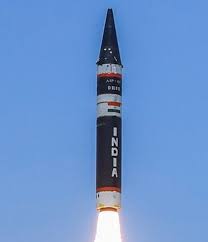
It can be launched from road-mobile launchers, ensuring high mobility and quick deployment. Agni-P enhances India’s strategic deterrence with better precision, reliability, and survivability.
2. Agni-2 Missile
Agni-II is a medium-range ballistic missile (MRBM) developed by DRDO and operated by India’s Strategic Forces Command. It has a range of about 2,000–3,000 km and uses a two-stage, solid-fuel propulsion system. Designed for quick deployment, it can be launched from rail-mobile and road-mobile platforms, giving it strong operational flexibility.
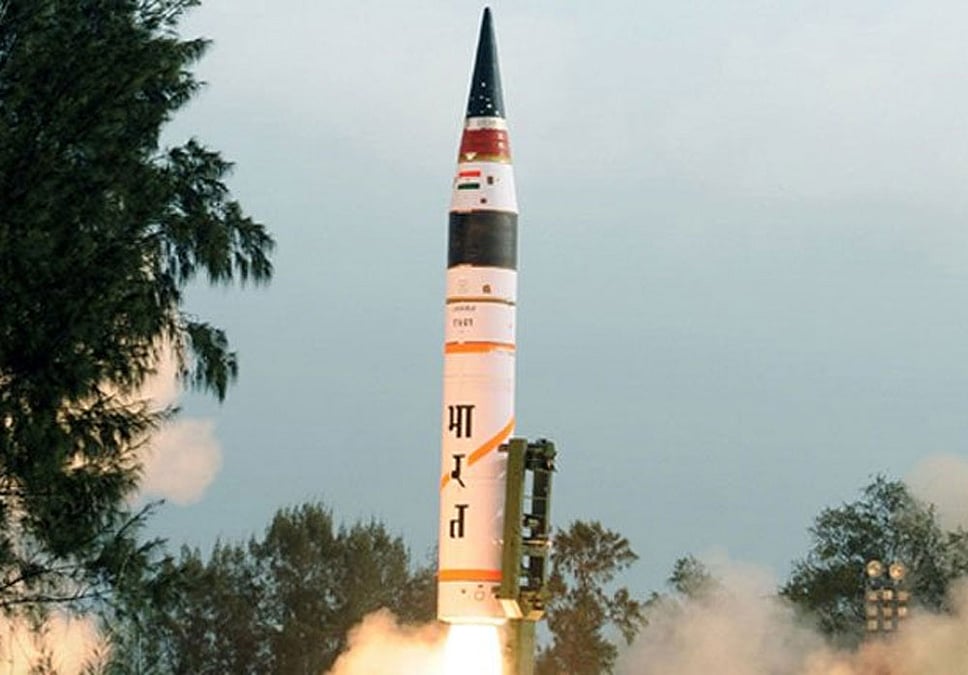
Agni-II carries conventional or nuclear warheads and features improved guidance for better accuracy. As part of India’s Agni family, it plays a key role in strengthening credible regional deterrence and enhancing strategic defence capabilities.
Missile Defence Challenges
Due to their high speed, steep trajectories, manoeuvrable re-entry vehicles, and advanced guidance systems, MRBMs are extremely difficult for enemy missile-defence systems to detect, track, and intercept. Their unpredictable flight profiles further reduce interception chances.
Launch Platforms
MRBMs can be deployed from:
-
Mobile TELs (Transporter-Erector-Launchers)
-
Fixed silos
-
Submarine platforms (in select systems)
These diverse platforms enhance mobility, survivability, and surprise-strike capability.
Operational Flexibility
MRBMs offer exceptional operational flexibility by supporting rapid deployment, mobile launch platforms, and diverse mission profiles. They can be quickly repositioned, launched on short notice, and adapted for both offensive and defensive roles, making them valuable assets in dynamic regional theatres.
CONCLUSION
Medium-Range Ballistic Missiles (MRBMs) play a pivotal role in modern defence and strategic deterrence, providing nations with the ability to project power across regional distances efficiently and accurately. Their combination of high speed, advanced guidance systems, and versatile warhead options allows them to perform both tactical and strategic missions, making them highly adaptable to different operational scenarios. MRBMs can be launched from mobile platforms, fixed silos, or even submarines, ensuring survivability and rapid deployment in the event of a conflict.
Modern Medium-Range Ballistic Missiles (MRBMs), with manoeuvrable re-entry vehicles and quasi-ballistic flight paths, further improve accuracy and reduce vulnerability to missile defence systems, reflecting advancements in technology and strategic planning.In essence, Medium-Range Ballistic Missiles (MRBMs) are not only a key element of regional deterrence but also an indispensable tool for maintaining military readiness, rapid-response capability, and strategic balance in volatile geopolitical environments. For more Such information About missiles visit Education Masters.
सरकारी नौकरियों, जीके अपडेट्स और करेंट अफेयर्स की ताज़ा जानकारी सबसे पहले पाने के लिए:






.png)
.png)
.png)
.jpg)
.jpg)