The Meteor beyond-visual-range (BVR) air to air missile is one of the most advanced long-range aerial combat weapons. Integrated with the Rafale fighter aircraft, Meteor provides India with a powerful first-shot, first-kill capability in modern air warfare. Equipped with a unique ramjet-powered propulsion system, advanced active radar guidance, and a very large no-escape zone, the Meteor missile enables Indian fighters to engage fast, maneuvering enemy aircraft at extended ranges with exceptionally high effectiveness.
As aerial combat increasingly shifts toward long-range, network-centric engagements, the Meteor missile plays a critical role in strengthening India’s air superiority and deterrence posture. Its ability to maintain high speed and energy throughout the flight makes it especially effective against modern fighters, electronic warfare-protected targets, and evasive threats. By combining sustained propulsion, mid-course data-link guidance, and strong resistance to countermeasures, the Meteor significantly enhances the Indian Air Force’s ability to dominate beyond-visual-range combat in contested airspace.
Overview of Meteor Missile
|
Category
|
Details
|
|
Missile Name
|
Meteor Beyond-Visual-Range Air-to-Air Missile
|
|
Country of Origin
|
Europe (MBDA)
|
|
Operator in India
|
IAF
|
|
Developer / Manufacturer
|
MBDA
|
|
Type
|
Long-Range / Beyond Visual Range (BVR) Air-to-Air Missile
|
|
Primary Role
|
Long-range aerial interception and air superiority
|
|
Target Types
|
Enemy fighter aircraft, strike aircraft, high-speed aerial threats
|
|
Engagement Range
|
Long range (exact figures classified)
|
|
Guidance System
|
Active radar seeker with mid-course data-link updates
|
|
Propulsion
|
Solid-fuel ducted ramjet propulsion system
|
|
Speed Class
|
Very high supersonic
|
|
No Escape Zone (NEZ)
|
Extremely large (one of the largest among modern BVR missiles)
|
Key Features of Meteor Missile
The Meteor is a fifth-generation Beyond Visual Range (BVR) air-to-air missile in service with the Indian Air Force, providing unmatched long-range interception capability. It is widely regarded as one of the most lethal BVR missiles currently operational, optimized to defeat fast, maneuvering, and well-defended aerial targets.
1. Fifth-Generation Beyond Visual Range (BVR) Missile
Designed for long-range air combat far beyond visual range.
Optimized to destroy enemy aircraft before they can launch their own weapons.
2. Ramjet-Powered Propulsion System
Uses a solid-fuel ducted ramjet engine instead of a traditional rocket motor.
Maintains sustained thrust throughout flight, unlike missiles that lose energy after burnout.
3. Extremely Large No-Escape Zone (NEZ)
Possesses one of the largest no-escape zones of any BVR missile.
Targets cannot easily outrun or evade once engaged, even at long distances.
4. Two-Way Data Link Capability
Supports mid-course guidance updates from the launch aircraft.
Allows retargeting, trajectory correction, and improved engagement flexibility.
Development Background Of The Meteor Missile
The Meteor missile is a long-range beyond-visual-range (BVR) air-to-air missile developed by MBDA to provide air forces with superior first-shot and no-escape-zone capability against modern enemy aircraft. It is designed to engage fast, highly maneuverable targets at extended ranges, even in dense electronic warfare environments.
Meteor features a ramjet-powered propulsion system, an advanced active radar seeker, and two-way data-link guidance, allowing it to maintain high energy throughout flight. This gives the missile an exceptionally large no-escape zone, making it one of the most effective BVR air-to-air missiles in service today.
Operational Roles Of The Meteor Missile
The Meteor missile is designed for very long-range BVR air combat, enabling fighters to engage enemy aircraft well before visual contact while maintaining air dominance from standoff distances. Its ramjet propulsion delivers sustained high speed, creating a large no-escape zone and high kill probability against advanced fighters and high-value aerial targets, even in electronic warfare and all-weather conditions, with full network-centric, fire-and-forget capability.
-
Very Long-Range BVR Air Combat
Meteor is designed for extended beyond visual range engagements, allowing fighters to engage enemy aircraft far before visual contact.
-
Air Dominance and Standoff Superiority
Its ramjet propulsion provides sustained high speed, enabling aircraft to maintain dominance while staying outside enemy missile envelopes.
-
Interception of High-Value Aerial Targets
Optimized to engage fighters, bombers, AEW&C aircraft, and aerial refueling tankers at long ranges.
-
Counter to Advanced Enemy Fighters
Designed to defeat highly maneuverable and modern fighter aircraft protected by electronic warfare systems.
-
Electronic Warfare-Resilient Combat
Advanced ECCM enables reliable performance in ECM-heavy environments with high resistance to jamming.
-
Multi-Platform Integration
Integrated on platforms such as Rafale, Eurofighter Typhoon, Gripen, and F-35 (planned), supporting multinational air operations.
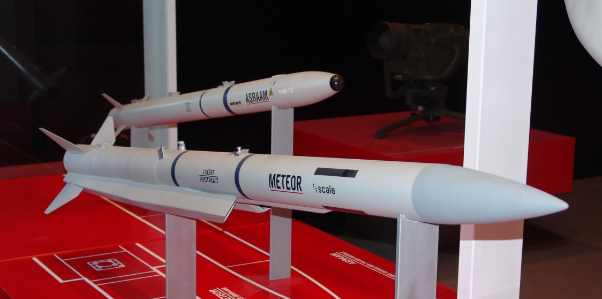
Advantages of Meteor Missile
The Meteor Beyond Visual Range (BVR) air to air missile provides the Indian Air Force with a decisive technological and tactical edge in long-range aerial combat. Its design focuses on sustained energy, large engagement zones, and dominance against modern air threats.
1. Exceptionally Large No-Escape Zone (NEZ)
Meteor possesses one of the largest no-escape zones among operational BVR missiles in the world.
Once an enemy aircraft enters this zone, escape through speed, maneuvering, or evasive tactics becomes extremely difficult, significantly increasing kill probability.
2. Sustained Thrust Advantage via Ramjet Propulsion
Unlike conventional rocket-powered missiles, Meteor’s solid-fuel ducted ramjet provides continuous thrust throughout most of the flight.
This allows the missile to retain high speed and energy even at long distances, making it far more lethal in extended-range engagements.
3. Superior End-Game Kinetic Energy
Meteor maintains very high terminal-phase energy, enabling sharp maneuvering during the final intercept.
This advantage makes it especially effective against fast, agile, or evasive fighter aircraft.
4. First-Shot, First-Kill Capability
Meteor gives Indian aircraft the ability to engage and destroy targets before the enemy can return fire.
This first-shot advantage plays a crucial role in modern BVR combat, where the initial engagement often determines mission success.
5. Strong Resistance to Electronic Countermeasures
The missile is designed to perform effectively in heavy electronic warfare and jamming environments.
Advanced seeker algorithms and signal processing reduce susceptibility to decoys and electronic deception.
6. Network-Centric Warfare Capability
Meteor supports a two-way data link, allowing mid-course updates, trajectory optimization, and retargeting.
This makes the missile highly adaptable in dynamic, fast-changing air combat scenarios.
7. Increased Survivability of Launch Aircraft
By enabling long-range, stand-off engagements, Meteor reduces risk to the firing aircraft.
Indian fighters can remain outside hostile missile envelopes while still engaging enemy aircraft.
8. Very High Probability of Kill
Meteor’s combination of:
Results in one of the highest Pk values among BVR missiles.
9. Combat-Proven and Operationally Mature System
Meteor is already in operational service with multiple advanced air forces.
Its maturity reduces operational risk and ensures reliability in real combat conditions.
10. Major Force Multiplier for IAF Rafale
When paired with the Rafale’s AESA radar and sensor fusion, Meteor dramatically enhances long-range lethality.
This combination provides the IAF with regional air superiority in BVR combat.
Limitations of Meteor Missile
Despite its advanced capabilities, the Meteor missile also has certain operational, logistical, and strategic limitations that affect its deployment and long-term flexibility within the Indian Air Force.
1. Limited Platform Availability in IAF
In Indian service, Meteor is currently integrated only with the Rafale fighter aircraft.
This restricts its operational reach across the broader IAF fleet.
2. High Acquisition and Lifecycle Cost
Meteor is a high-cost missile system due to its ramjet propulsion and advanced electronics.
This limits large-scale procurement and sustained high-volume usage.
3. Dependence on Foreign Supply Chain
Meteor is a foreign-developed missile, not an indigenous Indian system.
India remains dependent on external suppliers for upgrades, spare parts, and future variants.
4. Larger Size and Weight
The ramjet engine increases the missile’s physical size and weight compared to some rocket-powered BVR missiles.
This can reduce missile carriage numbers and affect aircraft loadout flexibility.
5. Limited Role in Close-Range Dogfights
Meteor is optimized exclusively for long-range BVR engagements.
It is ineffective in short-range combat, requiring support from SR AAMs like Python-5 or ASRAAM.
6. Reliance on Data Links and Sensor Support
Long-range effectiveness depends heavily on mid-course updates and sensor fusion.
If data links are disrupted by jamming or battlefield conditions, engagement effectiveness may reduce.
7. Vulnerability to Future Countermeasures
Although highly resistant, no missile is immune to evolving ECM, decoys, or stealth technologies.
Future adversary advancements could challenge its effectiveness.
8. Export Control and Upgrade Restrictions
Any major upgrades or modifications are subject to manufacturer and partner-nation approvals.
This limits India’s independent control over future improvements.
9. Complex Maintenance and Logistics
Ramjet propulsion and advanced guidance systems require specialized maintenance infrastructure.
This increases operational complexity and long-term support costs.
10. Part of a Layered Missile Ecosystem
Meteor is not a standalone solution.
Effective air combat still requires integration with short-range, medium-range, sensors, and AWACS support.
CONCLUSION
The Meteor beyond-visual-range (BVR) air to air missile stands as one of the most formidable long-range aerial combat weapons in service with the Indian Air Force today. With its unique ramjet propulsion system, exceptionally large no-escape zone, and advanced active radar guidance, Meteor provides India with a decisive first-shot, first-kill advantage in modern air warfare. Integrated with the Rafale fighter, the missile significantly enhances India’s ability to detect, engage, and neutralize fast, maneuvering, and electronically protected aerial threats at extended ranges.
While the Meteor missile comes with certain limitations such as high cost, foreign dependency, and limited platform integration, its operational maturity and proven combat effectiveness make it a critical asset in India’s air combat arsenal. As part of a layered air-to-air missile ecosystem, Meteor strengthens India’s long-range interception capability, enhances deterrence, and ensures air superiority in contested environments. Until indigenous next-generation systems fully mature, the Meteor remains a benchmark BVR missile, providing the Indian Air Force with a powerful edge in regional and future aerial combat scenarios. For more information about missile you can visit our site Education Masters.
सरकारी नौकरियों, जीके अपडेट्स और करेंट अफेयर्स की ताज़ा जानकारी सबसे पहले पाने के लिए:

.jpg)




.png)
.png)
.png)
.jpg)
.jpg)