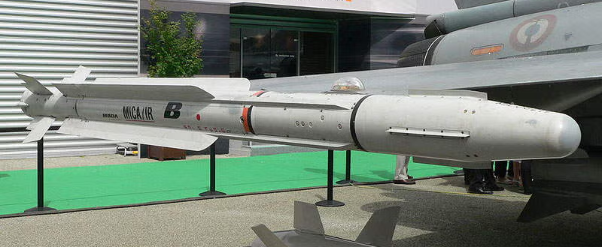
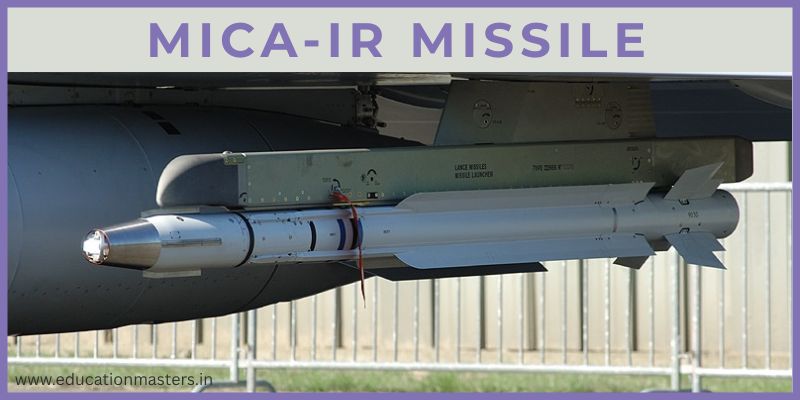
The MICA-IR missile is one of India’s most advanced infrared-guided Air to air missiles, designed to deliver unmatched accuracy and reliability in modern aerial combat. Integrated on frontline Indian Air Force platforms such as the Rafale and upgraded Mirage-2000, this next-generation missile from MBDA empowers India with superior air-defence and interception capability. Its state-of-the-art Imaging Infrared (IIR) seeker provides precise target tracking, high-resolution detection, and exceptional resistance to heat-based countermeasures, stealth features, and electronic warfare.
Engineered for both Within Visual Range (WVR) and Beyond Visual Range (BVR) operations, the MICA-IR combines fire-and-forget technology, powerful thrust, and extreme agility, allowing pilots to neutralize fast, maneuvering enemy aircraft in all weather and high-threat scenarios. Its 360-degree engagement envelope, rapid reaction time, and high probability of kill make it a critical system for air superiority. With proven performance, multi-mission flexibility, and strong combat survivability, the MICA-IR missile continues to play a vital role in strengthening India’s strategic air-combat readiness.
OVERVIEW OF MICA-IR MISSILE
|
Category
|
Details
|
|
Full Name
|
Missile d’Interception et de Combat Aérien - InfraRed (MICA-IR)
|
|
Type
|
Infrared-guided Air to air missile
|
|
Role
|
WVR (Within Visual Range) & BVR (Beyond Visual Range) combat
|
|
Developer
|
MBDA (Europe)
|
|
Used By India On
|
Mirage-2000, Rafale
|
|
Guidance System
|
Advanced Imaging Infrared (IIR) seeker
|
|
Range
|
Approx. 60–80 km (varies with launch conditions)
|
|
Speed
|
Over Mach 3
|
|
Seeker Strengths
|
High-resolution IR imaging, flare-resistant, countermeasure-resistant
|
|
Navigation
|
Inertial + Two-way datalink (mid-course updates)
|
|
Warhead Type
|
High-explosive fragmentation
|
|
Engagement Envelope
|
360-degree, fire-and-forget capability
|
|
Target Types
|
Fighter jets, UAVs, cruise missiles, maneuvering aircraft
|
|
Combat Strengths
|
High agility, all-weather use, strong EW resistance, fast reaction time
|
|
Launch Platforms
|
Air-launched (from fighter aircraft)
|
Key features of MICA-IR Missile
The MICA-IR missile features an advanced Imaging Infrared (IIR) seeker that delivers precise, all-aspect target detection. Designed for both WVR and BVR air combat, it offers exceptional agility through thrust vector control, fire-and-forget capability, and Lock-On After Launch (LOAL) for off-boresight engagements.
1. Imaging Infrared (IIR) Seeker
-
Uses a high-resolution imaging IR seeker (dual-band IR).
-
Capable of all-aspect target detection — front, side, rear.
-
Very strong counter-countermeasure capability against flares and heat decoys.
2. Beyond Visual Range + Within Visual Range
3. TVC
4. Fire-and-Forget
-
Once fired, it locks onto the target and guides itself using the IR seeker.
-
The pilot can break away immediately after launch.
5. Lock-On After Launch (LOAL)
6. Dual Role
7. High Resistance to Jamming
8. Helmet-Mounted Sight Cueing
Advantages of MICA-IR Missile
The MICA-IR missile offers major advantages, including complete immunity to radar jamming, superior counter-countermeasure performance, and highly accurate target tracking through its advanced IIR seeker. Its exceptional agility and thrust vector control make it deadly in dogfights, while its fire-and-forget and LOAL capabilities allow pilots to engage hidden or off-boresight targets with confidence.
1. Immune to Radar Jamming
-
Since it uses an imaging infrared seeker, radar jammers or ECM pods cannot affect it.
-
Gives a huge advantage in modern electronic warfare.
2. Excellent Counter-Countermeasures (CCM)
3. High Agility + Thrust Vector Control
4. Fire-and-Forget
5. Lock-On After Launch (LOAL)
6. Capability Of Dual-Role
One missile does the job of two.
7. High Accuracy With IIR Imaging
8. Stealth-Friendly (Passive Guidance)
-
Because the missile doesn’t use radar for tracking,
the enemy doesn’t get a radar-warning signal.
-
Surprise kills with no warning.
Limitation of MICA-IR Missile
The MICA-IR missile has certain limitations. Its range is shorter than the radar-guided MICA-RF, and its performance depends on the target’s infrared heat signature, making cold or high-altitude targets harder to lock onto. The missile’s IR seeker can also be affected by fog, clouds, and strong sunlight, reducing effectiveness in harsh atmospheric conditions. It offers a narrower off-boresight angle compared to newer 5th-generation missiles like the AIM-9X or Python-5, and its smaller warhead limits lethality at long distances.
1. Shorter Range Compared to MICA-RF
-
The IR variant has a lower maximum range (≈ 60–80 km class) compared to the radar-guided MICA-RF.
-
At long distances, IR lock reliability decreases.
2. Requires Heat Signature
3. Weather & Atmospheric Limitation
4. Not Ideal for First-Look/First-Shoot BVR
5. Limited Off-Boresight Compared to Newer Gen Missiles
-
Although good, its off-boresight angle is less than modern 5th-gen missiles like:
-
Python-5
-
AIM-9X Block II
-
ASRAAM
-
Those missiles have even wider high-agility engagement zones.
6. Smaller Warhead Compared to Some BVR Missiles
This limits lethality against larger aircraft at long distances.
7. More Expensive Than Many Missiles
-
MICA missiles are high-cost, increasing the operating expense per launch.
-
This limits large-scale use during training.
8. IR Seeker Can Be Distracted in Extreme Situations
-
Though resistant to flares, extremely hot backgrounds (e.g., sun, burning terrain) can sometimes reduce seeker clarity.
CONCLUSION
The MICA-IR missile stands as one of India’s most advanced and strategically important air-to-air weapons, combining high-precision infrared guidance, all-aspect target detection, and powerful maneuverability into a single combat-proven system. With its dual WVR–BVR capability, fire-and-forget guidance, and exceptional resistance to stealth tactics, flares, and electronic warfare, the MICA-IR gives the Indian Air Force a significant edge in air-superiority missions, interception roles, and close-range dogfights.
Integrated on frontline platforms like the Rafale and upgraded Mirage-2000, the missile strengthens India’s ability to counter fast, agile, and technologically advanced aerial threats in all-weather and high-threat environments. While it has limitations such as a shorter range than radar-guided variants and reliance on heat signatures, its reliability, agility, and passive stealth-friendly guidance make it one of the most versatile and lethal infrared missiles in modern air combat.Overall, the MICA-IR missile enhances India’s operational readiness, boosts deterrence capability, and plays a crucial role in maintaining air dominance across contested skies—solidifying its position as a key component of India’s future-ready aerial warfare systems. If you want to know more about missiles you can visit our site Education Masters.
सरकारी नौकरियों, जीके अपडेट्स और करेंट अफेयर्स की ताज़ा जानकारी सबसे पहले पाने के लिए:



.png)
.jpg)
.jpg)