


Lalita Bhauryal
I am Lalita, a content creator at Education Masters. I create simple, well-researched, and engaging educational content to help students understand concepts easily and succeed in their academic journey.

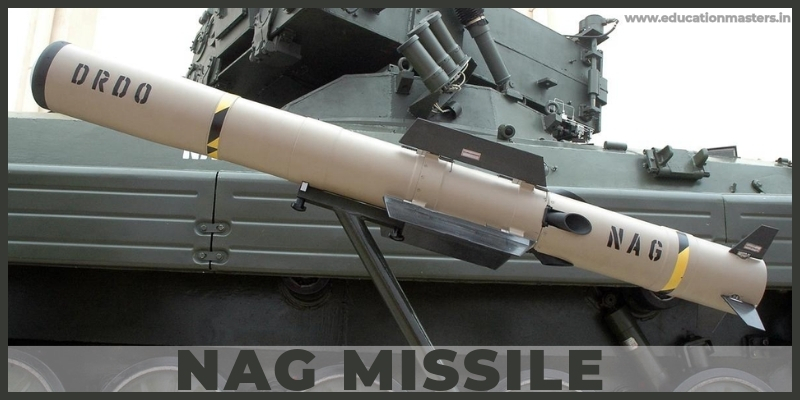
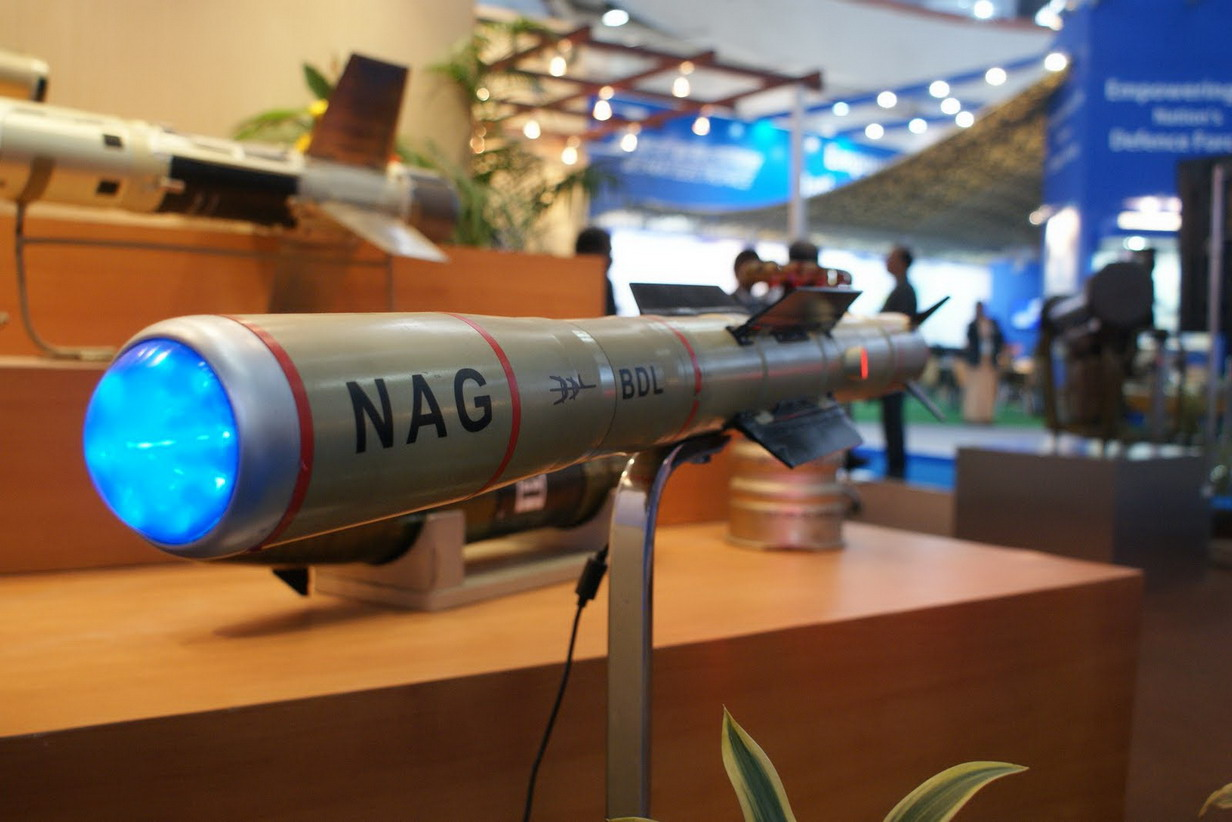
The NAG missile is an indigenously developed third-generation, fire-and-forget Anti-Tank Guided Missile (ATGM) designed by Defence Research and Development Organisation of India (DRDO) under the Integrated Guided Missile Development Program (IGMDP). Engineered to counter modern armored threats, NAG is capable of accurately engaging and destroying main battle tanks, armored vehicles, and fortified enemy positions, including those protected by advanced composite and explosive reactive armor. Equipped with an imaging infrared (IIR) seeker and top-attack capability, the missile delivers high precision and lethality while minimizing operator exposure. The development of NAG marks a significant milestone in India’s quest for self-reliance in advanced missile technology and has laid the foundation for a family of indigenous anti-armor missile systems for land and aerial platforms.
|
Aspect |
Details |
|
Missile Name |
NAG |
|
Full Form |
ATGM–Anti-Tank Guided Missile |
|
Developer |
DRDO (India) |
|
Program |
(IGMDP) Integrated Guided Missile Development Programme |
|
Generation |
Third-generation |
|
Guidance Type |
Fire-and-forget type |
|
Seeker |
Imaging Infrared seeker (IIR) |
|
Attack Mode |
Top-attack |
|
Primary Role |
Destructing enemy tanks and armored vehicles |
|
Targets |
Main battle tanks, bunkers, APCs, IFVs |
|
Warhead Type |
High-Explosive Anti-Tank (Tandem HEAT) |
|
Armor Penetration |
Defeats composite and reactive armor |
|
Launch Platform |
Ground-based launcher (variants for helicopter launch exist) |
|
Range |
Short to medium range (varies by variant) |
|
Accuracy |
Quite high |
|
Operational Use |
Anti-armor warfare in conventional conflicts |
|
Key Advantage |
High lethality with minimal operator exposure |
|
Strategic Importance |
Strengthens India’s indigenous anti-armor capability |
Development of the NAG missile began in the late 1980s as part of India’s efforts to equip its armed forces with a modern anti-armor weapon comparable to global systems. The missile faced technological challenges, particularly in developing an indigenous imaging infrared (IIR) seeker capable of operating on the battlefield with extreme weather conditions. After extensive testing and improvements, NAG matured into a reliable third-generation ATGM, forming the foundation for advanced variants like HELINA and Dhruvastra.
NAG uses an advanced imaging infrared seeker combined with onboard guidance electronics to lock onto targets before launch. After firing, the missile follows an autonomous flight path toward the target. It is powered by a solid-fuel rocket motor, providing stable flight and sufficient range for battlefield engagements.
Third-Generation Fire-and-Forget Capability:
NAG is a true third-generation ATGM that autonomously locks onto and tracks the target after launch, eliminating the need for operator guidance and significantly improving survivability on the battlefield.
Imaging Infrared (IIR) Seeker is Advanced:
Equipped with a state-of-the-art IIR seeker, NAG can accurately identify and engage targets during day and night as well as under adverse weather conditions such as fog, smoke, and dust.
Top-Attack Engagement Mode:
The missile employs a top-attack profile, striking the comparatively weaker upper armor of tanks, thereby maximizing kill probability against heavily armored modern main battle tanks.
Penetration Capability of High Armor:
NAG carries a powerful tandem HEAT warhead specifically designed to defeat Explosive Reactive Armor (ERA) and penetrate advanced composite armor systems.
Multi-Terrain and All-Weather Operation:
Designed for reliable performance across diverse environments, NAG is effective in deserts, plains, semi-urban areas, and varied battlefield conditions, ensuring operational flexibility.
Operational Range:
The ground-launched variant of the NAG missile has an effective operational range of approximately 4 km, making it suitable for frontline anti-armor engagements.
Engagement Capability:
Designed for short- to medium-range anti-armor combat, NAG is optimized to counter enemy tanks and armored vehicles in tactical battlefield scenarios.
High Accuracy:
Equipped with an advanced imaging infrared (IIR) seeker and fire-and-forget guidance, the missile offers very high accuracy by autonomously tracking and striking the designated target.
Speed:
NAG operates at subsonic speed, which, combined with its precision guidance and top-attack profile, ensures reliable target engagement and effective armor penetration.
NAMICA (Nag Missile Carrier): A tracked, armored vehicle based on the BMP-2 chassis.
Ground-based Launchers: For infantry and mechanized units.
Basis for Air-Launched Variants: Technology adapted for HELINA and Dhruvastra.

Destructing Enemy Tanks and Armored Vehicles:
NAG is primarily deployed to accurately engage and destroy modern main battle tanks and armored vehicles, including those protected with composite and reactive armor.
Protect Against Armored Breakthroughs:
The missile plays a crucial defensive role by halting or neutralizing enemy armored advances, protecting critical positions, supply routes, and forward defensive lines.
Mechanized Formations and Infantry support:
NAG provides powerful anti-armor support to infantry and mechanized units during both offensive and defensive operations, enhancing their capacity against armored threats.
Area Denial and Battlefield Ambush:
NAG’s fire-and-forget capability and great accuracy make it very useful in ambush roles, enabling forces to deny or control key terrain, chokepoints, and engagement zones.
Offensive and Defensive Anti-Armor Operations:
The missile is suitable for a wide range of combat missions, including planned offensive strikes and reactive defensive engagements, making it a versatile weapon in modern ground warfare.
Lethality and High Accuracy:
Equipped with an advanced IIR seeker and tandem HEAT warhead, NAG delivers precise and highly lethal strikes against armored targets.
Fire-and-Forget Capability:
Autonomous guidance after launch significantly reduces operator exposure and enhances battlefield survivability.
Works Well Against Modern Armored Threats:
Capable of defeating composite and explosive reactive armor (ERA), NAG remains effective against contemporary main battle tanks.
Indigenous Technology:
Fully developed in India, NAG strengthens strategic autonomy and reduces dependence on foreign weapon systems.
Adaptable to Different Warfare Scenarios:
Suitable for both conventional and asymmetric warfare, including desert, plain, and semi-urban combat environments.
Limited Range Compared to Aerial Variants:
The ground-launched NAG has a shorter range than helicopter-launched variants like HELINA, limiting stand-off engagement distance.
Vulnerability to Advanced Active Protection Systems (APS):
Tanks equipped with modern APS can potentially intercept incoming missiles, reducing effectiveness.
Higher Cost:
Advanced seekers and indigenous technology make NAG more expensive than older-generation ATGMs.
Target Identification Requirement:
Effective use requires clear target identification before launch, which can be challenging in cluttered or low-visibility environments.
HELINA: Helicopter-Launched Nag for attack helicopters
Dhruvastra: Air-launched variant for advanced helicopter platforms
MPATGM (Technology Spin-Off): Man-portable ATGM for infantry use
India’s Anti-Armor Capability is Strengthed:
The NAG missile significantly enhances India’s ability to counter modern main battle tanks and armored vehicles, ensuring effective response to armored threats in both offensive and defensive operations.
Boosts Indigenous Defence Self-Reliance:
Developed entirely under DRDO’s indigenous missile programs, NAG represents a major step toward Atmanirbhar Bharat by reducing dependence on anti-tank missile systems of foreign.
Increases Battlefield Survivability:
Its third-generation fire-and-forget capability allows operators to engage targets and immediately relocate, reducing exposure to enemy fire and enhancing survivability on the battlefield.
Works Effectively Against Modern Armor Technologies:
With top-attack mode and tandem HEAT warhead, NAG can defeat tanks protected by Explosive Reactive Armor (ERA), ensuring relevance against evolving armored platforms.
Multi-Domain Warfare Supporter:
NAG forms the foundation for multiple variants such as HELINA and Dhruvastra, extending India’s anti-armor strike capability across land and air domains.
Improves Deterrence at Tactical Level:
The presence of a reliable indigenous ATGM strengthens tactical deterrence by raising the cost of armored incursions for adversaries.
Future Missile Development Foundation:
Technologies developed for NAG—such as imaging infrared seekers and guidance systems—continue to influence next-generation missile programs and upgrades.
The NAG missile stands as a cornerstone of India’s modern anti-tank missile ecosystem, representing a significant leap in indigenous defense capability. Equipped with advanced fire-and-forget guidance, top-attack engagement mode, and high armor penetration power, NAG provides the Indian Armed Forces with a highly reliable and lethal solution against modern armored threats. Its ability to defeat tanks protected by composite and reactive armor enhances battlefield effectiveness while reducing risk to operators. The successful development and induction of the NAG missile marks a major achievement in India’s defense research and self-reliance, and its technologies continue to influence and shape future generations of Indian missile systems. For more information about missiles visit Education Masters.
सरकारी नौकरियों, जीके अपडेट्स और करेंट अफेयर्स की ताज़ा जानकारी सबसे पहले पाने के लिए: