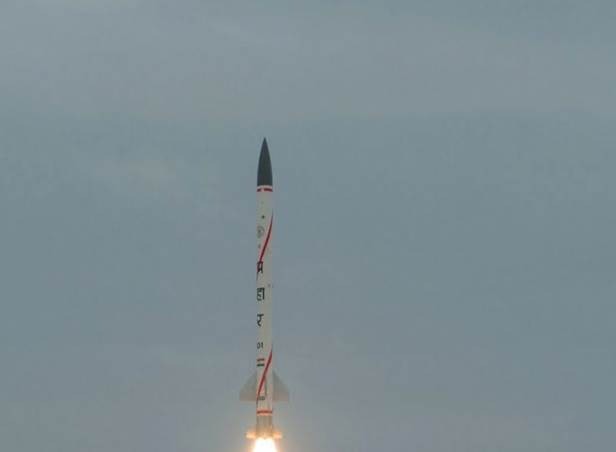
Prahaar missile is a short-range, road-mobile, surface-to-surface tactical missile developed by India’s Defence Research and Development Organisation (DRDO). Designed to deliver high-precision, rapid-response strike capability, Prahaar missile enables the Indian Armed Forces to engage critical battlefield targets with speed and accuracy. Its quick-launch readiness, combined with advanced guidance systems, makes it highly effective for modern, high-tempo combat scenarios.
The missile fills the operational gap between multi-barrel rocket systems (like Pinaka) and longer-range ballistic missiles, offering an ideal balance of mobility, firepower, and responsiveness. The Prahaar missile is capable of striking a variety of tactical targets such as enemy command posts, logistics hubs, air defence sites, and troop concentrations. Mounted on a road-mobile launcher with multiple canisters, it allows salvo firing, ensuring overwhelming impact during short, intense engagements.With its robust design, enhanced accuracy, and ability to be rapidly deployed, Prahaar missile significantly strengthens India’s theatre-level deterrence and tactical strike capabilities, making it a vital asset in short-range battlefield operations.
Prahaar Missile – Overview
|
Parameter
|
Details
|
|
Name
|
Prahaar Missile
|
|
Developed By
|
Defence Research and Development Organisation (DRDO), India
|
|
Category
|
Short-Range, Surface-to-Surface Tactical Missile
|
|
Role / Purpose
|
Quick-reaction, high-precision strike against tactical battlefield targets
|
|
Range
|
150 km
|
|
Launch Platform
|
Road-mobile Transporter Erector Launcher (TEL) with multiple canister zed missiles
|
|
Warhead Type
|
High-explosive, fragmentation, and other tactical warheads
|
|
Guidance System
|
Inertial Navigation System (INS) with GPS/modern satellite guidance for accuracy
|
|
Accuracy
|
High accuracy suitable for tactical operations
|
|
Key Features
|
Quick launch readiness, salvo firing capability, high mobility, precision strike
|
|
Targets
|
Command posts, air defence sites, logistical nodes, troop concentrations
|
|
Operational Role
|
Fills the gap between MBRL systems (e.g., Pinaka) and medium-range ballistic missiles
|
|
Status
|
Developed and tested; intended for deployment with Indian Armed Forces
|
Design & Capabilities of Prahaar missile
-
Canisterised Missile:
Prahaar missile is stored and transported in sealed canisters, enabling rapid deployment, better safety, and long-term storage without maintenance.
-
Quick Reaction System:
The system can be prepared and launched within a short time, giving commanders swift tactical strike options during fast-moving battlefield conditions.
-
High Mobility:
The launcher vehicle is road-mobile, allowing it to relocate quickly, avoid detection, and operate in diverse terrains.
-
Precision Strike:
Equipped with modern guidance and control systems, Prahaar missile can accurately engage a variety of targets such as:
-
enemy bunkers
-
command posts
-
troop concentrations
-
logistics nodes
-
radar sites
-
Multi-Missile Launcher:
A single launcher can carry six missiles, allowing for salvo firing to overwhelm enemy defences and strike multiple targets simultaneously.
Operational Role of Prahaar missile
Prahaar missile is intended to serve as India’s tactical battlefield support missile, providing:
- rapid precision engagement at short ranges
- an alternative to artillery in high-value target scenarios
- coverage of areas where long-range missile use is not practical
- deterrence against close-border threats
It bridges the gap between longer-range systems like Prithvi and shorter-range artillery rockets like Pinaka.
Development & Testing of Prahaar missile
- First successfully tested: 2011
- Subsequent improvements have been made to accuracy, guidance, and mobility.
- Developed as a modern, agile, accurate, and cost-effective tactical missile for the Indian Army.
- Developed by DRDO as part of India’s tactical missile modernization
- Continuous upgrades focusing on accuracy, responsiveness, and mobility
Advantages of Prahaar missile
1. Quick Reaction Capability
Prahaar missile can be launched on very short notice, making it ideal for fast-moving battlefield situations.
2. High Mobility
Mounted on a road-mobile launcher, it can relocate quickly, reducing detection and improving survivability.
3. Precision Strike
With advanced guidance systems, Prahaar missile delivers high accuracy against tactical targets such as command posts, radar stations, and troop concentrations.
4. Canisterised System
The canisterisation enhances safety, storage life, and rapid launch readiness. It also allows all-weather operation.
5. Multiple Launch Capability
Each launcher carries six missiles, enabling salvo firing against multiple or hardened targets.
6. Solid-Fuel Technology
Solid propulsion ensures quicker preparation time, low maintenance, and faster response.
7. Fills Tactical Capability Gap
It bridges the gap between short-range artillery rockets (like Pinaka) and longer-range ballistic missiles (like Prithvi).
8. Cost-Effective
Compared to medium- and long-range ballistic missiles, Prahaar missile is easier to maintain and cost-effective for battlefield roles.
Launch Platform
-
Road-mobile launcher
-
Capable of carrying six ready-to-launch missiles
-
Supports salvo launches, increasing firepower and target coverage
Limitations of Prahaar missile
1. Limited Range
With a range of around 150 km, Prahaar missile is suitable only for close-to-border engagements and short-range missions.
2. Conventional Warheads Only
The Prahaar missile is intended for non-nuclear, conventional battlefield use, limiting its strategic deterrence role.
3. Limited Payload Capacity
Being a short-range tactical missile, the payload capacity is smaller compared to longer-range ballistic systems.
4. Vulnerability to Advanced Air Defence
Modern anti-missile systems may intercept short-range ballistic missiles if detected early.
5. Not Suitable for Strategic Deep-Strikes
Prahaar missile cannot replace MRBMs or IRBMs when targeting infrastructure deeper within enemy territory.
Operators of Prahaar Missile
1. Indian Army (Primary Operator)
The Indian Army is the primary intended operator of the Prahaar tactical missile system.
The Prahaar missile was developed specifically to meet the Army’s requirement for a quick-reaction, high-precision, short-range ballistic missile that can support ground forces during fast-paced battlefield operations.
Why the Army Uses Prahaar
-
Fills the capability gap between Pinaka MBRL and Prithvi series.
-
Provides rapid tactical strike capability (up to 150 km).
-
Enhances battlefield mobility, as the missile system is road-mobile.
-
Allows precision engagement of high-value tactical targets.
Current Status
Prahaar missile has undergone multiple test flights and is expected to be fielded in the Army’s artillery missile units once deployment and induction processes are completed.
2. Indian Air Force (Potential / Not Confirmed)
There is no confirmed operational induction of the Prahaar missile in the Indian Air Force.
However, the Air Force may coordinate with the Army in joint operations when tactical missile strikes are required.
Prahaar missile remains primarily an Army asset due to its battlefield role and ground-launch platform.
3. Indian Navy (Not an Operator)
4. Future Prospects & Upgraded Version (Pranash)
DRDO is developing Pranash, an extended-range (200–300 km) version of Prahaar.
Potential Operators of Pranash
- Indian Army (primary)
- Export customers (DRDO indicated Pranash may be offered internationally)
Conclusion
The Prahaar missile represents a significant advancement in India’s tactical strike capabilities, offering a fast-response, high-precision solution for short-range battlefield engagements. Designed for mobility, rapid deployment, and accuracy, Prahaar missile fills the critical gap between long-range ballistic missiles and conventional artillery systems. Its solid-fuel propulsion, canisterised configuration, and road-mobile launcher enable high operational flexibility and quick launch readiness in intense combat environments. With its ability to deliver precision strikes against enemy troop concentrations, logistics hubs, and strategic assets, Prahaar strengthens India’s deterrence posture and enhances the Army’s tactical firepower. As part of India’s growing missile ecosystem, it reflects DRDO’s efforts to develop modern, indigenous, and highly responsive surface-to-surface weapon systems. For more information about missiles visit Education masters.
सरकारी नौकरियों, जीके अपडेट्स और करेंट अफेयर्स की ताज़ा जानकारी सबसे पहले पाने के लिए:

.jpg)



.png)
.jpg)
.jpg)