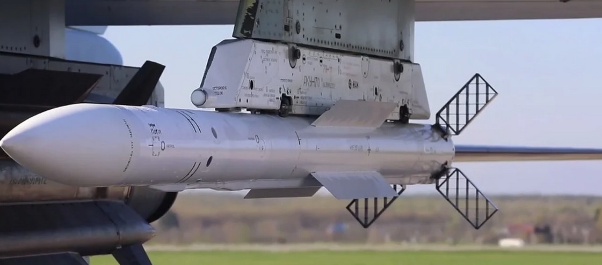
The R-77 is a medium range Air to air missile (MR AAM) that plays a vital role in the Indian Air Force’s beyond visual range (BVR) air combat capability. Designed in Russia, the R-77 was developed to counter modern fighter aircraft through active radar homing guidance, allowing pilots to engage targets using a fire-and-forget approach. This capability enables Indian Air Force fighters to launch the missile and immediately maneuver defensively or engage additional threats, significantly improving survivability in aerial combat.The missile is optimized to intercept high-speed, highly maneuverable fighter aircraft in contested airspace and is known for its distinctive lattice-fin control surfaces, which enhance agility during the terminal phase. Within the Indian Air Force, the R-77 is integrated on frontline platforms such as the Su-30MKI and MiG-29, forming a core component of India’s radar-guided medium-range air-to-air missile inventory.
Although India has inducted indigenous alternatives such as Astra Mk-1, the R-77 continues to serve as an important operational asset, providing proven BVR interception capability while supporting a diversified missile arsenal. Its continued use reflects the Indian Air Force’s emphasis on layered air-to-air combat capability, operational flexibility, and sustained air superiority.
Overview of R-77 Missile
|
Category
|
Details
|
|
Missile Name
|
R-77 (RVV-AE)
|
|
Type
|
MRAAM (Medium-Range Air to Air Missile)
|
|
Role
|
Beyond Visual Range (BVR) air combat
|
|
System Guidance
|
Active Radar Homing + Inertial Navigation
|
|
Fire and Forget
|
Yes
|
|
Primary Targets
|
Fighter aircraft, maneuvering aerial targets
|
|
Origin
|
Russia
|
|
IAF Platforms
|
Su-30MKI, MiG-29
|
|
Control Design
|
Lattice (grid) fins for high maneuverability
|
|
Combat Advantage
|
Autonomous terminal guidance and multi-target engagement capability
|
Development Background of The R-77 Missile
The R-77 missile was developed by Russia’s Vympel Design Bureau during the late Cold War to provide a modern active radar-guided BVR air-to-air missile capable of countering advanced Western fighters. It was intended to replace older semi-active radar missiles and give Soviet and later Russian aircraft a true fire-and-forget capability.
The missile introduced innovative features such as active radar homing, mid-course data-link guidance. Over time, the R-77 program evolved into improved variants with extended range, better seekers, and enhanced resistance to electronic countermeasures, keeping it relevant in modern air combat.
Operational Roles Of The R-77 Missile
The R-77 missile is primarily employed for beyond-visual-range air combat, supporting air superiority and medium-range interception missions against enemy fighters, bombers, and UAVs. Equipped with an active radar homing seeker, it offers fire-and-forget capability, effective engagement of maneuvering targets, and reliable all-weather, day-night performance, with built-in ECCM features for operation in electronically contested airspace.
-
Beyond Visual Range (BVR) Air Combat
The R-77 is primarily used to engage enemy aircraft beyond visual range, reducing dependence on close-range dogfights.
-
Air Superiority Missions
Supports fighter aircraft in gaining and maintaining control of contested airspace against hostile fighters.
-
Medium-Range Interception Role
Employed to intercept enemy fighters, bombers, and UAVs before they can threaten friendly airspace.
-
Fire-and-Forget Engagements
Equipped with an active radar homing seeker, allowing pilots to launch and maneuver immediately after firing.
-
Operations Against Maneuvering Targets
Designed to engage agile aircraft, maintaining guidance during evasive maneuvers in BVR combat.
-
All-Weather, Day-Night Operations
Radar guidance allows effective operation in poor visibility, adverse weather, and nighttime conditions.
-
Electronic Warfare Environment Operations
Incorporates ECCM features to operate in jamming and ECM-contested airspace, though effectiveness depends on variant and seeker type.
Advantages of R-77 Missile
Its active radar homing seeker provides true fire-and-forget capability, allowing pilots to maneuver or engage multiple targets after launch. With inertial navigation and mid-course data-link updates, the R-77 can track maneuvering targets more accurately, while its unique lattice fin design ensures high maneuverability in the terminal phase. Widely integrated on Su-30MKI and MiG-29 fighters, the R-77 strengthens India’s medium-range air combat capability with a combat-proven, reliable, and operationally mature missile system.
1. Beyond Visual Range (BVR) Combat Capability
R-77 is designed to engage enemy aircraft well beyond visual range, allowing Indian Air Force pilots to attack targets before entering dogfight distance.
This provides a first-shot, first-kill advantage, reducing pilot risk
2. ARH Seeker
The missile uses an active radar seeker in the terminal phase, enabling true fire-and-forget capability.
This significantly improves survivability in contested airspace.
3. Mid-Course Guidance with Data Link
During flight, R-77 uses Inertial Navigation System (INS) with mid-course updates from the launch aircraft.
Benefits include:
-
Ability to correct target position if it maneuvers
-
Higher probability of intercept against evasive fighters
-
Efficient energy management during long-range engagements
4. Capability In Multi Target Engagement
R-77 enables aircraft like Su-30MKI and MiG-29 to fire multiple missiles at different targets in quick succession, making it effective in multi-aircraft engagements.
5. Lattice Fin Design for High Maneuverability
The distinctive grid (lattice) fins provide:
This improves hit probability against maneuvering targets at medium range.
6. Integrated Across Multiple IAF Platforms
R-77 is widely deployed across the Indian Air Force:
-
Su-30MKI
-
MiG-29
-
MiG-29UPG
This makes it a core BVR missile in India’s current air combat inventory.
7. Combat-Proven and Mature System
R-77 has been in service for decades, making it:
Limitations of R-77 Missile
The R-77 missile has several limitations despite its widespread use in the Indian Air Force. It uses older radar seeker technology in most operational variants, making it more vulnerable to modern electronic countermeasures and jamming. The missile is powered by a single-pulse rocket motor, which leads to energy loss in the terminal phase and a smaller no-escape zone compared to newer BVR missiles like Astra Mk-2 or Meteor. Its radar-only guidance reduces effectiveness against low-RCS stealth aircraft and in dense electronic warfare environments.
While effective, R-77 has notable shortcomings compared to modern Western and indigenous BVR missiles.
1. Inferior Seeker Compared to Modern AESA-Based Missiles
Older R-77 variants use mechanically scanned radar seekers, which are:
This reduces effectiveness against advanced fighters using strong electronic warfare.
2. Limited No-Escape Zone
Compared to newer missiles like Astra Mk-2 or Meteor, R-77 has:
This limits its dominance in high-end BVR combat.
3. Sub-Optimal Performance Against Stealth Aircraft
R-77 relies on radar guidance, which struggles against:
This reduces detection and tracking reliability.
4. Older Motor Technology
The missile uses a single-pulse solid rocket motor, resulting in:
Modern missiles now use dual-pulse or ramjet propulsion for better sustained energy.
5. Import Dependency on Russia
This creates long-term strategic dependency and limits customization.
6. Being Gradually Superseded
R-77 is increasingly being replaced by:
This indicates its technology ceiling has been reached.
CONCLUSION
The R-77 missile continues to hold a significant place in the Indian Air Force’s medium-range air-to-air missile inventory, delivering proven beyond visual range (BVR) combat capability through its active radar homing, fire-and-forget guidance system. Deployed on key frontline fighters such as the Su-30MKI and MiG-29, the R-77 enables Indian pilots to engage hostile aircraft at standoff distances, conduct multi-target interceptions, and maneuver freely after launch, enhancing both survivability and mission effectiveness. Its lattice-fin design, mid-course guidance updates, and mature operational profile make it a dependable weapon in high-intensity aerial combat scenarios.
Although newer indigenous systems like Astra Mk-1, Mk-2, and Mk-3 represent the future of India’s BVR warfare with improved seekers and propulsion, the R-77 remains a combat-tested and reliable force multiplier. It plays a vital role in maintaining a layered air combat strategy, ensuring redundancy, flexibility, and sustained readiness. In the broader context of India’s evolving air power, the R-77 bridges legacy and next-generation missile technologies, reinforcing the Indian Air Force’s ability to maintain air superiority, deter adversaries, and respond effectively to aerial threats. For more information about missiles you can visit our site Education Masters.
सरकारी नौकरियों, जीके अपडेट्स और करेंट अफेयर्स की ताज़ा जानकारी सबसे पहले पाने के लिए:





.png)
.png)
.png)
.jpg)
.jpg)