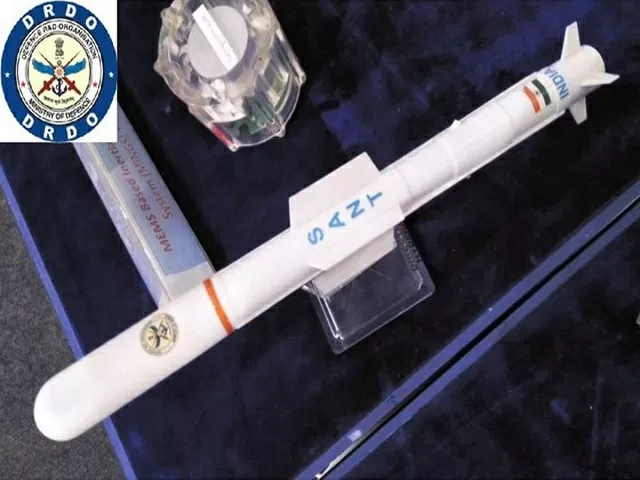
The Stand-off Anti-Tank (SANT) Missile is an advanced air-launched, long-range precision anti-armor weapon developed by India’s Defence Research and Development Organisation (DRDO) as part of the country’s effort to modernize and strengthen its battlefield strike capabilities. Engineered specifically for deployment from attack helicopters, SANT is designed to engage and destroy heavily armored vehicles, modern main battle tanks, and fortified battlefield targets from extended stand-off distances, allowing helicopters to operate well outside the engagement envelope of enemy air-defence systems, small-arms fire, and shoulder-launched missiles.
By leveraging cutting-edge technologies such as fire-and-forget guidance, an imaging infrared (IIR) seeker, and a top-attack flight profile, SANT delivers high precision and lethality against targets protected by advanced armor and Explosive Reactive Armor (ERA). The missile’s long range and accuracy significantly enhance platform survivability while enabling rapid and decisive battlefield effects in high-threat environments. As a key element of India’s evolving indigenous missile ecosystem, SANT complements existing helicopter-launched anti-tank systems such as HELINA and Dhruvastra, strengthens joint force operations, and reinforces India’s strategic objective of defence self-reliance through the development of advanced, homegrown precision-guided weapons.
SANT Missile – Overview
|
Parameter
|
Details
|
|
Name of Missile
|
(SANT) Stand-off Anti-Tank Missile
|
|
Developer
|
DRDO (India)
|
|
Type
|
Anti-Tank Guided Missile (Air-launched)
|
|
Launch Platform
|
Attack helicopters (e.g., Rudra, LCH – future integration)
|
|
Guidance
|
Fire-and-Forget - Imaging Infrared (IIR)
|
|
Attack Mode
|
Top-attack
|
|
Range
|
8–10 km (stand-off capability)
|
|
Warhead
|
Tandem HEAT
|
|
Primary Targets
|
Main battle tanks, bunkers, armored vehicles
|
|
Role
|
Anti-armor strike (Long-range)
|
|
Operational Environment
|
Day/Night, all-weather
|
|
Status
|
Successfully tested
|
Development Background
SANT was developed to overcome the limitations of shorter-range helicopter-launched ATGMs and to counter increasingly sophisticated enemy armor and air-defence systems. DRDO leveraged experience from the Nag missile family (HELINA, Dhruvastra) and enhanced the design to achieve greater range, higher precision, and safer engagement distances for helicopters operating in contested battlefields.
Main Features of SANT Missile
• Stand-Off Strike Ability
SANT allows helicopters to engage armored targets from 8–10 km away, keeping the launch platform outside enemy air-defence and small-arms fire range.
• Fire-and-Forget Guidance System
Equipped with an advanced Imaging Infrared (IIR) seeker, the missile autonomously tracks the target after launch, allowing the helicopter to disengage immediately.
• Top-Attack Mode
The missile strikes targets from above, where tank armor is weakest, ensuring high kill probability even against Explosive Reactive Armor (ERA).
• High Precision
Advanced guidance and seeker technology enable accurate engagement of both stationary and moving armored targets.
• All-Weather Capability (Day/Night)
IIR guidance enables effective operations in darkness, dust, smoke, and adverse weather conditions.
Operational Role of SANT Missile
• Long-Range Destruction of Enemy Main Battle Tanks
SANT enables attack helicopters to engage and destroy enemy main battle tanks from extended stand-off distances, preventing armored forces from advancing into friendly territory.
• Neutralization of Armored Formations Before Close Combat
By striking armored columns early, SANT disrupts and weakens enemy formations before they can engage friendly ground forces at close range.
• Support to Ground Forces During Offensive Operations
The missile provides precise and timely fire support to advancing troops, enhancing the effectiveness of combined arms and joint operations.
• Suppression of Enemy Armored Thrusts
SANT plays a critical role in halting or degrading enemy armored offensives, contributing to battlefield stabilization and defensive countermeasures.
• Precision Strikes in High-Threat and Contested Airspace
Its fire-and-forget guidance and stand-off capability allow helicopters to conduct accurate strikes even in heavily defended environments while minimizing their vulnerability to enemy air defences.
SANT acts as a force multiplier for attack helicopters, enabling them to shape the battlefield from a safe distance.
Advantages of SANT Missile
• Extended Engagement Range for Greater Survivability
SANT’s long stand-off range allows attack helicopters to engage armored targets from a safe distance, significantly enhancing platform survivability against enemy air defences and ground fire.
• High Lethality Against Today’s Armored Vehicles
Equipped with a powerful tandem HEAT warhead and top-attack profile, SANT is highly effective against modern main battle tanks and armored vehicles protected by advanced armor and ERA.
• Reduced Exposure to Enemy Air Defences
By striking targets from outside hostile air-defence envelopes, SANT minimizes helicopter vulnerability in contested and high-threat environments.
• Seamless Integration with Existing ATGM Systems
SANT complements helicopter-launched ATGMs such as HELINA and Dhruvastra, creating a layered and flexible anti-armor strike capability across different engagement ranges.
• Strengthens Indigenous Air-Launched Strike Capability
As an indigenously developed missile, SANT reinforces India’s domestic defence ecosystem and advances self-reliance in advanced air-launched precision strike technologies
Limitations of SANT Missile
• Restricted Deployment Platform
SANT is designed exclusively for helicopter-based launch, making its operational use dependent on the availability, survivability, and readiness of attack helicopters.
• Smaller Payload Size
As a tactical anti-tank missile, SANT carries a smaller warhead compared to strategic missile systems, confining its role to battlefield-level armored targets.
• Dependence on Accurate Target Acquisition
Effective engagement requires precise target detection and lock-on before launch, which can be affected by battlefield clutter, poor visibility, or electronic countermeasures.
• System is Higher in Cost
The missile’s advanced imaging infrared seeker, fire-and-forget capability, and sophisticated guidance technologies contribute to a higher unit cost.
Strategic Importance of SANT Missile
• Helicopter Survivability
By enabling stand-off engagements, SANT allows attack helicopters to strike armored targets from safe distances, minimizing exposure to enemy ground fire and air defences.
• Strengthens Anti-Armor Warfare Ability
SANT significantly improves India’s ability to counter modern main battle tanks and armored formations, especially in high-intensity conflict scenarios.
• Supports High-Intensity and Conventional Conflicts
The missile is optimized for fast-paced, high-threat battlefields, where precision, speed, and survivability are critical for mission success.
• Complements India’s Layered ATGM Architecture
SANT fills the gap between shorter-range helicopter-launched ATGMs and longer-range strike systems, integrating seamlessly with HELINA and Dhruvastra.
• Indigenous Defence Capability is Boosted
As a DRDO-developed system, SANT reinforces India’s defence self-reliance and showcases indigenous expertise in advanced seeker and precision-guided missile technologies.
Conclusion
The Stand-off Anti-Tank (SANT) Missile marks a major leap in India’s helicopter-launched anti-armor warfare capability, combining extended stand-off range, fire-and-forget guidance, and top-attack lethality into a highly survivable strike system. By enabling attack helicopters to engage and destroy modern armored formations from well beyond enemy air-defence envelopes, SANT significantly enhances battlefield dominance while reducing platform vulnerability. As an integral part of India’s evolving indigenous missile ecosystem, SANT strengthens joint force operations, supports high-intensity and conventional warfare scenarios, and underscores India’s growing capability to develop advanced, next-generation precision-guided weapons in line with strategic self-reliance objectives. For more information about missiles visit Education Masters.
सरकारी नौकरियों, जीके अपडेट्स और करेंट अफेयर्स की ताज़ा जानकारी सबसे पहले पाने के लिए:

 Missile .jpg)





.png)
.png)
.png)
.jpg)
.jpg)