Submarine-Launched Ballistic Missiles (SLBMs) are powerful strategic weapons designed to be fired from beneath the ocean’s surface using specially configured ballistic missile submarines. They represent one of the most advanced components of modern military technology, combining long-range strike capability with exceptional stealth. Because submarines can operate undetected across vast ocean regions, SLBMs provide nations with a highly survivable and flexible second-strike nuclear deterrent, ensuring that even in the event of a first-strike attack, a credible and devastating retaliation remains possible.
SLBMs typically employ multi-stage solid-fuel propulsion, advanced guidance systems, and often feature MIRV (Multiple Independently Targetable Re-entry Vehicle) technology, allowing a single missile to strike multiple targets with precision. Their underwater launch capability, global range options, and near-impenetrable concealment make SLBMs a cornerstone of nuclear triad stability, strategic balance, and long-term national security. India has developed its own underwater ballistic missile arsenal as part of its strategic defence posture. The country’s SLBMs family includes the K-15 missile (Sagarika) with a short-to-medium range, the K-4 missile with greater reach and accuracy, and future advanced systems such as K-5 missile and K-6 missile, which aim to significantly enhance sea-based nuclear deterrent of India. These missiles, deployed on Indian Navy’s Arihant-class SSBNs, ensure that India maintains a strong, survivable, and effective ocean-based deterrence capability.
Overview of Submarine-Launched Ballistic Missiles (SLBMs)
|
Category
|
Details
|
|
Full Name
|
Ballistic Missiles based on Submarine-Launch (SLBMs)
|
|
Type
|
Ballistic Surface-to-Surface Missiles launched from submarines
|
|
Launch Platform
|
Submarines
|
|
Propulsion
|
Mostly solid-fuel, multi-stage rocket propulsion
|
|
Range
|
Typically 700 km to 12,000+ km (variant-dependent)
|
|
Guidance System
|
Inertial navigation + satellite navigation assistance
|
|
Payload
|
Nuclear or conventional warheads; often MIRV-capable
|
|
Trajectory
|
Ballistic flight after initial boost phase
|
|
Primary Role
|
Strategic long-range nuclear deterrence
|
|
Key Advantage
|
High survivability due to stealthy underwater deployment
|
|
Examples (India)
|
K-15 missile (Sagarika), K-4 missile, future K-5 missile & K-6 missile
|
How SLBMs Work
SLBMs are stored in vertical launch tubes inside submarines. When launched:
-
The missile is ejected from the submarine using gas pressure (cold launch).
-
It clears the surface and ignites its rocket stages.
-
The missile follows a ballistic path through space before re-entry.
This sequence enables silent, surprise-capable underwater launches.
Guidance & Accuracy of SLBMs
SLBMs use advanced navigation technologies:
-
Inertial Navigation System (INS)
-
Ring Laser Gyros & Micro Navigation Systems
-
Potential support of satellite navigation
Modern SLBMs achieve high accuracy despite being launched from a moving submarine.
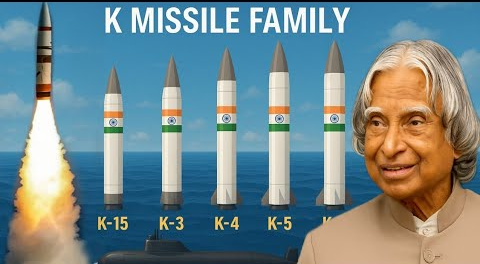
Range Categories of Submarine-Launched Ballistic Missiles (SLBMs)
SLBMs vary widely in range, depending on national strategy:
-
Short-range (700–1,500 km) – e.g., India’s K-15 missile
-
Intermediate-range (3,000–5,000 km) – e.g., India’s K-4 missile
-
Intercontinental-range (6,000–12,000+ km) – future K-5 missile/K-6 missile concepts
Role in Nuclear Deterrence of Submarine-Launched Ballistic Missiles (SLBMs)
SLBMs are considered the most survivable nuclear delivery system because:
-
Submarines can hide in deep oceans
-
They remain mobile and unpredictable
-
They ensure credible second-strike capability
This deterrence stability prevents nuclear coercion or surprise attacks.
Advantages of SLBMs
-
Highest survivability among all missile classes
-
Unpredictable deployment locations
-
Capability to carry multiple warheads
-
Extended endurance and worldwide reach
-
Nuclear triad (main component)
Limitations of SLBMs
-
Highly cost to develop and maintain
-
Requires nuclear submarines, complex infrastructure
-
High training and technological demands
-
Detection risk if submarine acoustics are compromised
Future Trends of Submarine-Launched Ballistic Missiles (SLBMs)
-
Greater MIRV and MaRV adoption
-
Stealthier SSBN designs
-
Extended ranges approaching full global strike
-
AI-supported navigation and evasion systems
Which Branch Operates SLBMs (India)?
Indian Navy
The Indian Navy exclusively operates SLBMs through its Arihant-class SSBNs, such as:
These submarines carry:
Conclusion
Submarine-Launched Ballistic Missiles (SLBMs) play a pivotal role in strengthening a nation’s strategic deterrence by providing a secure, concealed, and survivable second-strike capability. Their ability to be launched from submerged submarines makes them extremely difficult to detect, enhancing national security and ensuring credible nuclear retaliation even under the most challenging conditions.
For India, SLBMs like K-15 missile Sagarika and K-4 missile form a crucial part of the sea-based leg of the nuclear triad, significantly boosting strategic stability and defense readiness. As nations continue advancing SLBMs technology in range, accuracy, and stealth, these missiles remain central to maintaining balanced deterrence and long-term geopolitical security. To know more about missilkes visit Education Masters.
सरकारी नौकरियों, जीके अपडेट्स और करेंट अफेयर्स की ताज़ा जानकारी सबसे पहले पाने के लिए:

.jpg)



.png)
.png)
.png)
.jpg)
.jpg)