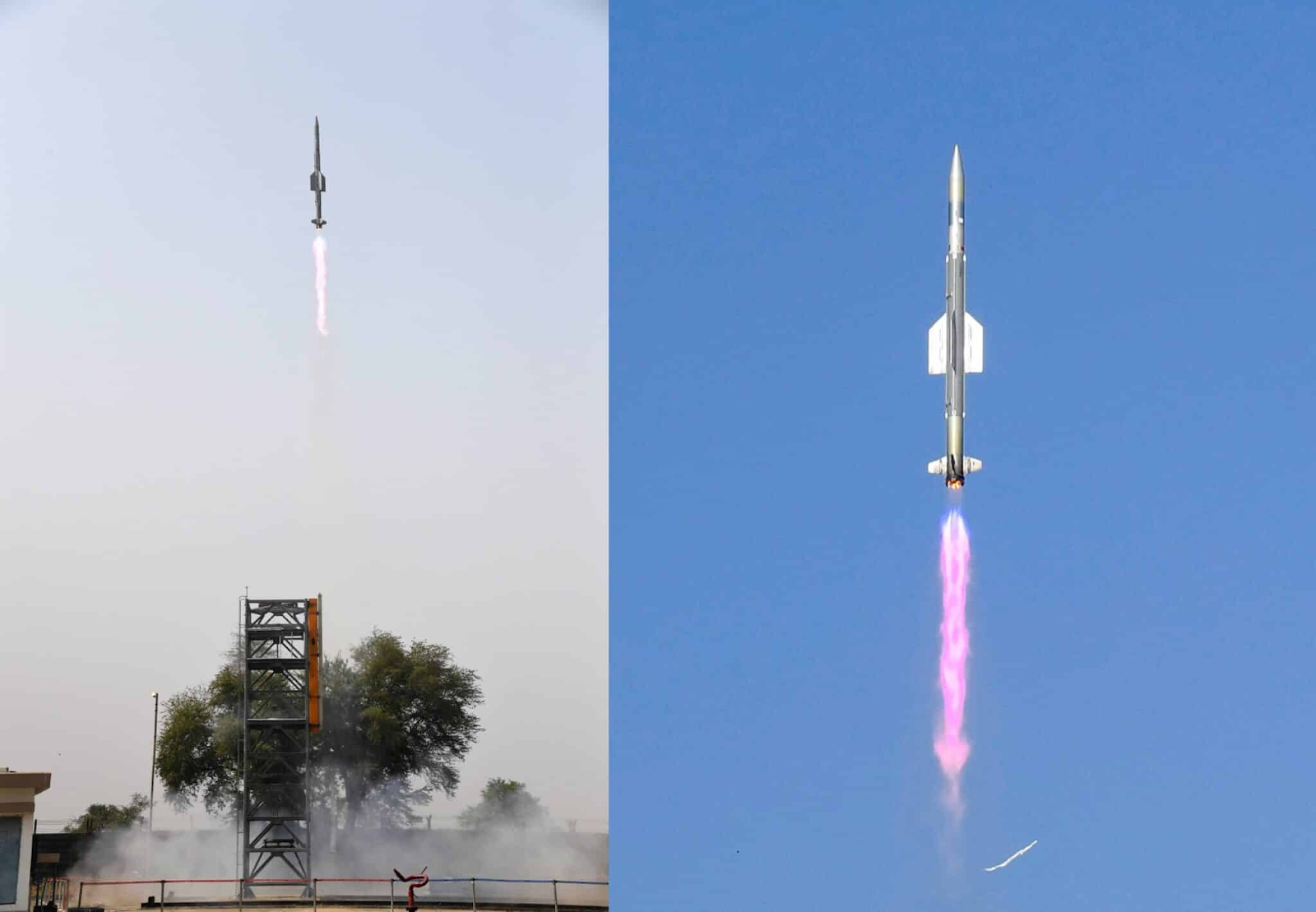
VL-SRSAM (Vertical Launch – Short-Range Surface-to-Air Missile) is an indigenous naval air-defence missile system developed by the Defence Research and Development Organisation (DRDO) specifically for the Indian Navy to meet the challenges of modern maritime warfare. Designed for quick-reaction and close-in air defence, VL-SRSAM provides a critical protective shield to naval platforms against sudden, low-altitude, and high-speed aerial threats. It forms the innermost defensive layer of a warship’s air-defence architecture, ensuring survivability even when outer defence layers are penetrated.
The system is optimized to counter a wide spectrum of threats, including sea-skimming cruise missiles, fighter aircraft, attack helicopters, UAVs and drone swarms, and precision-guided munitions operating in cluttered maritime environments. Its vertical launch configuration offers 360-degree engagement capability, enabling instantaneous response to threats approaching from any direction without the need to reorient launchers. Combined with high agility, rapid reaction time, and seamless integration with shipborne combat management systems, VL-SRSAM delivers high interception probability, all-weather day-and-night performance, and robust protection in the fast-paced and unpredictable conditions of naval combat.
Overview of VL-SRSAM
|
Aspect
|
Details
|
|
System Name
|
VL-SRSAM (Vertical Launch – Short-Range SAM)
|
|
Category
|
Naval Short-Range Surface-to-Air Missile
|
|
Developer
|
DRDO (India)
|
|
User
|
Indian Navy
|
|
Primary Role
|
Close-in / point air defence of warships
|
|
Launch Method
|
Vertical Launch (360° coverage)
|
|
Typical Range
|
Short range (naval point defence)
|
|
Targets
|
Aircraft, helicopters, UAVs/drones, sea-skimming cruise missiles
|
|
Reaction Time
|
Very fast
|
|
Operational Capability
|
All-weather, day & night
|
|
Deployment
|
Ship-borne vertical launchers
|
|
Role in Layered AD
|
Inner layer of naval air defence
|
|
Strategic Value
|
Indigenous, fast-reaction ship protection system
|
Development Background of VL-SRSAM
The VL-SRSAM programme was initiated to replace older naval short-range air-defence systems and to strengthen indigenous shipborne air-defence capability for the Indian Navy. Conceived as part of India’s broader vision for a modern and layered naval air-defence architecture, the system addresses the growing threat from sea-skimming missiles, UAVs, and low-flying aircraft in maritime environments.
Developed under India’s Atmanirbhar Bharat initiative, VL-SRSAM integrates indigenous missile technology, advanced seekers, propulsion systems, and command-and-control interfaces. It is specifically tailored to operate in cluttered maritime conditions, where detection and interception are challenging due to sea clutter, fast-moving targets, and short reaction windows, ensuring reliable close-in defence for naval platforms.
Operational Role of VL-SRSAM
The VL-SRSAM plays a vital operational role as the last and most responsive defensive shield for Indian Navy warships. By providing rapid, all-directional interception of low-altitude and sea-skimming threats, it strengthens the inner layer of naval air defence and ensures robust protection against modern aerial and missile attacks in dynamic maritime combat scenarios.
-
Close-in air defence of naval warships, including destroyers, frigates, corvettes, and other frontline vessels, ensuring survivability in high-threat environments.
-
Interception of sea-skimming cruise missiles during their terminal phase, where reaction time is extremely limited and precision is critical.
-
Counter-UAV and anti-drone operations, including effective response to saturation and swarm attacks in congested maritime airspace.
-
Defence against low-altitude aircraft and helicopters, preventing surprise attacks that exploit terrain masking over the sea.
-
Inner layer of layered naval air defence, working in coordination with medium- and long-range naval SAMs to provide continuous, multi-tier protection.
Importance of VL-SRSAM
-
Strengthens the inner layer of naval air defence, providing a reliable last line of protection for warships.
-
Enhances survivability of Indian Navy vessels, especially against modern sea-skimming and surprise aerial attacks.
-
Complements medium- and long-range naval SAMs, closing critical gaps in layered naval air-defence architecture.
-
Highly effective in cluttered maritime environments, where rapid response and precision are essential.
-
Boosts India’s indigenous naval warfare capability, reinforcing operational readiness and strategic autonomy at sea.
VL-SRSAM Types (Operational Classification)
| Type / Variant |
Description |
Key Features |
Platforms |
| Ship-Integrated VL-SRSAM (VLS-Based) |
Standard vertical-launch configuration integrated into warship VLS cells |
360° engagement, quick reaction, hot vertical launch |
Destroyers & frigates |
| Canisterised VL-SRSAM |
Sealed, modular canister version for easier integration and storage |
Reduced maintenance, rapid reload, improved safety |
Future & upgraded warships |
1) Ship-Integrated VL-SRSAM (VLS-Based)
-
Vertical hot-launch from below-deck VLS modules
-
360-degree coverage for multi-directional threats
-
Designed to defeat low-flying sea-skimming missiles
-
Integrated with ship radar and combat management systems
Typical Roles:
2) Canisterised VL-SRSAM
-
Missile housed in hermetically sealed canisters
-
Faster installation on new ships and upgrades
-
Better logistics, safety, and shelf life
-
Supports quicker fleet-wide induction
Typical Roles:
Common Technical Features (All Types)
-
Range: 40 km (class)
-
Guidance: INS + mid-course update + active RF seeker
-
Launch: Vertical (hot launch)
-
Targets: Fighters, helicopters, UAVs, anti-ship missiles
-
Reaction Time: Very short (quick-reaction system)
Advantages of VL-SRSAM
-
360-degree engagement capability enabled by the vertical launch architecture, allowing instant response to threats approaching from any direction without launcher realignment.
-
Extremely fast reaction time, which is critical in naval combat where sea-skimming missiles and low-flying threats allow only seconds for interception.
-
High interception probability against low-altitude targets, including cruise missiles, UAVs, and helicopters operating close to the sea surface.
-
Indigenous design and development, significantly reducing dependence on foreign systems and strengthening self-reliance under Atmanirbhar Bharat.
-
Seamless integration with ship Combat Management Systems (CMS), enabling automated detection-to-engagement cycles and coordinated defence with other onboard weapons.
Limitations of VL-SRSAM
-
Short engagement range, restricting its role primarily to close-in or point defence rather than wide-area air defence.
-
Naval-specific system, not designed for land-based air-defence roles.
-
Dependence on ship sensors and CMS, meaning performance is closely linked to the effectiveness of onboard detection and tracking systems.
-
Limited effectiveness against high-altitude or long-range threats, which must be handled by medium- and long-range naval SAM systems.
-
Primarily defensive in nature, requiring integration with outer defence layers for comprehensive airspace protection.
Conclusion
The VL-SRSAM (Vertical Launch – Short-Range Surface-to-Air Missile) stands as a vital close-in naval air-defence system that delivers rapid, precise, and 360-degree protection to Indian Navy warships operating in highly contested maritime environments. Its vertical launch configuration, extremely short reaction time, and proven effectiveness against low-altitude, sea-skimming cruise missiles, UAVs, and drone swarms make it an indispensable component of layered naval air-defence architecture, especially as modern naval threats become faster, stealthier, and more complex.
By providing a reliable inner defensive shield, VL-SRSAM ensures continuous protection even when outer air-defence layers are penetrated, significantly improving fleet survivability and combat resilience. Seamless integration with shipborne combat management systems enables fast, automated response cycles, enhancing operational readiness and mission effectiveness. As an indigenous system developed under Atmanirbhar Bharat, VL-SRSAM not only strengthens India’s maritime security posture but also reinforces long-term self-reliance and technological sovereignty in advanced naval weapon systems. For more information about missiles visit Education Masters.
सरकारी नौकरियों, जीके अपडेट्स और करेंट अफेयर्स की ताज़ा जानकारी सबसे पहले पाने के लिए:





.png)
.png)
.png)
.jpg)
.jpg)