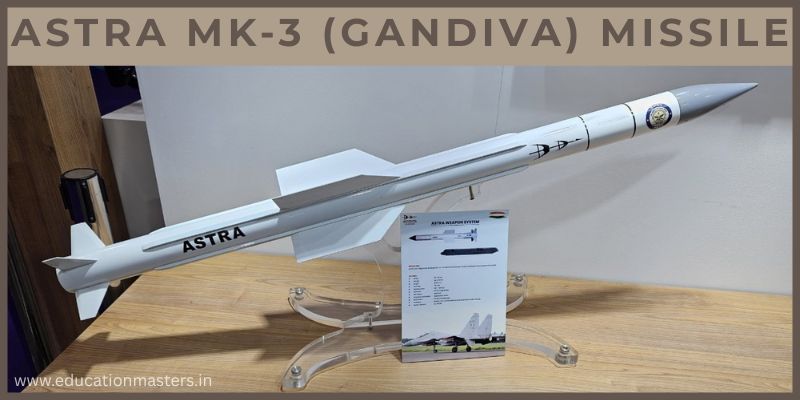
The Astra Mk-3 missile, also known as Gandiva, is India’s upcoming long range beyond visual range (BVR) Air to air missile being developed by the Defence Research and Development Organisation (DRDO). As the most advanced variant of the Astra missile family, Astra Mk-3 is designed to engage hostile aircraft at extended ranges while maintaining high accuracy, survivability, and effectiveness in modern, electronically contested battle environments.
The missile is expected to incorporate advanced propulsion technology, a modern seeker system, mid-course guidance with secure data-link updates, and robust electronic counter-countermeasures, allowing it to counter agile and technologically advanced aerial threats. Planned for integration with frontline fighter platforms such as the Su-30MKI, LCA Tejas, and future Indian combat aircraft, Astra Mk-3 aims to significantly improve long-range interception capability, first-shot advantage, and overall air superiority, while reducing India’s reliance on foreign Air to air missile systems.
Overview of Astra Mk-3 (Gandiva) Missile of India
|
Category
|
Details
|
|
Missile Name
|
Astra Mk-3 (Gandiva)
|
|
Type
|
Long range (BVR) Air to Air Missile (AAM)
|
|
Developer
|
DRDO
|
|
User
|
(IAF)
|
|
Role
|
Long-range aerial interception and air superiority
|
|
Guidance System
|
Advanced seeker with mid-course guidance and data-link updates
|
|
Propulsion
|
Advanced propulsion system for extended-range engagement
|
|
Key Capabilities
|
High accuracy, long engagement range, strong ECCM resistance
|
|
Combat Advantage
|
First-shot capability, high no-escape zone
|
|
Target Types
|
Fighter aircraft, support aircraft, high-value aerial targets
|
|
Launch Platforms
|
Su-30MKI, LCA Tejas, future Indian fighter aircraft
|
|
Strategic Importance
|
Reduces dependence on foreign missiles, boosts indigenous capability
|
|
Development Status
|
Under development
|
Key Features of Astra Mk-3 (Gandiva) Missile
The Astra Mk-3 (Gandiva) missile features long-range beyond-visual-range (BVR) capability, advanced propulsion for sustained high speed, modern seeker technology with mid-course data-link guidance, a high no-escape zone, strong resistance to electronic countermeasures, fire-and-forget operation, and compatibility with frontline Indian Air Force fighter aircraft, strengthening indigenous air combat capability.
1. Long-Range BVR Air to Air Missile –Astra Mk-3 is a next-generation beyond-visual-range (BVR) air-to-air missile designed to engage enemy aircraft at very long distances, giving the Indian Air Force a decisive first-shot advantage.
2. Advanced High-Energy Propulsion System – The missile is expected to use an advanced propulsion system that allows sustained high speed and energy retention throughout flight, improving effectiveness against fast and maneuvering targets.
3. Modern Active Seeker Technology – Equipped with a state-of-the-art seeker system for accurate target acquisition, tracking, and terminal guidance in modern air combat scenarios.
4. Mid-Course Guidance with Secure Data-Link – Features mid-course guidance supported by real-time data-link updates, enabling target corrections after launch and higher hit probability.
Development Background Of The Astra Mk-3 (Gandiva) Missile
The Astra Mk-3, also known as Gandiva, is being developed by DRDO as India’s next-generation long-range BVR air-to-air missile to counter advanced enemy fighters and force multipliers at very long distances. It builds upon the experience gained from Astra Mk-1 and Mk-2, with a focus on dramatically extended range and sustained high-energy flight.
Astra Mk-3 is planned to use an advanced propulsion system (ramjet or solid-fuel ducted rocket), along with an improved active radar seeker, secure data-link, and strong ECCM capability. The missile is intended to provide the Indian Air Force with deep air combat reach, a very large no-escape zone, and first-shot dominance, marking a major leap in India’s indigenous air-to-air missile capability.
Operational Roles Of The Astra Mk-3 (Gandiva) Missile
-
Very Long-Range BVR Air Combat
Astra Mk-3 is designed for very long-range beyond visual range engagements, allowing Indian fighters to engage enemy aircraft far before visual contact.
-
Air Dominance and Deep Standoff Role
Provides strong standoff capability, enabling fighters to dominate contested airspace without entering enemy missile envelopes.
-
Interception of High-Value Aerial Targets
Optimized to engage high-value assets such as enemy fighters, bombers, AEW&C aircraft, and tanker platforms at extended ranges.
-
First-Shot, First-Kill Advantage
Ramjet propulsion allows sustained speed throughout flight, significantly increasing no-escape zone and kill probability at long ranges.
-
Fire-and-Forget Operations
Active radar homing enables pilots to launch and maneuver immediately, improving survivability in high-threat environments.
-
Counter to Advanced Enemy BVR Missiles
Designed to counter next-generation missiles like Meteor and PL-15 by maintaining high energy in the terminal phase.
-
Electronic Warfare-Resilient Combat
Built to operate in ECM-heavy environments with advanced ECCM, maintaining guidance under sophisticated jamming.
-
All-Weather, Day-Night Missions
Radar-based guidance allows effective operation in poor visibility, adverse weather, and night conditions.

Advantages of Astra Mk-3 (Gandiva) Missile
The Astra Mk-3 (Gandiva) missile provides long-range BVR capability, a strong first-shot advantage, high accuracy, and resistance to electronic warfare. Its indigenous development enhances Indian Air Force air superiority while reducing reliance on foreign missile systems.
1. Engagement Extended Range – Astra Mk-3 provides the ability to engage hostile aircraft at very long distances, allowing pilots to neutralize threats before they enter effective combat range.
2. First-Shot Advantage in Air Combat – Its long-range BVR capability enhances first-look, first-shot, and first-kill potential, which is critical in modern aerial warfare.
3. High Kill Probability – Advanced guidance, mid-course updates, and a large no-escape zone significantly increase the chances of a successful interception.
4. Effective Against Modern Fighter Aircraft – Designed to counter fast, agile, and technologically advanced enemy fighters operating in contested airspace.
5. Resistance to Electronic Warfare – Strong electronic counter-countermeasure (ECCM) capability allows effective operation even under heavy jamming and deception.
6. Workload Reduced Of Pilot – Fire-and-forget capability enables pilots to focus on evasive maneuvers or engage multiple targets after launch.
7. Multi-Platform Integration – Compatible with frontline aircraft such as the Su-30MKI and LCA Tejas, ensuring flexible deployment across the Indian Air Force fleet.
8. Improved Air Superiority – Strengthens India’s long-range interception capability, contributing to overall air dominance in both defensive and offensive operations.
9. Indigenous Strategic Capability – Enhances India’s self-reliance in critical defence technology and reduces dependence on foreign long-range air-to-air missiles.
10. Future-Ready Design – Built to meet the requirements of next-generation aerial combat and evolving threat environments.
Limitation of Astra Mk-3 (Gandiva) Missile
The Astra Mk-3 (Gandiva) missile is still under development, so its full operational performance is yet to be proven in service. Like other long-range BVR air-to-air missiles, its effectiveness depends on aircraft sensors, combat networks, and electronic warfare conditions, while integration and deployment timelines may take additional time.
1. Still In Under Development – Astra Mk-3 is not yet operational, so its full performance and combat effectiveness are yet to be proven through trials and induction.
2. Integration Timeline Challenges – Integration with multiple fighter platforms requires extensive testing, which can extend deployment timelines.
3. High Development –Advanced propulsion, guidance, and ECCM systems increase technical complexity, making development and validation more demanding.
4. Dependence on Platform Sensors – Like all BVR missiles, its effectiveness depends on the quality of the launching aircraft’s radar, sensors, and networked support.
5. Electronic Warfare Environment Risks – Despite strong ECCM design, intense electronic warfare and advanced jamming can still affect long-range engagements.
6. Cost Compared to Short-Range Missiles – Long-range BVR missiles are more expensive than short-range air-to-air missiles, limiting large-scale deployment per aircraft.
7. Rules of Engagement Constraints – Long-range engagements may be restricted by identification and rules of engagement requirements in certain combat scenarios.
8. Operational Training Requirements – Effective use requires advanced pilot training and coordinated command-and-control support.
9. Competition from Mature Foreign Systems – Competes with already operational long-range air-to-air missiles that have extensive combat and service experience.
10. Logistics and Production Scaling – Large-scale production and sustained logistics support may take time to stabilize after induction.
CONCLUSION
In conclusion, the Astra Mk-3 (Gandiva) missile marks a significant advancement in India’s indigenous long-range beyond visual range (BVR) Air to air missile capability and reflects the growing maturity of the country’s defence technology ecosystem. Developed by DRDO for the Indian Air Force, Astra Mk-3 is designed to deliver extended engagement range, high accuracy, and strong resistance to electronic countermeasures, enabling effective interception of modern aerial threats in complex combat environments. Its advanced guidance systems and compatibility with frontline fighter aircraft position it as a key asset in next-generation aerial warfare.
Overall, Astra Mk-3 is expected to substantially strengthen India’s air superiority and long-range interception capability, providing a decisive first-shot advantage in future air combat scenarios. By reducing reliance on foreign long-range air-to-air missiles and reinforcing self-reliance in critical defence technologies, Astra Mk-3 plays a vital role in shaping India’s future air combat doctrine and enhancing national security readiness. For more information about missiles you can visit our site Education Masters.
सरकारी नौकरियों, जीके अपडेट्स और करेंट अफेयर्स की ताज़ा जानकारी सबसे पहले पाने के लिए:



.png)
.png)
.png)
.jpg)
.jpg)