
KD
I’m Kiran, a content creator at Education Masters. I write and share informative articles on jobs, education updates, and career opportunities to help students and aspirants stay informed and succeed in their goals.
.jpg)
Ballistic Missiles are advanced, long-range weapons designed to deliver warheads over great distances with extreme speed and destructive power. They follow a steep, curved trajectory called a ballistic path. During the boost phase, powerful rocket engines lift the missile into the upper atmosphere or even into space. Once the engines stop, the missile enters the midcourse phase, where it travels freely under the force of gravity, often outside the Earth’s atmosphere. Finally, in the terminal phase, the warhead re-enters the atmosphere at hypersonic speed and strikes its target with tremendous kinetic energy.
These missiles can carry conventional, nuclear, or specialized warheads and are used for strategic deterrence, battlefield precision strikes, and national defense. Depending on their range and mission, they are launched from land-based platforms, submarines (SLBMs), ships, or aircraft, forming a crucial part of modern military arsenals. Their speed, altitude, and long reach make them difficult to intercept, which is why they play a major role in global security and power balance.

Range: Up to 1,000 km
Short-Range Ballistic Missiles (SRBMs) are missiles with a range of 300–1,000 km, used for quick, high-impact strikes in nearby conflict zones. They launch using rocket boosters and follow a ballistic path. SRBMs are mobile, solid-fuelled, accurate, and ideal for fast battlefield operations.
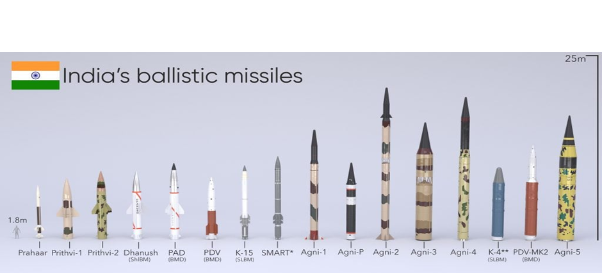
Examples: Prithvi-1, Prithvi-2, Prithvi-3, Prahaar, Agni-I, Shaurya missile.

Range: 1,000 to 3,000 km
MRBMs are a category of ballistic missiles capable of striking targets at medium distances—beyond short-range systems but below intermediate-range missiles.
Examples: Agni-II and Agni-P (Agni Prime Missile)

Range: 3,000 to 5,500 km
IRBMs are ballistic missiles designed to strike targets at long distances—beyond MRBMs but below Intercontinental Ballistic Missiles (ICBMs). They are primarily used for regional strategic deterrence and can carry either conventional or nuclear warheads.
Examples: Agni-III, Agni-IV, K-4 / Kalam‑4
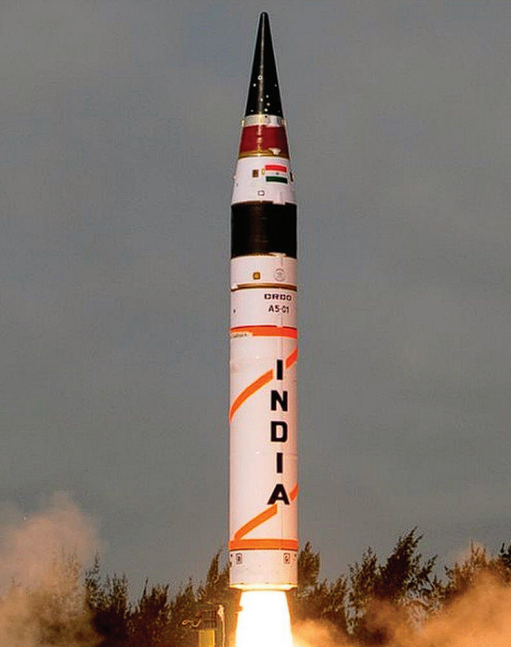
Range: 5,500 km and above
ICBMs are the longest-range ballistic missiles in the world, designed to deliver nuclear or conventional warheads across intercontinental distances
Example: Agni-V, Agni-VI
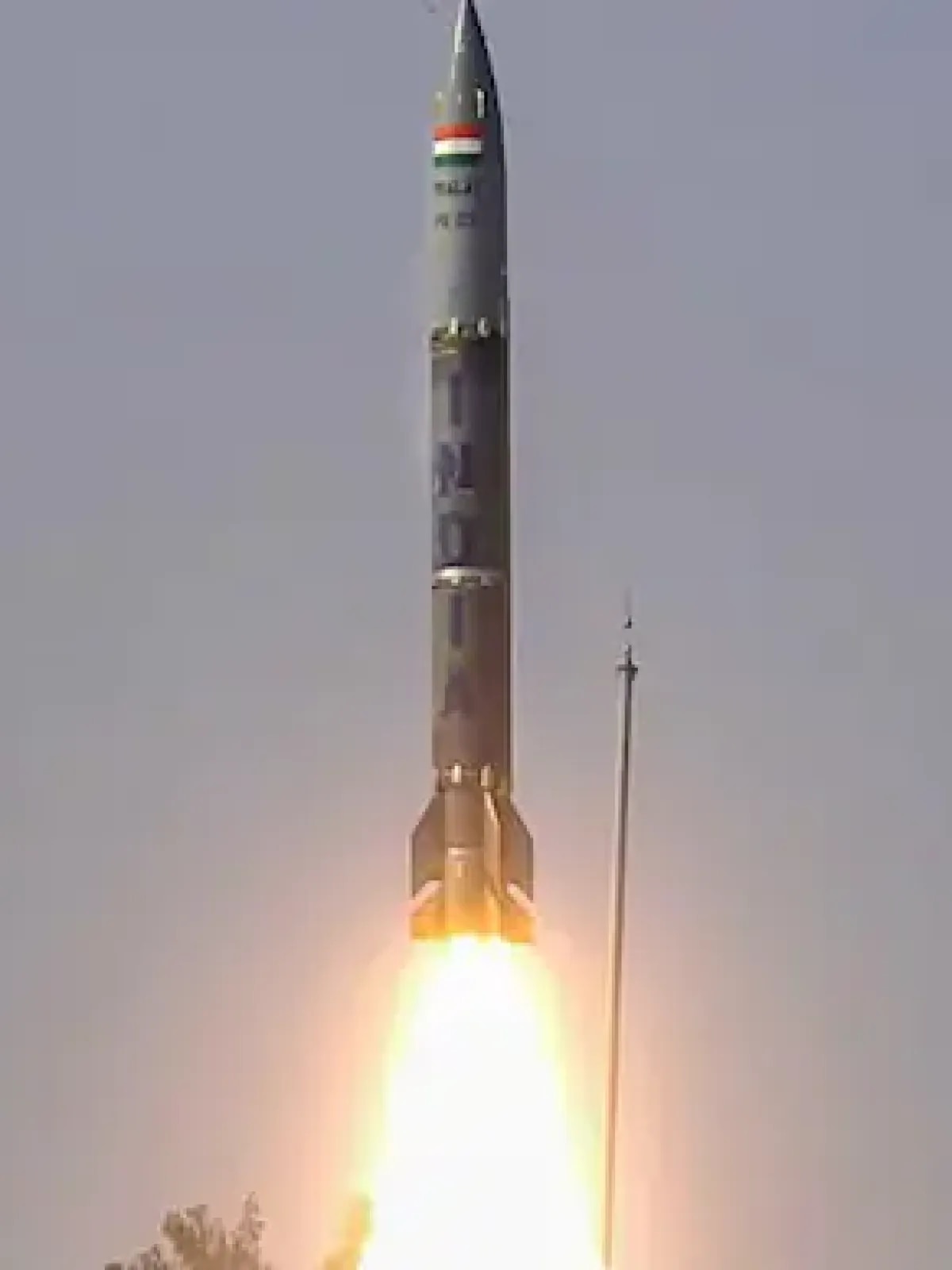
Advanced SSMs are modern missiles that can change direction during flight, travel at high or hypersonic speeds, and evade missile defence systems. They use advanced guidance for high accuracy and quick-strike capability.
Example – Agni-P (Agni Prime), Pralay, Dhanush, Shaurya, Agni-I Prime.
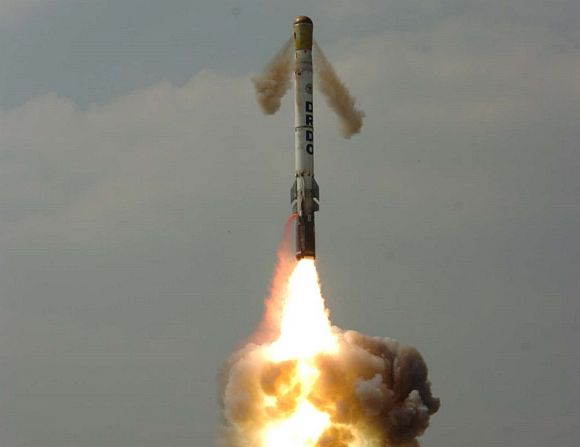
Submarine-Launched Ballistic Missiles (SLBMs) are powerful, long-range ballistic missiles fired from submarines. They form a crucial part of a nation’s second-strike capability, ensuring that even if land-based systems are destroyed, the country can still retaliate.
Examples: K-15 missile, K-4 missile, K-5 missile, K-6 missile
A ballistic missile’s flight has three phases:
Ballistic missiles play a crucial role in modern military strategy by providing a nation with long-range, high-impact strike capabilities. Their ability to travel at extreme speeds, reach distant targets, and deliver powerful warheads makes them a key element of national defense and deterrence systems. Classified into types such as SRBM, MRBM, IRBM, and ICBM based on their range, these missiles are designed for different tactical and strategic purposes. Together, they strengthen a country’s security, maintain power balance, and serve as a strong warning against potential threats. for more updates and knowledge visit Education Masters.
सरकारी नौकरियों, जीके अपडेट्स और करेंट अफेयर्स की ताज़ा जानकारी सबसे पहले पाने के लिए:



.png)
.jpg)
.jpg)