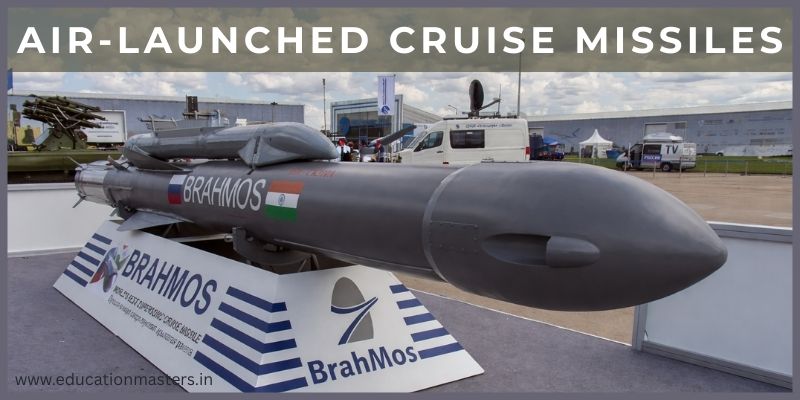
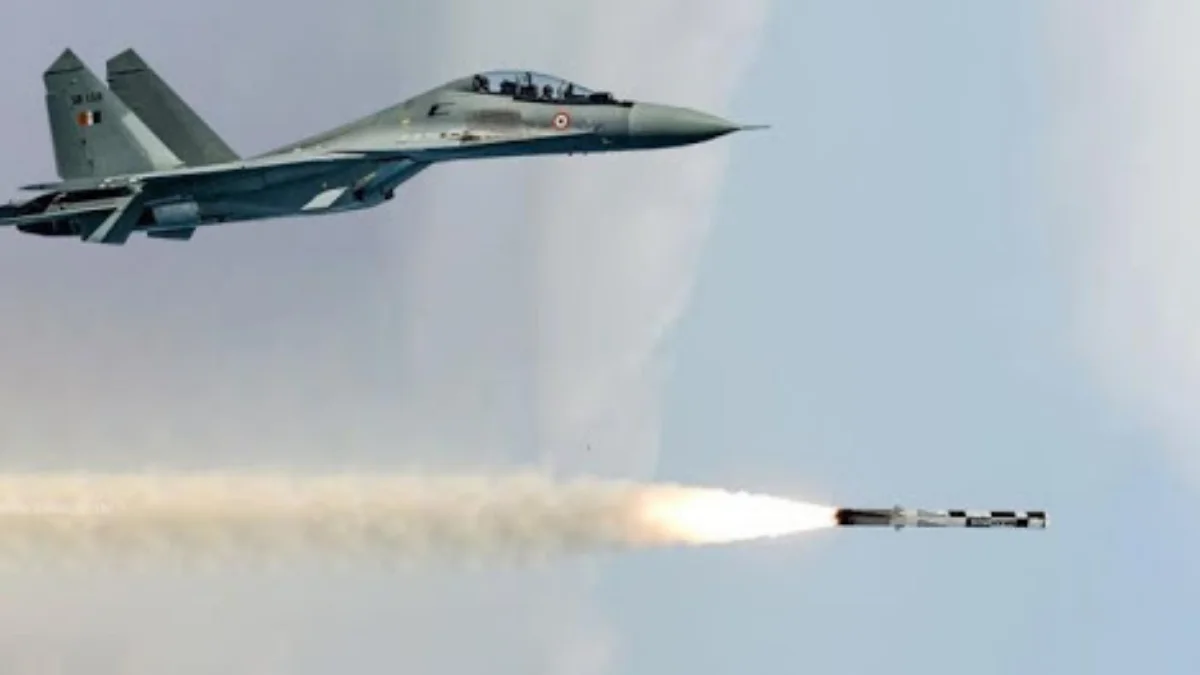
BrahMos-A is the air-launched version of the BrahMos supersonic cruise missile, specifically developed for the Indian Air Force (IAF) and integrated primarily with the Su-30MKI multirole fighter aircraft. It is designed to deliver high-speed, long-range precision strikes against land and naval targets while keeping the aircraft outside the enemy’s air-defence envelope.
BrahMos-A is a modified, lighter, and aerodynamically optimized version of the BrahMos missile. It retains the missile’s signature Mach 2.8–3 speed, high accuracy, and powerful kinetic impact, making it one of the most formidable air-launched cruise missiles in the world. Its standoff capability allows IAF aircraft to strike deep inside hostile territory without entering contested airspace.
Overview of BrahMos-A missile
|
Parameter
|
Details
|
|
Speed
|
Mach 2.8–3
|
|
Range
|
400–450+ km (extended versions under development)
|
|
Launch Platform
|
Su-30MKI
|
|
Warhead
|
200–300 kg
|
|
Flight Profile
|
Low-altitude, sea-skimming/terrain-following
|
|
Guidance
|
INS + GPS/GLONASS + terminal seeker
|
Key Features of BrahMos-A missile
• Supersonic Speed (Mach 2.8–3)
BrahMos-A travels at nearly three times the speed of sound, drastically reducing enemy reaction time and ensuring a high probability of penetrating even advanced air-defence systems.
• Air-Launched Advantage
Released from a high-altitude, high-speed aircraft, the missile gains additional range, improved fuel efficiency, and enhanced survivability, making it a highly effective standoff strike weapon.
• Reduced Weight & Aerodynamically Modified Airframe
This variant is approximately 500 kg lighter than the standard BrahMos and features redesigned fins, altered center of gravity, and structural refinements to ensure safe, stable launch from the Su-30MKI.
• High-Precision Guidance Suite
BrahMos-A uses an advanced combination of INS, GPS/GLONASS, and terminal seekers, enabling pinpoint accuracy against both stationary and moving targets, even in contested electronic environments.
• Versatile Target Engagement Capability
With its high speed and precision, BrahMos-A can effectively neutralize warships, hardened bunkers, radar stations, command centers, and other high-value infrastructure, making it a potent multi-role strike weapon across land and maritime theatres.
Launch Platform – Su-30MKI
The Su-30MKI has been extensively modified to carry the missile, including:
Each Su-30MKI can carry one BrahMos-A under its fuselage due to the missile’s size.
Advantages of BrahMos-A Missile
1. Supersonic Speed Advantage
Flying at Mach 2.8 – 3, BrahMos-A drastically reduces enemy reaction time, making interception extremely difficult and increasing strike success.
2. Long-Range Standoff Capability
The air-launched profile allows attacks from 400+ km, enabling aircraft to strike targets without entering hostile airspace.
3. High Precision Strike
Advanced guidance systems ensure pinpoint accuracy, allowing destruction of high-value targets with minimal collateral damage.
4. Enhanced Survivability
Launch from high altitude combined with low-altitude terminal flight improves missile survivability against air-defence systems.
5. Multi-Role Target Engagement
Capable of engaging both land and naval targets, including warships, bunkers, radar stations, and command centers.
6. Rapid Response Capability
Fighter aircraft can quickly reposition and launch BrahMos-A, making it ideal for time-sensitive and retaliatory missions.
7. Force Multiplier for the IAF
Integrating BrahMos-A significantly enhances the Indian Air Force’s strike reach, deterrence strength, and multi-domain combat effectiveness.
Operational Role of BrahMos-A missile
BrahMos-A enables the IAF to:
-
Conduct standoff precision strikes from 400+ km away
-
Destroy heavily defended naval and land targets
-
Perform deep-strike missions without entering hostile airspace
-
Support joint operations with the Navy and Army
-
Achieve rapid-response capability during conflict
The missile’s supersonic speed and low-altitude terminal flight give it strong resistance against interception.
Strategic Importance of BrahMos-A missile
• Expands India’s Air-Launched Strike Capability
BrahMos-A dramatically boosts the Indian Air Force’s ability to conduct long-range, high-precision standoff strikes, giving India a powerful edge in both offensive and deterrence operations.
• Strengthens Deterrence Against Advanced Air-Defence Systems
Its supersonic speed, maneuverability, and low-altitude terminal flight allow it to penetrate robust enemy air-defence networks, making it a credible deterrent against technologically advanced adversaries.
• Enhances Multi-Domain Offensive Power
By integrating seamlessly into joint operations, BrahMos-A provides rapid and accurate strike options that support land, air, and maritime missions, improving India’s overall combat readiness across domains.
• Boosts India’s Maritime Superiority
With its air-launched anti-ship capability, the missile enhances India’s ability to target hostile naval vessels from long distances, reinforcing control and dominance in critical maritime regions.
Limitations of BrahMos-A Missile
1. Heavy Payload Limits Aircraft Loadout
Despite weight reduction, BrahMos-A remains a large and heavy missile, restricting the carrying aircraft (Su-30MKI) to one missile per sortie, which limits salvo size.
2. Limited Aircraft Integration
Currently, BrahMos-A is integrated only with modified Su-30MKI fighters, reducing deployment flexibility compared to lighter air-launched cruise missiles.
3. Detectable Launch Platform
The launch aircraft can still be detected by enemy radar during mission execution, requiring careful mission planning and support measures.
4. Dependence on Air Superiority
Effective deployment often requires air dominance, electronic warfare support, or fighter escorts, increasing operational complexity.
5. High Cost per Missile
As a high-performance supersonic weapon, BrahMos-A is more expensive than subsonic cruise missiles, limiting its use to high-value targets.
6. Limited Stealth Compared to Subsonic Missiles
While extremely fast, BrahMos-A is less stealthy than subsonic cruise missiles that rely on prolonged low-observable flight profiles.
Current Status of BrahMos-A missile
• Successfully Tested by the Indian Air Force
BrahMos-A has undergone multiple successful test launches, validating its air-release capability, guidance accuracy, and supersonic performance across various mission profiles.
• Operational on Select Su-30MKI Squadrons
The missile is fully integrated on modified Su-30MKI aircraft and is currently operational with designated IAF squadrons trained for long-range standoff strike missions.
• Future Expansion Planned
As lighter and more compact versions of BrahMos are developed, the integration is expected to expand to additional Su-30MKI units and potentially future fighter platforms, enhancing the IAF’s overall strike flexibility.
Conclusion
BrahMos-A serves as a major force multiplier for the Indian Air Force, seamlessly combining the unmatched speed and strike power of the BrahMos missile with the flexibility and reach of air-launch capability. Its long-range standoff precision, supersonic velocity, and deep-strike effectiveness make it one of India’s most formidable air-to-surface weapons. By enabling aircraft to engage high-value land and maritime targets from outside hostile airspace, BrahMos-A provides a decisive strategic advantage, significantly boosting India’s deterrence posture and operational dominance across multiple theatres. For more information about missiles visit Education Masters.
सरकारी नौकरियों, जीके अपडेट्स और करेंट अफेयर्स की ताज़ा जानकारी सबसे पहले पाने के लिए:

.jpg)




.jpg)
.jpg)