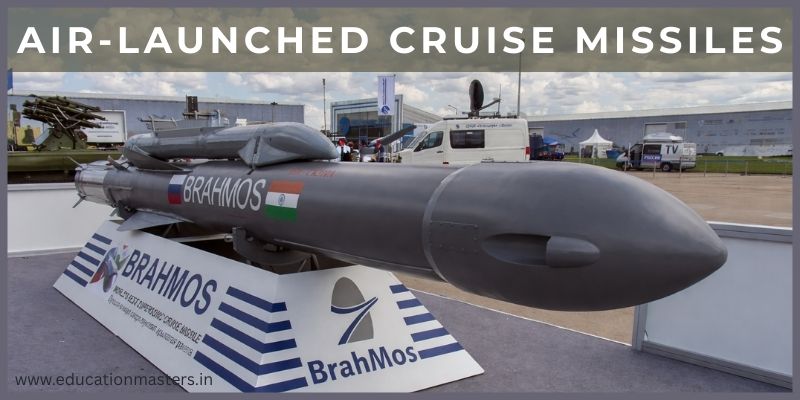
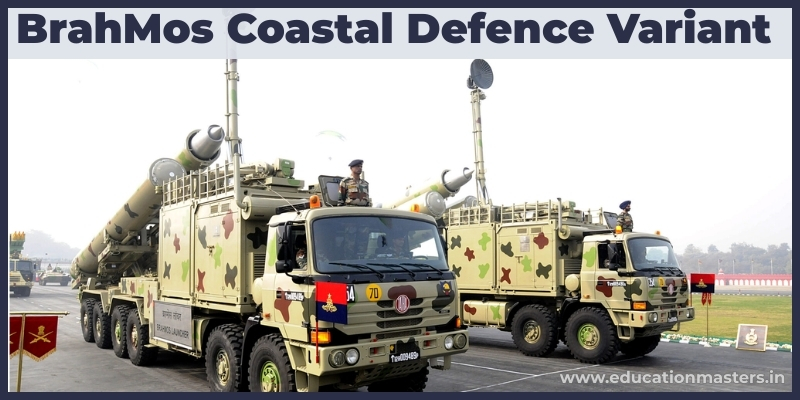
The BrahMos Coastal Defence Variant is a land-based, surface-launched anti-ship missile system designed to protect coastlines, harbours, naval bases, and strategic maritime zones from hostile warships and amphibious forces. It is derived from the BrahMos supersonic cruise missile, which is jointly developed by India and Russia through the BrahMos Aerospace venture.
This variant is optimized for shore-based deployment, allowing ground forces to launch high-speed precision strikes against enemy vessels operating in coastal waters or approaching national maritime boundaries. It plays a crucial role in coastal security and sea denial operations.
Purpose & Role of BrahMos anti-ship missile
The main purpose of the BrahMos Coastal Defence Variant anti-ship missile is:
-
To prevent enemy naval forces from approaching coastlines
-
To protect ports, shipyards, and naval bases
-
To support anti-access / area denial (A2/AD) strategy
-
To deter amphibious landings or invasion attempts
-
To strengthen India’s coastal strike and deterrence capability
This system creates a powerful defensive barrier along vulnerable coastal regions.
Key Features of BrahMos anti-ship missile
|
Feature
|
Description
|
|
Missile Type
|
Supersonic cruise missile
|
|
Launch Mode
|
Surface-to-Surface (land-based launcher)
|
|
Primary Role
|
Anti-ship / coastal defence
|
|
Speed
|
Around Mach 2.8–3.0 (nearly 3x speed of sound)
|
|
Range (export/domestic)
|
Depending on variant – approx. 300–500 km+ (unclassified estimate)
|
|
Flight Profile
|
Sea-skimming / low-altitude terminal flight
|
|
Guidance
|
INS + GPS + Active Radar Homing
|
|
Accuracy
|
Very high precision (meter-level)
|
|
Reaction Time
|
Very fast due to supersonic speed
|
|
Warhead
|
Conventional high-explosive
|
|
Launch Platform
|
Mobile autonomous launch vehicle (TEL)
|
How BrahMos anti-ship missile Works
1. Enemy warship is detected by radar or external surveillance
The process begins when coastal radars, naval ships, aircraft, or satellites detect a hostile vessel. These surveillance systems track the ship’s location, speed, and direction to build a complete target picture.
2. Target data is sent to the command vehicle
All collected information is transferred to the BrahMos coastal command-and-control unit, which processes the target’s coordinates and prepares the engagement plan.
3. Operators select target and launch solution
Operators analyze the threat, choose the best attack angle, and input the target data into the fire-control system. The system calculates the missile’s launch parameters, trajectory, and seeker mode for maximum accuracy.
4. Missile is fired from a land-based canister
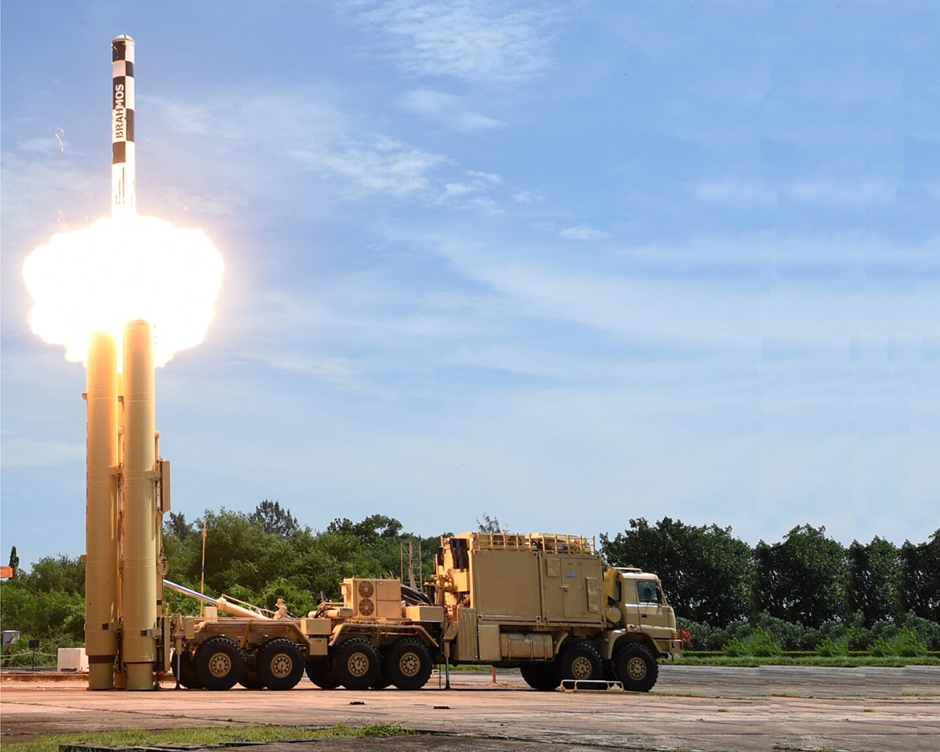
The BrahMos is launched from a road-mobile canisterized launcher, allowing rapid deployment along coastal highways. A booster motor accelerates the missile before its ramjet engine takes over.
5. It travels at supersonic speed just above sea level
During flight, BrahMos maintains supersonic speed (Mach 2.8–3) and performs sea-skimming, flying only a few meters above the water surface. This extremely low altitude helps it avoid enemy radar detection.
6. In the final stage, it uses a radar seeker to lock onto the ship
As it nears the target, the missile activates its active radar seeker, which scans for the enemy ship, identifies it, and locks onto it with high precision—even if the ship is moving or performing evasive maneuvers.
7. Strikes the target with extreme speed and force
BrahMos hits the ship at supersonic speed, delivering massive kinetic energy along with its explosive warhead. The impact is powerful enough to disable or destroy even large naval vessels.
This makes interception extremely difficult for enemy ships.
Strategic Importance of BrahMos anti-ship missile
The BrahMos Coastal Defence Variant anti-ship missile is strategically important because:
-
Covers large sections of coastline
-
Acts as a strong deterrent against naval threats
-
Provides rapid-response capability
-
Enhances India’s blue-water navy support
-
Strengthens national security in areas like:
It also supports India’s regional maritime dominance and defensive posture.
Advantages of BrahMos anti-ship missile
1. Very high speed – hard to intercept
BrahMos travels at supersonic speeds (Mach 2.8–3), giving enemy ships minimal reaction time. Its high velocity makes interception extremely difficult and increases the missile’s destructive impact.
2. Long range coverage
With extended-range versions reaching 450–500+ km, BrahMos can strike enemy ships far before they approach critical maritime areas, ensuring strong stand-off capability.
3. Highly accurate strike capability
Advanced GPS/INS navigation and an active radar seeker enable pinpoint accuracy against moving naval targets, ensuring high lethality even in complex battle conditions.
4. Mobile & survivable system
Road-mobile coastal launchers allow BrahMos units to be repositioned quickly, making them hard to detect and improving their survivability during conflict.
5. Excellent deterrence factor
The missile’s speed, precision, and destructive power act as a strong deterrent, discouraging enemy fleets from entering or threatening Indian maritime zones.
6. Works in all weather and day/night conditions
BrahMos’ seekers and guidance systems function reliably during rain, storms, fog, or darkness, ensuring effective performance in any environment.
7. Quick deployment on coastal highways
Its mobile launchers can rapidly move across coastal roads and strategic locations, allowing fast setup of defensive positions when required.
Limitations of BrahMos anti-ship missile
-
More expensive than subsonic missiles
-
Limited number of missiles per launcher
-
Requires sophisticated support systems
-
Cannot be reused (one-time launch)
-
Needs strong intelligence & surveillance for maximum effectiveness
Operators of BrahMos anti-ship missile
Currently operated by:
Other countries have shown interest in acquiring this system for coastal defence.
Conclusion
The BrahMos Coastal Defence Variant is among the world’s most potent shore-based anti-ship missile systems, providing exceptional capability to protect maritime borders. With its supersonic speed, extended range, high precision, and rapid mobility, it forms a powerful defensive shield along the coastline. This system can detect, engage, and destroy hostile naval forces long before they approach critical maritime zones, ensuring layered coastal security. Its ability to deliver devastating strikes at stand-off distances significantly enhances India’s maritime defence posture. Beyond its operational strength, the BrahMos Coastal Defence Variant serves as a formidable deterrent, signaling to adversaries that any attempted intrusion will be met with swift, overwhelming response. Overall, it plays a crucial role in safeguarding India’s strategic waters, ports, naval bases, and sea lanes. To know more about missiles of India visit Education Masters.
सरकारी नौकरियों, जीके अपडेट्स और करेंट अफेयर्स की ताज़ा जानकारी सबसे पहले पाने के लिए:






.png)
.jpg)
.jpg)