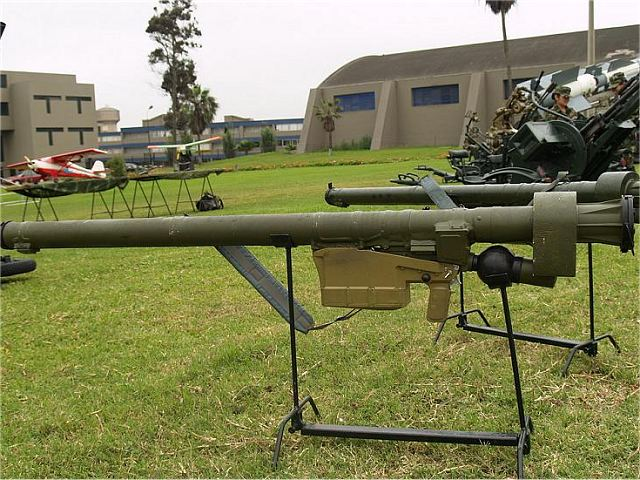
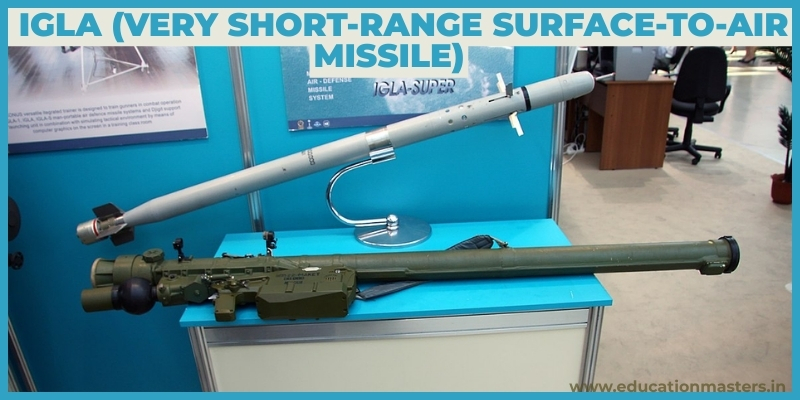
Igla is a Very Short-Range Surface-to-Air Missile (VSHORAD) system, widely classified as a MANPADS (Man-Portable Air-Defense System), developed by Russia to provide effective defence against low-altitude aerial threats. Engineered for high mobility, rapid reaction, and frontline deployment, Igla is capable of engaging fighter aircraft, attack helicopters, unmanned aerial vehicles (UAVs/drones), and low-flying cruise missiles that attempt to evade detection by operating close to the ground. The system employs an infrared homing guidance seeker with fire-and-forget capability, allowing the operator to disengage immediately after launch, thereby enhancing survivability in combat environments. Its compact design, ease of operation, and proven reliability have made Igla a widely adopted air-defence solution across the world. In India, Igla plays a crucial role in the innermost layer of the national air-defence architecture, providing close-range protection to frontline troops, military convoys, air bases, and critical infrastructure against emerging aerial threats.
Overview of Igla (VSHORAD / MANPADS)
|
Aspect
|
Details
|
|
System Name
|
Igla
|
|
Category
|
Very Short-Range Surface-to-Air Missile (VSHORAD)
|
|
Also Known As
|
MANPADS (Man-Portable Air-Defense System)
|
|
Country of Origin
|
Russia
|
|
Primary Role
|
Defence against low-altitude aerial threats
|
|
Targets Engaged
|
Fighter aircraft, attack helicopters, UAVs/drones, low-flying cruise missiles
|
|
Guidance System
|
Infrared (IR) homing
|
|
Launch Method
|
Shoulder-fired
|
|
Engagement Range
|
5–6 km
|
|
Engagement Altitude
|
Up to ~3.5 km
|
|
Speed
|
Supersonic ( Mach 1.9)
|
|
Warhead Type
|
High-Explosive Fragmentation
|
|
Fuze
|
Proximity and impact fuze
|
|
Operational Mode
|
Fire-and-forget
|
|
Mobility
|
Highly mobile, man-portable
|
|
Role in Air Defence
|
Innermost layer of layered air defence
|
|
Status in India
|
In service with Indian Army and IAF
|
Development Background of Igla
Igla was developed by the Soviet Union (later Russia) in the late 1970s–1980s to overcome the limitations of earlier MANPADS like the Strela series, which had restricted accuracy and poor resistance to countermeasures. Designed to counter low-flying aircraft and attack helicopters, Igla introduced an improved infrared seeker, better target discrimination, and all-aspect engagement capability. Entering service in the early 1980s, it evolved through multiple variants, becoming a reliable and widely adopted VSHORAD system, including in Indian service.
Working Principle
The operator visually acquires and tracks a low-flying aerial target, after which the missile’s infrared homing seeker locks onto the target’s heat signature. Upon launch, the missile operates in fire-and-forget mode, autonomously guiding itself toward the target without further operator input. During the terminal phase, a proximity or direct-impact fuze activates the high-explosive warhead near the target, ensuring reliable interception and effective destruction.
Variants of Igla
The Igla MANPADS family includes several variants developed to enhance performance over time. Igla-1 (SA-16) was an early version with basic infrared guidance, followed by Igla (SA-18), which featured an improved seeker and better accuracy. The most advanced variant, Igla-S (SA-24), offers enhanced resistance to countermeasures, a larger warhead, and a higher probability of kill against modern aerial threats.
-
Igla-1 (SA-16)
An early operational variant equipped with basic infrared (IR) guidance. It provided improved performance over earlier MANPADS but had limited resistance to countermeasures.
-
Igla (SA-18)
An upgraded version featuring an improved infrared seeker, enhanced tracking capability, and better accuracy against low-flying aircraft and helicopters.
-
Igla-S (SA-24)
The most advanced variant, designed with enhanced resistance to infrared countermeasures, a larger and more lethal warhead, and a higher probability of kill, making it effective against modern aerial threats.
Operational Role of Igla MANPADS
Igla MANPADS provides close-range air defence against low-flying aircraft, attack helicopters, and drones. It is used for point defence of air bases, headquarters, convoys, and critical infrastructure, while also supporting battlefield air defence for frontline troops. Operating as the innermost layer of a layered air defence system, Igla complements SHORAD and MRAD systems and plays an important role in countering low-altitude and unmanned aerial threats.
-
Point Defence
Provides close-range protection to vital assets such as air bases, headquarters, bridges, ammunition depots, and military convoys against low-altitude aerial threats.
-
Battlefield Air Defence
Plays a crucial role in defending frontline troops and armored formations from enemy attack helicopters and low-flying close air support aircraft during combat operations.
-
Counter-UAS Operations
Highly effective against drones, loitering munitions, and other low-speed unmanned aerial targets, making it relevant in modern drone-centric warfare.
-
Layered Air Defence Support
Functions as the innermost layer of a layered air defence system, complementing SHORAD and MRAD systems by covering very low-altitude engagement gaps.
Advantages of Igla MANPADS
-
High Mobility and Rapid Deployment
Igla is lightweight and man-portable, allowing quick deployment and repositioning, making it ideal for frontline and mobile air-defence operations.
-
Fire-and-Forget Capability
Once launched, the missile autonomously guides itself to the target, enabling the operator to take cover or relocate immediately, thus enhancing survivability.
-
Effective Against Low-Flying and Maneuvering Targets
Designed to engage helicopters, drones, and low-flying aircraft, Igla performs well against agile targets operating at very low altitudes.
-
Cost-Effective Air Defence Solution
Compared to larger air-defence systems, Igla provides an economical yet effective means of point and battlefield air defence.
Limitations of Igla MANPADS
-
Short Range and Limited Altitude Coverage
Igla is restricted to close-range engagements and cannot counter high-altitude or long-range aerial threats.
-
Vulnerability to Infrared Countermeasures
Earlier variants are susceptible to flares and IR jammers, though this limitation is significantly reduced in the advanced Igla-S variant.
-
Sensitivity to Weather Conditions
Adverse conditions such as fog, dust, smoke, or heavy rain can degrade seeker performance and affect target acquisition.
-
Dependence on Operator Skill
Accurate target identification and successful engagement require well-trained operators, especially in complex and cluttered battlefield environments.
Igla in Indian Service
India operates Igla MANPADS with the Indian Army and the Indian Air Force as an integral part of its VSHORAD (Very Short-Range Air Defence) inventory. The system provides close-range protection against low-flying aircraft, helicopters, and drones, particularly for frontline formations and critical assets. While Igla continues to remain operationally relevant, India is actively pursuing indigenous VSHORAD solutions to replace ageing missile stocks, enhance technological capability, and strengthen defence self-reliance under the Atmanirbhar Bharat initiative.
Importance of Igla MANPADS
-
Strengthens Close-Range Air Defence: Igla plays a critical role in protecting troops, convoys, air bases, and key installations from low-flying aircraft, helicopters, and drones.
-
Rapid Reaction Capability: Its shoulder-fired, highly mobile design allows quick deployment and immediate response to sudden aerial threats on the battlefield.
-
Enhances Battlefield Survivability: The fire-and-forget capability enables operators to relocate after launch, reducing exposure to enemy fire.
-
Effective Counter to Emerging Threats: Igla remains relevant against UAVs, loitering munitions, and low-speed aerial targets, which are increasingly used in modern conflicts.
-
Key Element of Layered Air Defence: Operating as the innermost layer, Igla complements SHORAD and MRAD systems by covering very low-altitude gaps.
-
Operational Readiness for India: In Indian service, Igla ensures immediate VSHORAD capability while indigenous systems are developed under defence self-reliance initiatives.
Conclusion
Igla MANPADS continues to be a highly significant element of very short-range air defence, providing reliable protection against low-altitude aerial threats such as attack helicopters, unmanned aerial vehicles, and low-flying aircraft. Its lightweight, man-portable design allows rapid deployment across diverse terrains, making it especially effective for frontline formations, mobile units, and the protection of critical assets. The system’s fire-and-forget infrared guidance enhances operator survivability and ensures quick reaction in dynamic battlefield environments.
As part of a layered air defence architecture, Igla fills the crucial close-range gap that larger SHORAD and MRAD systems cannot fully cover, thereby strengthening overall airspace security. Despite limitations in range and altitude, its proven combat performance and cost-effectiveness keep it operationally relevant. In Indian service, Igla provides dependable VSHORAD capability while the nation advances toward indigenous air defence solutions under self-reliance initiatives. Overall, Igla remains an important and effective air defence system, bridging current operational needs with future modernization goals. F or more information about missiles visit Education Masters.
सरकारी नौकरियों, जीके अपडेट्स और करेंट अफेयर्स की ताज़ा जानकारी सबसे पहले पाने के लिए:




.png)
.png)
.png)
.jpg)
.jpg)