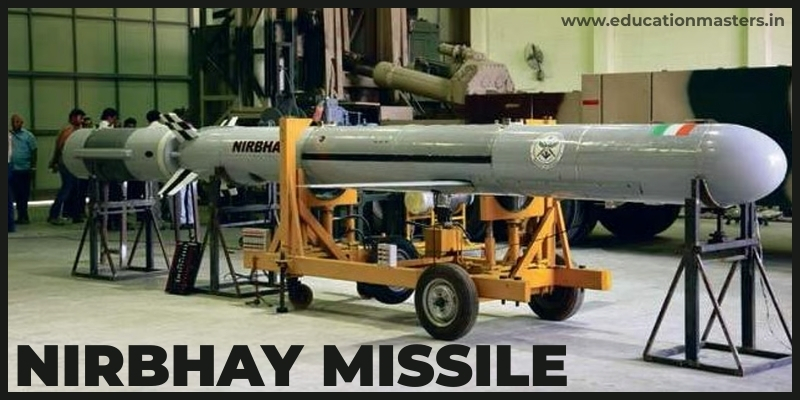
The Nirbhay Cruise Missile represents a major milestone in India’s quest for long-range precision-strike capabilities, marking the nation’s entry into an elite group of countries that possess indigenous subsonic cruise missile technology. Developed by the Defence Research and Development Organisation (DRDO), Nirbhay missile is designed to execute deep-penetration attacks with exceptional accuracy while flying at extremely low altitudes to evade enemy radar and air defence networks. With a range of over 1,000 km, the missile is capable of navigating complex trajectories, making sharp course corrections, and even loitering over a target before striking—features typically seen in advanced Western cruise missiles like the Tomahawk.
Equipped with sophisticated guidance systems such as INS, GPS/GLONASS, NavIC, TERCOM, and DSMAC, Nirbhay missile ensures reliable precision across long distances, regardless of terrain complexity. Its subsonic speed, stealthy radar cross-section, and endurance make it ideal for neutralizing high-value strategic targets during both preemptive and retaliatory operations. As a flexible platform with potential land, air, and naval variants, Nirbhay missile significantly strengthens India’s conventional deterrence posture and complements higher-speed systems like the BrahMos. The missile’s ongoing refinement through the ITCM program, featuring an indigenous turbofan engine, further underscores India’s commitment to self-reliance and next-generation strike capabilities.
Overview of Nirbhay Missile
|
Parameter
|
Details
|
|
Name
|
Nirbhay Cruise Missile
|
|
Type
|
Long-range subsonic cruise missile
|
|
Origin / Developer
|
India (DRDO – Aeronautical Development Establishment)
|
|
Role
|
Land-attack cruise missile (LACM)
|
|
Range
|
1,000–1,500 km (varies by version)
|
|
Speed
|
Subsonic (0.7–0.9 Mach)
|
|
Flight Profile
|
Terrain-hugging, low-altitude, sea-skimming
|
|
Guidance System
|
INS + GPS/GLONASS + TERCOM + Digital Scene Matching (DSMAC)
|
|
Accuracy (CEP)
|
High precision due to advanced guidance suite
|
|
Propulsion
|
Turbofan engine; earlier tests used turbojet
|
|
Warhead Capacity
|
200–300 kg (conventional)
|
|
Launch Platforms
|
Land-based canister launchers; future variants planned for air & naval launch
|
|
Stealth Features
|
Yes, low radar cross-section and terrain-following flight
|
|
Special Features
|
Long endurance, maneuvering capability, mission flexibility
|
|
Successor Variant
|
ITCM (Indigenous Technology Cruise Missile)
|
Development History of Nirbhay Missile
-
Began in early 2000s to create a desi alternative to foreign cruise missiles.
-
Several test flights conducted between 2013–2021 with incremental improvements.
-
Faced early challenges with guidance system and engine reliability, later resolved.
-
The ITCM (Indigenous Technology Cruise Missile) project evolved from Nirbhay, incorporating a fully indigenous engine (Manik turbofan).
Purpose and Role of Nirbhay Missile
Nirbhay missile is designed to:
-
Conduct deep-strike missions up to 1,000+ km.
-
Destroy hardened, high-value land targets such as:
-
Command centers
-
Missile launch sites
-
Air bases
-
Storage depots
-
Strategic infrastructure
-
Provide a low-cost alternative to ballistic missiles.
-
Support precision, stand-off attacks in contested environments.
-
Strengthen India’s deterrence and long-range offensive capabilities.

Key Features of Nirbhay Missile
• Long Range
• Subsonic Speed
• Terrain-Following & Terrain-Hugging
-
Can fly 50–100 meters above ground, sometimes even lower in terminal phase.
-
Enters enemy territory without being easily tracked by radar.
• Highly Maneuverable
• Stealth Features
• Precision Strike
These features enable very precise targeting even at long ranges.
Operational Advantages of Nirbhay Missile
1. Difficult to detect due to low-altitude flight
Nirbhay flies very close to the ground, staying below radar coverage and making early detection or interception extremely difficult.
2. Long endurance enables complex routes
Its long-range and efficient engine allow it to follow winding, non-linear paths, helping it bypass enemy defences and strike from unexpected directions.
3. High survivability against air-defence
With low flight, maneuverability, and flexible routing, Nirbhay becomes a hard target for enemy air-defence systems, increasing mission success.
4. Cost-effective long-range precision strike
Using an air-breathing engine, Nirbhay offers a cheaper alternative to ballistic missiles while still delivering accurate, long-distance attacks.
5. Strengthens India’s deep conventional strike capability
Its non-ballistic flight path lets India hit distant, high-value targets precisely without escalating to strategic or nuclear options.
Strategic Importance of Nirbhay Missile
-
Strengthens India's conventional deterrence.
-
Provides the military with a strategic, precision-guided, long-range strike option.
-
Ideal for preemptive or retaliatory missions.
-
Complements systems like BrahMos by offering a slower, stealthier, longer-range alternative.
-
A key part of India’s evolving missile triad and battlefield dominance doctrine.
Conclusion
The Nirbhay missile stands as a major milestone in India’s efforts to develop an indigenously designed, long-range cruise missile with high precision and terrain-hugging stealth characteristics. Its ability to navigate complex routes, strike deep inside enemy territory, and operate across multiple platforms greatly boosts India’s strategic and tactical strike options. As its upgraded successor, the ITCM, continues to refine propulsion and avionics, the Nirbhay missile program remains crucial to strengthening India’s long-range deterrence and improving missile self-reliance. To know more about missiles visit Education Masters.
सरकारी नौकरियों, जीके अपडेट्स और करेंट अफेयर्स की ताज़ा जानकारी सबसे पहले पाने के लिए:






.png)
.jpg)
.jpg)