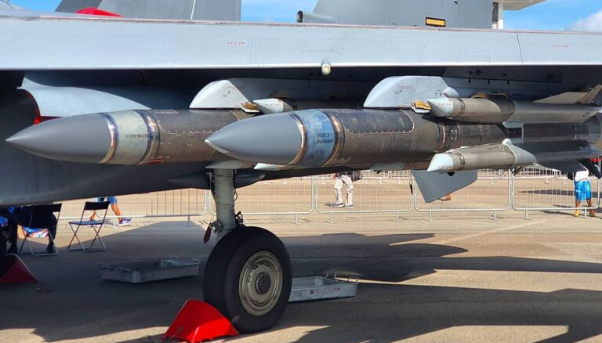
Kh-31A is a supersonic air-launched anti-ship missile that forms an important part of India’s maritime strike and sea-denial capability. Designed to engage enemy warships and high-value naval assets, the Kh-31A allows combat aircraft to conduct high-speed precision attacks from stand-off distances, significantly reducing exposure to ship-based air defenses. Operated by the Indian Air Force (IAF), the missile is optimized for use in contested maritime environments, where speed, accuracy, and survivability are essential for mission success. Its supersonic flight profile makes interception extremely difficult, giving it a decisive advantage against modern naval task forces equipped with layered air-defense systems.
The Kh-31A is specifically tailored for maritime strike operations, using active radar homing guidance to autonomously locate and engage moving naval targets at sea. Once launched from aircraft such as the Su-30MKI, the missile accelerates to supersonic speeds (Mach 3 class), compressing enemy reaction time and overwhelming ship-based defenses. This capability makes it especially effective for anti-surface warfare, sea control, and coastal defense missions, where neutralizing enemy ships early can shape the outcome of naval engagements. For India, the induction of the Kh-31A strengthened the IAF’s ability to support the Navy during joint operations, providing a powerful air-delivered anti-ship strike option that complements other maritime weapons.
Overview of Kh-31A Missile of India
|
Category
|
Details
|
|
Missile Name
|
Kh-31A
|
|
Missile Type
|
Supersonic Anti-Ship Air-to-Surface Missile (ASM)
|
|
Primary Role
|
Maritime strike & sea-denial
|
|
Purpose
|
Destroy enemy warships and high-value naval targets
|
|
Country of Origin
|
Russia
|
|
Operator (India)
|
Indian Air Force (IAF)
|
|
Launch Mode
|
Air-launched
|
|
Launch Platforms (India)
|
Su-30MKI fighter aircraft
|
|
Guidance System
|
Active radar homing seeker
|
|
Attack Capability
|
Autonomous targeting of moving ships
|
|
Engagement Type
|
Precision stand-off maritime strike
|
|
Target Types
|
Warships, surface combatants, naval task groups
|
|
Speed Class
|
Supersonic (Mach 3 class)
|
|
Operational Range
|
Medium-range stand-off (estimated / classified)
|
|
Countermeasure Resistance
|
Designed to penetrate ship-based air defenses
|
|
Operational Role
|
Anti-surface warfare, sea control, coastal defense
|
|
Strategic Importance
|
Enhances India’s maritime deterrence and joint air–naval strike capability
|
|
Status in India
|
Operational
|
Key Features of Kh-31A Missile of India
The Kh-31A is a Russian-designed supersonic air-launched anti-ship missile operated by the Indian Air Force and Indian Navy (via air platforms). It is designed to destroy enemy warships, especially those protected by modern naval air-defense systems. Unlike the Kh-31P (anti-radiation), the Kh-31A is optimized for high-speed maritime strike missions, using speed and sea-skimming flight to overwhelm ship defenses.
1. Supersonic speed capability
The missile flies at very high supersonic speed, significantly reducing enemy reaction time and making interception by ship-based air defenses difficult.
2. Dedicated anti-ship role
Specifically designed to attack enemy surface combatants such as destroyers, frigates, and large naval vessels.
3. Sea-skimming attack profile
Flies at very low altitude over the sea during the terminal phase, minimizing radar detection and increasing penetration probability.
4. Fire-and-forget capability
Once launched, the missile does not require further guidance from the launch aircraft, allowing the aircraft to disengage immediately.
5. Standoff launch capability
Can be launched from outside the effective range of most ship-based air-defense systems, improving aircraft survivability.
6. High-explosive fragmentation warhead
Carries a powerful warhead designed to cause severe damage to ship structures, sensors, and combat systems.
7. Designed to penetrate naval air defenses
Its combination of speed, low-altitude flight, and small engagement window makes it difficult for CIWS and SAM systems to intercept.
Development Background of Kh-31A Missile of India
Kh-31A was developed to counter modern, well-defended naval forces by providing a supersonic, air-launched anti-ship strike capability. Its design emphasizes high speed, active radar homing, and stand-off launch, allowing it to overwhelm ship-based air defenses.
India inducted the Kh-31A to enhance the Indian Air Force’s maritime strike role, particularly in joint operations with the Navy. Integrated with the Su-30MKI, the missile strengthened India’s sea-denial and maritime deterrence capability by enabling fast, precise attacks on enemy warships from safe distances.
Operational Roles of Kh-31A Missile of India
The Kh-31A serves as a supersonic air-launched anti-ship weapon for India, designed to neutralize enemy naval forces in high-threat maritime environments. Its operational roles focus on rapid strike, standoff engagement, and penetration of ship-based air-defense systems, making it effective against surface combatants protected by modern sensors and interceptors.
1. Offensive anti-surface warfare (ASuW)
Used to attack enemy warships such as destroyers, frigates, and large surface combatants during naval conflicts.
2. Maritime strike missions
Employed in air-launched maritime strike operations against hostile naval task groups operating in open seas or near coastlines.
3. High-speed naval strike role
Uses its supersonic speed to reduce enemy reaction time and overwhelm ship-based air-defense systems.
4. Standoff attack against naval formations
Allows launch aircraft to strike naval targets from outside the effective range of ship-based surface-to-air missiles.
5. Penetration of layered naval air defenses
Designed to penetrate modern naval air-defense networks by combining speed, sea-skimming flight, and terminal radar homing.
6. Fleet defense neutralization
Targets key surface combatants that provide air-defense coverage to naval fleets, reducing overall fleet protection.
7. Early-phase naval conflict operations
Often used in the opening stages of maritime conflict to quickly degrade enemy naval combat capability.
8. Sea control and sea denial missions
Supports sea denial by threatening and deterring enemy surface vessels from operating in contested maritime zones.
Advantages of Kh-31A Missile of India
The Kh-31A provides the Indian armed forces with a fast and lethal air-launched anti-ship strike capability, especially effective in high-threat maritime environments where enemy ships are protected by modern air-defense systems.
1. Very high supersonic speed
Its high speed drastically reduces enemy reaction time, making interception by ship-based surface-to-air missiles and CIWS systems difficult.
2. Strong anti-ship specialization
Purpose-built to destroy enemy surface combatants, ensuring effective damage to critical ship systems.
3. Sea-skimming attack profile
Low-altitude terminal flight reduces radar detection range and increases the probability of penetrating naval defenses.
4. Fire-and-forget capability
Once launched, the missile does not require further guidance from the aircraft, allowing the launch platform to disengage immediately.
5. Standoff launch range
Allows aircraft to strike naval targets from outside most ship-based air-defense envelopes, improving aircraft survivability.
6. Effective against modern naval air defenses
The combination of speed and low-level approach makes it challenging for layered naval defense systems to counter.
7. High-explosive fragmentation warhead
Capable of causing serious structural damage and mission kill to large surface vessels.
8. Quick reaction maritime strike
Well suited for rapid-response maritime attack missions against time-sensitive naval targets.
Limitations of Kh-31A Missile of India
Despite its high speed and strong anti-ship capability, the Kh-31A has several limitations that affect its effectiveness in modern, heavily defended maritime environments. It is based on an earlier-generation missile design and relies mainly on speed and low-altitude flight for survivability. Against advanced naval air-defense systems, electronic warfare, and networked sensors, the missile requires careful mission planning and often coordinated attacks to achieve high success rates.
1. Limited range compared to newer anti-ship missiles
Its effective range is shorter than modern long-range anti-ship missiles, requiring aircraft to operate closer to hostile naval formations.
2. Lack of stealth features
Does not incorporate stealth shaping or radar signature reduction, making detection easier at longer ranges.
3. Vulnerable to advanced electronic warfare
Active radar homing can be affected by jamming, deception, and electronic countermeasures employed by modern warships.
4. Single-role specialization
Optimized only for anti-ship missions, limiting flexibility compared to multi-role strike missiles.
5. Dependence on accurate target data
Requires reliable target detection and tracking information before launch, especially against maneuvering naval targets.
6. Reduced effectiveness against point defenses
Although fast, it can still be engaged by modern close-in weapon systems (CIWS) and advanced short-range SAMs.
7. Older seeker technology
The seeker is less advanced than those used in newer generation missiles, affecting performance in cluttered maritime environments.
8. Platform integration limitations
Compatible only with certain aircraft and avionics systems, restricting deployment flexibility.
CONCLUSION
Kh-31A represents a powerful element of India’s air-launched maritime strike capability, combining supersonic speed, precision guidance, and stand-off attack range to effectively counter hostile naval forces. Designed to engage enemy warships, surface combatants, and high-value maritime targets, the Kh-31A allows Indian combat aircraft to launch attacks from safe distances outside ship-based air-defense envelopes. Its high-speed flight profile drastically shortens enemy response time, increasing the probability of mission success even against naval task groups protected by layered air-defense systems.
As part of India’s broader maritime security and joint air–naval operations doctrine, the Kh-31A continues to provide a credible sea-denial and deterrence option in the Indian Ocean Region. When integrated with advanced platforms like the Su-30MKI and supported by maritime surveillance, electronic warfare, and targeting assets, the missile enhances India’s ability to conduct anti-surface warfare, coastal defense, and strategic power projection missions. While newer systems continue to emerge, the Kh-31A remains a relevant and reliable supersonic anti-ship strike weapon, contributing to India’s overall naval deterrence, operational flexibility, and precision strike effectiveness in modern maritime combat scenarios. For more information about missiles visit our site Education Masters.
सरकारी नौकरियों, जीके अपडेट्स और करेंट अफेयर्स की ताज़ा जानकारी सबसे पहले पाने के लिए:

.jpg)




.png)
.png)
.png)
.jpg)