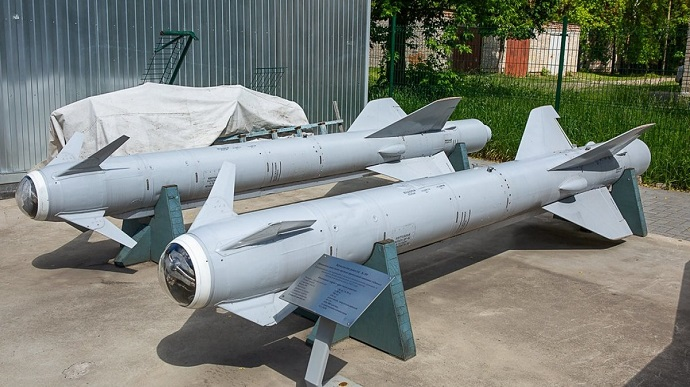
Kh-59 is a long-range precision stand-off air-to-surface missile developed to meet the demands of modern high-intensity air warfare, where accuracy, reach, and survivability are critical. Designed for deployment from combat aircraft, the Kh-59 enables air forces to conduct deep precision strikes against heavily defended ground targets such as bunkers, bridges, command-and-control centers, radar sites, ammunition depots, and strategic military infrastructure. Its stand-off strike capability allows launch platforms to remain outside hostile air-defence envelopes, greatly reducing exposure to surface-to-air missiles and enemy interceptors.
At the core of the Kh-59’s combat effectiveness is its advanced precision guidance system, integrating electro-optical or TV guidance with inertial navigation to ensure high accuracy against fixed and hardened targets. This capability makes the missile highly effective for first-day-of-war missions, infrastructure denial operations, and battlefield shaping strikes, where neutralizing key targets early can disrupt enemy operations. As air forces increasingly prioritize long-range precision engagement and low-risk strike options, the Kh-59 continues to represent an important class of precision stand-off air-to-surface missiles, reinforcing their role in achieving air superiority and operational dominance.
Overview of Kh-59 Missile of India
|
Category
|
Details
|
|
Missile Name
|
Kh-31P
|
|
Missile Type
|
Supersonic Anti-Radiation Air-to-Surface Missile (ARM / ASM)
|
|
Primary Role
|
Suppression & Destruction of Enemy Air Defenses (SEAD / DEAD)
|
|
Purpose
|
Detect and destroy enemy radar and SAM fire-control systems
|
|
Country of Origin
|
Russia
|
|
Launch Mode
|
Air-launched
|
|
Launch Platforms (India)
|
Su-30MKI fighter aircraft
|
|
Attack Capability
|
Homes on radar emissions; memory mode if radar shuts down
|
|
Engagement Type
|
Precision stand-off air-to-surface strike
|
|
Target Types
|
Surveillance radars, fire-control radars, SAM systems
|
|
Speed Class
|
Supersonic (Mach 3+)
|
|
Operational Range
|
Medium-range stand-off (estimated / classified)
|
|
Countermeasure Resistance
|
Designed to operate in heavy electronic warfare environments
|
|
Combat Advantage
|
Reduces pilot risk; opens safe air corridors
|
|
Operational Role
|
First-day-of-war air-defense suppression
|
|
Strategic Importance
|
Strengthens India’s SEAD and precision strike capability
|
|
Status in India
|
Operational
|
Key Features of Kh-59 Missile of India
The Kh-59 is a Russian-designed air-launched precision strike missile used by the Indian Air Force to attack high-value ground targets. It is mainly intended for deep-strike and infrastructure attack missions, where accuracy, standoff range, and warhead power. The missile is typically used against fixed and well-defended targets as part of planned air strike operations.
1. Precision strike
Designed to accurately engage fixed targets such as command centers, hardened bunkers, bridges, and airfield infrastructure.
2. Long-range standoff launch
Allows the launch aircraft to strike targets from outside dense enemy air-defense zones, reducing risk to the aircraft.
3. Subsonic cruise flight profile
Follows a stable subsonic flight path that supports controlled navigation and high accuracy throughout the mission.
4. Advanced guidance system
Uses TV, electro-optical, and data-link guidance (variant dependent), enabling mid-course correction and improved terminal accuracy.
5. Heavy high-explosive warhead
Carries a powerful warhead capable of destroying reinforced and hardened structures.
6. Dedicated land-attack role
Optimized purely for air-to-surface strike missions and not intended for anti-radiation or anti-ship roles.
7. Proven operational reliability
Based on a mature and reliable missile design, making it suitable for planned deep-strike missions by the Indian Air Force.
Development Background of Kh-59 Missile of India
Kh-59 was developed to meet the need for a precision stand-off air-to-surface strike weapon capable of engaging hardened and high-value ground targets from safe distances. Designed during the Cold War era, the missile focused on combining long-range reach, powered flight, and electro-optical / TV guidance to allow combat aircraft to strike targets accurately without entering heavily defended airspace.
For India, the induction of the Kh-59 provided the Indian Air Force (IAF) with a reliable precision strike capability against targets such as bunkers, bridges, and command infrastructure. Integrated with platforms like the Su-30MKI, the Kh-59 enhanced India’s stand-off attack doctrine, supporting deep strike and first-day-of-war missions while reducing risk to pilots and aircraft.
Operational Roles of Kh-59 Missile (Used by India)
The Kh-59 serves as a precision land-attack weapon in the Indian Air Force, primarily used for planned, high-value strike missions. Its operational roles emphasize standoff engagement, accuracy, and the destruction of critical enemy infrastructure.
1. Deep strike operations
Used to hit important military and strategic targets located deep inside enemy territory without requiring aircraft to enter heavily defended airspace.
2. Strategic infrastructure destruction
Employed against command-and-control centers, communication hubs, power facilities, bridges, and logistics nodes that support enemy operations.
3. Airfield suppression and base attack
Used to strike runways, taxiways, hangars, fuel depots, and maintenance facilities to disrupt or halt enemy air operations.
4. Hardened target engagement
Capable of attacking reinforced bunkers, shelters, underground facilities, and fortified structures using its heavy high-explosive warhead.
5. Standoff precision strike role
Allows fighter aircraft to launch the missile from outside dense surface-to-air missile coverage, improving survivability during strike missions.
6. Pre-planned conventional strike missions
Best suited for operations where targets are fixed and known in advance, enabling careful mission planning and high accuracy.
7. Follow-up strike after air-defense suppression
Typically used after SEAD/DEAD missions to destroy remaining high-value ground targets once air defenses are weakened.
8. Limited-conflict and escalation-controlled strikes
Suitable for precision strikes in limited or localized conflicts where controlled escalation and reduced collateral damage are important.
Advantages of Kh-59 Missile (Used by India)
The Kh-59 offers several operational and tactical advantages to the Indian Air Force by combining precision, standoff reach, and reliable strike capability against high-value ground targets.
1. High precision against fixed targets
Provides accurate engagement of known targets such as command centers, bunkers, bridges, and airfield infrastructure, reducing the need for multiple strike sorties.
2. Standoff launch capability
Allows aircraft to launch from outside dense enemy air-defense zones, significantly improving pilot and platform survivability.
3. Effective against hardened structures
Its heavy high-explosive warhead is capable of damaging or destroying reinforced and hardened targets.
4. Reduced risk to launch aircraft
Does not require deep penetration into hostile airspace, lowering exposure to surface-to-air missiles and enemy fighters.
5. Reliable and proven design
Based on a mature missile family with a long service record, offering dependable performance in planned strike missions.
6. Suitable for planned strike operations
Well suited for pre-planned missions where target coordinates are known, enabling precise and controlled execution.
7. Lower cost compared to supersonic cruise missiles
Generally more economical than high-speed supersonic missiles, allowing cost-effective use in conventional strike roles.
8. Complements high-speed missiles
Works alongside faster missiles by focusing on precision and infrastructure destruction rather than speed or radar suppression.
Limitations of Kh-59 Missile
Despite being a capable precision strike weapon, Kh-59 has limitations that affect its use in modern combat, including subsonic speed, limited survivability against advanced air defenses, and reliance on accurate pre-mission intelligence, making it most effective against pre-identified fixed targets after enemy air defenses have been weakened.
1. Subsonic speed
Its subsonic flight profile makes it slower than supersonic cruise missiles, giving enemy air-defense systems more time to detect and respond.
2. Limited survivability against modern IADS
Against advanced and layered Integrated Air Defense Systems, the missile is more vulnerable compared to very high-speed or stealth-optimized weapons.
3. Primarily effective against fixed targets
Best suited for pre-planned strikes on known locations; not ideal for engaging mobile or time-sensitive targets.
4. Requires air-defense suppression support
Often SEAD/DEAD missions are conducted first, as it is less effective when strong air defenses remain intact.
5. Guidance dependence on clear target data
TV and electro-optical guidance variants require accurate target intelligence and favorable conditions for optimal effectiveness.
6. Limited penetration capability
Lacks advanced stealth shaping or terrain-hugging capability found in newer generation cruise missiles.
7. Older design compared to modern missiles
Being based on an earlier generation design, it does not incorporate the latest guidance, networking, or survivability features.
8. Restricted operational flexibility
Not suitable for anti-ship, anti-radar, or multi-role missions, limiting its use to land-attack roles only.
9. Range constraints compared to newer systems
Its effective range is lower than modern long-range cruise missiles, requiring careful mission planning.
CONCLUSION
Kh-59 continues to hold relevance as a precision stand-off air-to-surface missile designed for long-range, accurate strikes against hardened and strategically important ground targets. Its stand-off launch capability, combined with precision guidance, allows combat aircraft to engage bunkers, bridges, command centers, and critical infrastructure while remaining outside hostile air-defence coverage. This makes the Kh-59 particularly valuable for planned deep-strike missions, infrastructure disruption, and first-day-of-war operations where minimizing risk to pilots and platforms is essential.
At the same time, the evolving nature of modern warfare requires the Kh-59 to be employed within a well-coordinated strike framework. When supported by air-defense suppression assets, electronic warfare systems, and accurate intelligence, the missile can still deliver effective results despite newer threats such as advanced IADS and interceptor systems. As part of a layered strike doctrine, the Kh-59 continues to contribute to precision airpower, stand-off attack capability, and operational flexibility, reinforcing its role in contemporary air-to-surface combat missions. For more information about missiles you can visit our site Education Masters.
सरकारी नौकरियों, जीके अपडेट्स और करेंट अफेयर्स की ताज़ा जानकारी सबसे पहले पाने के लिए:

.jpg)


.png)
.png)
.png)
.jpg)