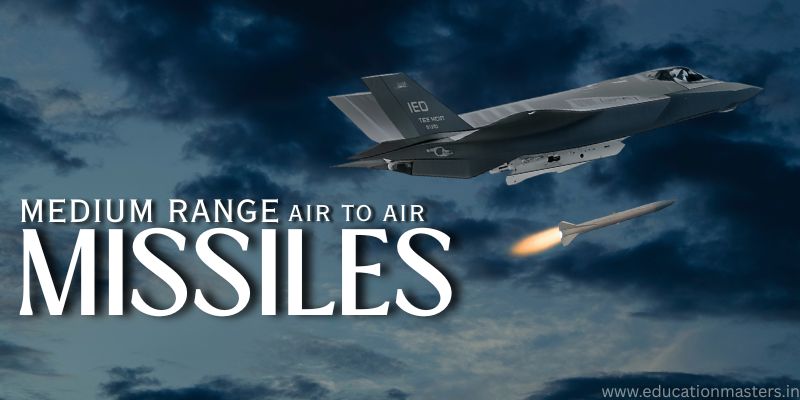
Medium range Air to air missiles (MR AAMs) play a critical role in strengthening the country’s aerial combat power. These advanced systems are designed to engage enemy aircraft at beyond visual range (BVR), giving fighter jets a decisive tactical advantage in both offensive and defensive missions. Over the past decade, India has made rapid progress in developing indigenous missile systems, enhancing guidance technologies, improving propulsion efficiency, and ensuring smoother integration with advanced fighter platforms.
With continuous upgrades, successful test trials, and a strong national push for self-reliance in defense manufacturing, India’s medium range air to air capabilities are evolving at an impressive pace. These systems not only boost the Indian Air Force’s operational flexibility but also support India’s long-term strategic goals in a highly competitive regional security environment. As advancements accelerate, India is steadily reinforcing its position as a growing power in next-generation aerial warfare technologies.
Overview of Medium range Air to air Missiles of India (MR AAMs)
|
Category
|
Details
|
|
Category Type
|
Medium-Range Air to Air Missiles (BVR – Beyond Visual Range)
|
|
Purpose
|
Engage and destroy enemy aircraft before visual contact
|
|
Primary Guidance
|
Inertial Navigation + Mid-Course Update + Active Radar Homing
|
|
Role in Combat
|
First-shot, first-kill capability at long distances
|
|
Key Strength
|
Fire-and-forget, all-weather, day & night operations
|
|
Platforms Equipped
|
Su-30MKI, Rafale, Tejas Mk-1A (planned), Mirage-2000
|
|
Core Missiles in Service
|
Astra Mk-1, Meteor, R-77 (legacy)
|
|
Upcoming Indigenous Missiles
|
Astra Mk-2, Astra Mk-3 (SFDR)
|
|
Pilot Support System
|
AESA radar, datalink, AWACS integration
|
|
Targeting Ability
|
Long-range lock, multi-target engagement
|
|
Countermeasure Defense
|
ECCM-resistant seekers, anti-jamming capability
|
Key Features of Medium Range Air to air missiles of India (MR AAMs)
India’s Medium Range Air-to-Air Missiles (MRAAMs) feature active radar guidance, fire-and-forget capability, mid-course data-link, and high resistance to electronic jamming. Missiles like Astra and MICA provide all-weather BVR combat, long engagement range, and seamless integration with IAF fighter aircraft, strengthening India’s air superiority and indigenous defense power.
1. Beyond Visual Range (BVR) Weapon
Designed to engage enemy aircraft before pilots can see each other, giving a decisive tactical edge.
2. Engagement Range (30–120+ km)
Covers medium to long distances, allowing early interception of hostile targets.
3. Primary Role: Air Superiority
Used to neutralize fighters, bombers, UAVs, and cruise missiles during BVR combat.
4. Active Radar Homing Guidance
The missile has its own radar seeker, enabling autonomous target tracking in the final phase.
5. (INS) Inertial Navigation System
Guides the missile during the mid-course phase toward the predicted target location.
6. Mid-Course Data-Link Updates
Target information can be updated in flight from the launching aircraft or AWACS, improving accuracy.
7. Fire-and-Forget Capability
After seeker lock-on, the pilot can turn away or engage other targets, increasing survivability.
8. High Speed (Mach 3–5+)
Very high velocity reduces enemy reaction time and escape chances.
9. High Maneuverability
Capable of high-G turns to intercept maneuvering targets.
10. Electronic Counter-Countermeasures (ECCM)
Designed to resist enemy jamming, chaff, and electronic deception.
11. All-Weather, Day-Night Operation
Radar guidance allows effective use in cloud, rain, fog, and darkness.
12. Network-Centric Warfare Compatible
Integrates with modern sensors, radars, and command networks.
Types of Medium Range Air to air missiles of India (MR AAMs)
|
Missile Name
|
Type / Guidance
|
Notes
|
|
Astra Mk-1
|
(ARH )Active Radar Homing
|
India’s first indigenous MR AAM; BVR missile with INS + datalink + active radar seeker; in service with Su-30MKI, Tejas
|
|
Astra Mk-2
|
Advanced Active Radar Homing
|
Improved range and ECCM over Mk-1; designed to counter modern jamming; under development
|
|
R-77 (RVV-AE)
|
Active Radar Homing
|
“Fire-and-forget” capability, lattice-fin design, used by IAF on Su-30MKI & MiG-29
|
|
MICA RF
|
Active Radar Homing
|
French BVR missile used by Mirage-2000; fire-and-forget with strong ECCM
|
|
Derby
|
Active Radar Homing
|
Israeli MR AAM integrated on Tejas; INS + datalink + active radar seeker
|
|
Derby-ER
|
Extended-Range ARH
|
Improved range over Derby; used on Tejas Mk-1A for enhanced BVR reach
|
Importance of Medium Range Air to air missiles of India (MR AAMs)
Medium Range Air to air missiles of India (AAMs) are the backbone of Beyond Visual Range (BVR) air combat, where detection, range, and first strike decide victory. These missiles allow Indian fighter aircraft to detect, track, and destroy enemy jets long before visual contact, drastically reducing the need for risky dogfights. Equipped with active radar seekers, mid-course datalink updates, and fire-and-forget capability, MR AAMs enable pilots to strike multiple targets while remaining outside enemy weapon envelopes. For India, facing technologically advanced air forces on multiple fronts, MR AAMs ensure air dominance and pilot safety.
1. Winning Beyond Visual Range (BVR) Air Battles
MR AAMs are designed to destroy enemy aircraft before they enter close combat.
They allow Indian pilots to engage targets 100+ km away, deciding the fight early.
2. First-Shot, First-Kill Advantage
In modern air warfare, the aircraft that fires first usually wins.
MR AAMs give India the ability to strike before the enemy can respond.
3. Core Weapon for Air Superiority
Most modern air battles are fought in BVR conditions.
MR AAMs form the primary offensive weapon of fighters like:
4. Reduced Risk to Pilot and Aircraft
By engaging from long range, pilots avoid:
-
enemy guns
-
short-range missiles
-
close-range ambushes
5. Effective Against Modern Threats
Indian MR AAMs can engage:
-
enemy fighters
-
bombers
-
UAVs
-
cruise missiles
Making them critical for airspace defense and interception missions.
6. Warfare Capability Network Centric
MR AAMs can receive target data from:
-
AWACS
-
ground radars
-
other fighters
Allowing off-board targeting beyond onboard radar limits.
7. Multi-Front Conflict Readiness
India may face simultaneous air threats from China and Pakistan.
MR AAMs allow Indian fighters to control large airspaces with fewer aircraft.
8. Strategic Deterrence
Advanced MR AAMs like Astra and Meteor act as deterrents by making enemy air operations riskier and costlier.
Advantages of Medium Range Air to air missiles of india (MR AAMs)
Medium-range air-to-air missiles provide long-range, high-speed, and high-precision engagement capability, making them decisive in modern air warfare. Their active radar guidance, datalink support, and fire-and-forget operation allow pilots to engage multiple targets while maintaining tactical flexibility and safety.
1. Long Engagement Range
Effective at 30–120+ km, far beyond visual range.
Allows destruction of enemy aircraft before dogfights begin.
2. Capability of Fire and Forget
the missile guides itself after launch,
Pilots can:
-
evade
-
reposition
-
engage new targets
3. Active Radar Homing Guidance
Onboard radar seeker ensures autonomous terminal guidance, even if the launching aircraft disengages.
4. Mid-Course Datalink Updates
Target information can be updated in flight.
Improves accuracy against fast or maneuvering aircraft.
5. High Speed (Mach 3–5+)
Extreme speed reduces enemy reaction time.
Makes escape or counter-maneuvers very difficult.
6. Large No-Escape Zone
Modern MR AAMs retain high energy till impact.
Once fired inside NEZ, target survival probability is very low.
7. Strong ECCM Capability
Resistant to:
-
radar jamming
-
chaff
-
electronic deception
8. All-Weather, Day-Night Capability
Radar guidance allows operation in:
Limitations of Medium Range Air to air missiles of india (MR AAMs)
Despite their advantages, MR AAMs have limitations related to radar dependence, electronic warfare, and cost, making them part of a layered missile strategy rather than a standalone solution.
1. Dependence on Radar & Sensors
MR AAMs rely on:
-
fighter radar
-
AWACS
-
datalinks
Heavy jamming or sensor degradation can affect effectiveness.
2. Vulnerable to Advanced Electronic Warfare
Sophisticated ECM can:
3. Higher Cost
MR AAMs are expensive compared to SRAAMs.
Limits the number carried and fired in combat.
4. Reduced Effectiveness at Very Close Range
Inside visual merge distances, MR AAMs are less effective.
Dogfights require SRAAMs and guns.
5. Energy Loss at Extreme Range
At maximum range, missile energy drops.
Fast or retreating targets may escape if fired too far.
6. Requires Accurate Target Data
Poor target identification or tracking errors reduce kill probability.
Crucial in network reliability
7. Not Ideal Against Sudden Close Ambush
If enemy aircraft appear suddenly at close range, MR AAMs are ineffective.
SRAAMs become necessary.
8. Limited Use Against Stealth Before Detection
Against stealth aircraft like J-20, effectiveness depends on:
-
detection range
-
sensor fusion
Until detected, launch is not possible.
CONCLUSION
Medium Range Air to air missiles of India (MR AAMs) form the decisive core of modern air combat capability. In an era where air battles are increasingly decided before visual contact, these weapons provide the Indian Air Force with the crucial first-shot, first-kill advantage. By combining long engagement ranges, active radar homing, mid-course datalink updates, and strong electronic counter-countermeasure capabilities, India’s MR AAM inventory enables pilots to dominate the battlespace while minimizing exposure to enemy threats.The steady shift from legacy imported systems to advanced indigenous missiles such as Astra Mk-1, Mk-2, and the future Mk-3 (SFDR/Gandiva) reflects India’s growing technology. Alongside world-class systems like Meteor and proven platforms like MICA and Derby-ER, India now possesses a layered and flexible BVR missile ecosystem suited for multi-front, network-centric warfare.
While limitations such as radar dependence, electronic warfare challenges, and high costs remain, these do not diminish the strategic importance of MR AAMs. Instead, they highlight the need for integrated operations with AWACS, AESA radars, sensor fusion, and complementary short-range missiles. Overall, medium range air to air missiles ensure air superiority, enhance deterrence, protect pilots and aircraft, and firmly position India as an emerging force in next-generation aerial warfare. If you want to know more about missiles you can visit our site Education Masters.
सरकारी नौकरियों, जीके अपडेट्स और करेंट अफेयर्स की ताज़ा जानकारी सबसे पहले पाने के लिए:




.png)

.jpg)
.jpg)