MICA-RF missile is a medium-range air-to-air missile (MRAAM) that plays a critical role in the Indian Air Force’s combat capability of (BVR). Developed by MBDA France, the MICA-RF is designed to engage enemy aircraft at medium distances using an active radar homing seeker, allowing true fire-and-forget operation in complex aerial combat environments.In Indian service, the MICA-RF equips frontline fighters such as the Mirage-2000 and Rafale, enabling them to detect, track, and destroy hostile aircraft before visual contact. The missile combines inertial navigation, mid-course datalink updates, and autonomous terminal radar guidance, ensuring high accuracy against fast and maneuvering targets. Its ability to operate effectively in all-weather, day-night, and electronic warfare conditions makes it a reliable component of India’s layered air-to-air missile inventory.
As India transitions toward greater self-reliance with indigenous systems like the Astra missile family, the MICA-RF continues to serve as a combat-proven, technologically mature, and operationally trusted BVR missile, complementing newer platforms and reinforcing the Indian Air Force’s air superiority and deterrence posture in contested airspace.
Overview of MICA-RF Missile
|
Category
|
Details
|
|
Missile Name
|
MICA-RF (Missile d’Interception, de Combat et d’Auto-défense – Radar Frequency)
|
|
Type
|
MRAAM (Medium Range Air to Air Missile)
|
|
Role
|
(BVR) air combat
|
|
Guidance System
|
Inertial Navigation + Mid-Course Datalink + Active Radar Homing
|
|
Fire and Forget
|
Yes
|
|
Engagement Range
|
~60–80 km (BVR)
|
|
Primary Targets
|
Bombers, UAVs, fighter aircraft
|
|
Seeker Type
|
Active Radar (RF)
|
|
Launch Platforms (India)
|
Mirage-2000, Rafale
|
|
Operational Conditions
|
Day & night, all weather
|
|
Electronic Warfare Resistance
|
ECCM-capable, anti-jamming
|
|
Combat Strength
|
Autonomous terminal guidance, multi-target engagement
|
|
Origin
|
France (MBDA)
|
|
Operational Status (India)
|
In active service with the Indian Air Force
|
Key Features of MICA-RF Missile
The MICA-RF missile is a medium-range, active radar-guided air-to-air missile used by the Indian Air Force for beyond visual range (BVR) combat. Integrated on Rafale and Mirage-2000, it provides fire-and-forget capability, all-weather operation, and strong resistance to electronic jamming, strengthening India’s air superiority.
1. Beyond Visual Range (BVR) Engagement Capability
MICA-RF is designed to engage enemy aircraft before visual contact, giving Indian Air Force pilots a decisive tactical edge.
Example:
A hostile fighter detected on Rafale radar is intercepted at long range before entering dogfight distance.
2. Active Radar Homing Seeker
The missile carries its own active radar seeker, allowing autonomous target tracking in the terminal phase.
Example:
After launch, MICA-RF continues to track the target independently without further pilot input.
3. True Fire-and-Forget Operation
Once fired, the missile no longer requires continuous radar support from the aircraft.
Example:
A Mirage-2000 pilot launches MICA-RF and immediately turns away to evade enemy threats.
4. Inertial Navigation with Mid-Course Datalink
The missile uses INS guidance with real-time updates from the launch aircraft or AWACS.
Example:
If the enemy jet changes direction mid-flight, updated data helps MICA-RF correct its intercept path.
5. All-Weather, Day-Night Combat Capability
Radar-based guidance allows operation in poor visibility conditions.
Example:
MICA-RF can engage targets during night operations or through cloud cover and rain.
6. Strong Electronic Counter-Countermeasure (ECCM) Resistance
Designed to resist radar jamming, chaff, and electronic deception.
Example:
Even when the enemy deploys electronic jammers, MICA-RF maintains lock on the real target.
7. High Maneuverability Against Agile Targets
Optimized to intercept high-speed, maneuvering fighter aircraft.
Example:
A fighter performing high-G evasive turns is still intercepted in the terminal phase.
8. Multi-Target Engagement Capability
Supports engagement of multiple hostile aircraft during BVR combat.
Example:
A Rafale can launch MICA-RF missiles at different targets in quick succession.
Development Background of MICA-RF Missile
MICA-RF was developed by MBDA in the 1990s to meet France’s requirement for a single, modern air-to-air missile that could replace multiple legacy weapons. The goal was to reduce logistics complexity while providing beyond-visual-range (BVR), all-weather, fire-and-forget capability for next-generation fighters, especially the Dassault Rafale.
The missile uses an active radar-frequency seeker, allowing autonomous terminal guidance and resistance to electronic countermeasures. Designed with a modular philosophy, MICA-RF shares its airframe with the infrared variant (MICA-IR), enabling flexibility, high agility, and multi-target engagement. It entered service in the early 2000s and remains operationally relevant today.
Operational Roles of MICA-RF (India)
MICA-RF (Missile d’Interception, de Combat et d’Auto-défense – Radar Frequency) is an active radar-guided, fire-and-forget air-to-air missile that equips Indian Air Force fighters, most notably the Rafale. It is designed for network-centric, multi-role air combat, offering both offensive and defensive capabilities across the full spectrum of aerial warfare.
Primary Beyond-Visual-Range (BVR) Air Combat
Engages and destroys hostile fighter aircraft at medium to long ranges using active radar homing, enabling decisive first-shot, first-kill capability.
Fire-and-Forget Aerial Engagement
Once launched, the missile autonomously tracks and intercepts targets, allowing the launching aircraft to maneuver, defend, or engage additional threats.
Multi-Target Engagement Capability
Supports simultaneous engagements of multiple airborne threats when integrated with modern AESA radars and data-link systems.
All-Aspect, All-Altitude Interception
Effective against targets approaching head-on, from the rear, or maneuvering aggressively at low, medium, or high altitudes.
Close-Range Air Combat Backup (WVR)
Although optimized for BVR, MICA-RF can also be employed at shorter ranges, providing flexibility in dynamic dogfight scenarios.
Air Defense & Interceptor Role
Used by fighter aircraft in quick reaction alert (QRA) missions to intercept hostile aircraft, strike packages, or intruding platforms.
Network-Centric Warfare Integration
Can receive mid-course updates from the launching aircraft or other networked sensors, improving accuracy against evasive or maneuvering targets.
Electronic Counter-Countermeasure (ECCM) Operations
Designed to operate in dense electronic warfare environments, resisting jamming, deception, and radar countermeasures.
Day / Night & All-Weather Combat
Maintains full operational effectiveness in darkness, cloud cover, rain, haze, and complex atmospheric conditions.
Air Superiority & Area Denial
Contributes to establishing local air dominance by denying enemy aircraft freedom of maneuver within contested airspace.
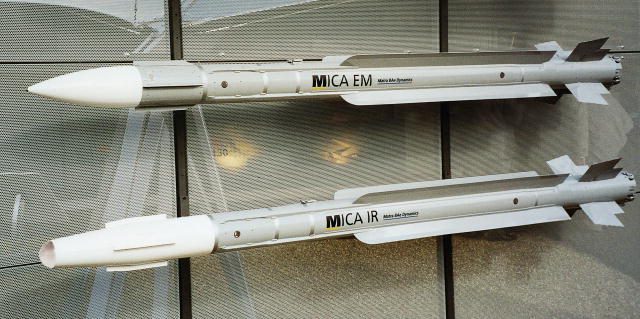
Advantages of MICA-RF Missile
The MICA-RF (Radar Frequency) gives the Indian Air Force a reliable and flexible medium range BVR combat capability, optimized for modern network-centric warfare. Unlike short-range IR dogfight missiles, MICA-RF is built to decide air battles before visual contact, combining active radar guidance, strong ECCM, and seamless integration with advanced fighter avionics.
1. True Beyond Visual Range (BVR) Engagement
Designed to destroy enemy aircraft well before visual contact, reducing the need for risky dogfights and giving pilots a first-launch advantage.
-
Effective in long-range interception missions
-
Ideal for countering enemy fighters, bombers, and UAVs
-
Enables early dominance in air combat
2. Active Radar Homing Seeker
Uses an onboard radar seeker in the terminal phase, enabling autonomous tracking.
-
No continuous radar lock required
-
Missile guides itself after launch
-
High reliability against maneuvering targets
3. Fire-and-Forget Operational Freedom
Once launched, pilots are free to turn away, defend, or engage other threats.
-
Improves pilot survivability
-
Supports multi-target engagement
-
Reduces exposure to enemy missiles
4. Strong ECCM & Anti-Jamming Capability
Engineered to operate in electronic warfare–heavy environments.
-
Resistant to radar jamming and deception
-
Maintains lock despite chaff deployment
-
Reliable in contested airspace
5. All-Weather, Day-Night Combat Capability
Radar guidance allows engagement in clouds, rain, fog, and darkness.
-
No dependence on visual conditions
-
Suitable for continuous combat operations
-
Effective during poor weather missions
6. High Accuracy Against Maneuvering Targets
Optimized for fast and agile enemy aircraft.
-
Effective against evasive fighters
-
Maintains intercept trajectory during sharp target maneuvers
-
High probability of kill in BVR combat
7. Multi-Target Engagement Capability
Supports simultaneous engagements in complex air battles.
-
Allows Rafale and Mirage-2000 to attack multiple threats
-
Ideal for large-scale BVR scenarios
-
Enhances squadron-level effectiveness
8. Seamless Integration with Advanced Fighters
Fully integrated with Rafale and Mirage-2000 avionics.
-
Works with AESA radar and sensor fusion
-
Compatible with network-centric warfare systems
-
Optimized for modern IAF combat doctrine
Limitations of MICA-RF Missile
The MICA-RF is a capable and reliable medium-range BVR missile, but like all radar-guided systems it has operational and technological limitations that require it to be used as part of a layered air-combat strategy, not as a standalone solution.
1. Shorter Effective Range Compared to Newer BVR Missiles
MICA-RF has a moderate engagement range, which is lower than newer long-range BVR missiles.
-
Outranged by missiles like Meteor, PL-15, and Astra Mk-2
-
Requires fighters to operate closer to enemy airspace
-
Reduces standoff advantage in long-range engagements
2. Single-Pulse Rocket Motor
Uses a conventional single-pulse solid rocket motor.
-
Loses energy in the terminal phase
-
Smaller no-escape zone compared to dual-pulse or ramjet missiles
-
Less effective against fast, retreating targets at maximum range.
3. Radar-Dependent Guidance
Relies on radar detection and tracking for BVR engagement.
-
Effectiveness depends on aircraft radar quality and target detection range
-
Performance degrades against low-RCS or stealth aircraft until detected
-
Requires strong sensor fusion support
4. Vulnerable to Advanced Electronic Warfare
Although ECCM-capable, it can still be challenged by modern ECM systems.
-
Advanced jammers can degrade seeker performance
-
Heavy electronic warfare environments reduce kill probability
-
Requires support from AWACS and networked sensors
5. Limited Growth Potential
MICA-RF is a mature design with limited scope for major upgrades.
-
No ramjet or dual-pulse propulsion
-
Incremental improvements only
-
Gradually being outclassed by newer-generation missiles
6. Import Dependency
MICA-RF is not indigenous to India.
-
Dependence on foreign supply chains
-
Spares, upgrades, and support controlled by external vendors
-
Strategic limitation during prolonged conflicts
7. Higher Cost Compared to Indigenous Alternatives
Imported missile systems are costlier to procure and maintain.
8. Not Optimized for Very Close-Range Combat
MICA-RF is a BVR-focused missile, not ideal for dogfights.
-
Less effective inside visual merge
-
Requires pairing with MICA-IR or other WVR missiles
-
Guns and IR missiles still needed for close combat
CONCLUSION
The MICA-RF missile continues to be an important medium range BVR air to air weapon in the Indian Air Force, offering active radar homing, true fire-and-forget capability, and strong ECCM resistance. Integrated with Rafale and Mirage-2000 fighters, it allows pilots to detect, engage, and destroy enemy aircraft before visual contact, even in all-weather and night operations. Its proven reliability, autonomous terminal guidance, and compatibility with modern avionics make MICA-RF a dependable choice for medium-range aerial combat in electronically contested environments.
Although its range and propulsion are more limited compared to newer long-range missiles like Meteor and Astra Mk-2, the MICA-RF remains highly relevant within India’s layered air combat doctrine. It effectively bridges the gap between short-range IR missiles and long-range BVR systems, ensuring flexibility in multi-threat scenarios. As India increases reliance on indigenous missiles, MICA-RF will continue to serve as a combat-proven, operationally mature BVR solution, strengthening the Indian Air Force’s air superiority, deterrence, and readiness. If you want to know more about missiles you can visit our site Education Masters.
सरकारी नौकरियों, जीके अपडेट्स और करेंट अफेयर्स की ताज़ा जानकारी सबसे पहले पाने के लिए:




.png)
.png)
.png)
.jpg)
.jpg)