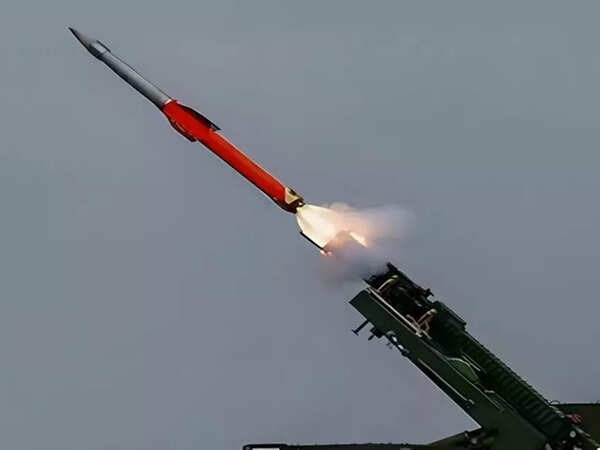
The Quick Reaction Surface-to-Air Missile (QRSAM) is a next-generation, indigenous short-range air-defence missile system developed by the Defence Research and Development Organisation (DRDO) to significantly enhance the tactical air-defence capability of the Indian Army. Engineered for speed, mobility, and precision, QRSAM is purpose-built to protect moving armoured and mechanized formations in dynamic combat environments, where conventional static air-defence systems are often ineffective. Its design reflects the evolving nature of warfare, where aerial threats emerge suddenly and operate at low altitudes to evade detection.
One of QRSAM’s most distinguishing features is its ability to search, track, and engage aerial targets while on the move, enabling uninterrupted air-defence coverage during rapid troop maneuvers. The system is capable of countering a wide range of threats, including fighter aircraft, attack helicopters, UAVs and drone swarms, and terrain-hugging cruise missiles that exploit short reaction windows. Integrated with advanced indigenous radars, an active radar homing missile, and network-centric command-and-control systems, QRSAM offers very fast reaction time, high kill probability, all-weather day-and-night operation, and strong resistance to electronic warfare. As a result, QRSAM plays a crucial role in strengthening India’s layered air-defence architecture, enhancing battlefield survivability, and supporting the nation’s drive toward self-reliance (Atmanirbhar Bharat) in defence technology.
Overview of QRSAM
|
Aspect
|
Details
|
|
System Name
|
Quick Reaction Surface-to-Air Missile (QRSAM)
|
|
Category
|
Short-Range Surface-to-Air Missile (SR-SAM)
|
|
Developer
|
DRDO (India)
|
|
User
|
Indian Army
|
|
Primary Role
|
Air defence of moving formations & point defence
|
|
Typical Range
|
25–30 km (short-range)
|
|
Targets
|
Aircraft, helicopters, UAVs/drones, cruise missiles
|
|
Guidance
|
Active Radar Homing (fire-and-forget)
|
|
Coverage
|
360-degree engagement
|
|
Mobility
|
Fully mobile, vehicle-mounted
|
|
Reaction Time
|
Very fast (quick reaction)
|
|
Operational Capability
|
All-weather, day & night
|
|
Role in Layered AD
|
Bridges VSHORAD and MR-SAM
|
Development Background of QRSAM
The Quick Reaction Surface-to-Air Missile (QRSAM) was conceived to replace older short-range air-defence systems and address a critical capability gap between Very Short-Range Air Defence (VSHORAD) systems and medium-range SAMs within India’s layered air-defence architecture. The increasing use of low-flying aircraft, UAVs, and precision-guided munitions highlighted the need for a fast, mobile, and highly responsive air-defence solution capable of operating alongside frontline forces.
Developed with a strong emphasis on high mobility, automation, and network-centric warfare, QRSAM integrates indigenous surveillance and fire-control radars, modern command-and-control systems, and advanced missile technology. The programme reflects India’s commitment to Atmanirbhar Bharat, promoting self-reliance through domestic design, development, and production while significantly enhancing the Indian Army’s tactical air-defence capability.
Operational Role of QRSAM
The operational role of QRSAM is centered on providing fast, mobile, and reliable air defence in highly dynamic combat environments. By protecting moving formations and forward assets while serving as the first line of response against low-altitude and surprise aerial threats, QRSAM significantly enhances battlefield survivability and tactical air-defence effectiveness.
-
Air defence of moving armoured and mechanized formations during both offensive thrusts and defensive maneuvers, ensuring continuous protection on the move.
-
Point defence of forward bases, logistics nodes, and tactical headquarters, safeguarding critical battlefield infrastructure from aerial attacks.
-
Counter-UAV and anti-drone missions, including detection and interception of low-altitude drone intrusions and emerging swarm threats.
-
First-response layer against surprise air attacks, effectively countering terrain-masking aircraft, helicopters, and low-flying cruise missiles with minimal reaction time.
Importance of QRSAM
-
Strengthens India’s tactical air-defence capability, particularly for mobile warfare and frontline operations.
-
Provides critical protection to moving forces, ensuring armoured and mechanized units can operate safely under an air-defence shield.
-
Highly effective against modern aerial threats, including UAVs, drone swarms, and low-altitude precision-guided weapons.
-
Closes a vital capability gap between very short-range and medium-range air-defence systems.
-
Enhances battlefield survivability and operational freedom, reducing vulnerability to surprise air attacks.
-
Supports Atmanirbhar Bharat, contributing to self-reliance through indigenous development and production.
Advantages of QRSAM
-
Very short reaction time, making it highly effective against low-flying, fast-approaching targets such as drones, helicopters, and cruise missiles.
-
Shoot-and-scoot mobility, allowing rapid relocation after engagement and significantly enhancing system survivability on the battlefield.
-
High interception accuracy, enabled by an active radar homing seeker with fire-and-forget capability.
-
Reduced crew workload, achieved through a high level of automation in detection, tracking, and engagement processes.
-
Seamless integration into layered air-defence networks, working in coordination with VSHORAD and medium-range SAM systems.
Limitations of QRSAM
-
Limited engagement range, restricting coverage to short distances and requiring support from MR-SAM and LR-SAM systems for wider protection.
-
Smaller defended footprint, necessitating multiple units to protect large or widely dispersed areas.
-
Dependence on radar and sensor performance, which can be challenged by heavy electronic warfare and jamming.
-
Primarily designed for tactical roles, not intended for strategic or long-range air-defence missions.
-
Potential saturation risk, where large numbers of simultaneous aerial threats may strain interception capacity.
Conclusion
The Quick Reaction Surface-to-Air Missile (QRSAM) stands out as a game-changing tactical air-defence system for the Indian Army, purpose-built to meet the demands of fast-paced, modern battlefield environments. Its exceptional ability to detect, track, and engage multiple aerial threats while on the move provides continuous air-defence cover to armoured and mechanized formations, even during rapid advances or redeployments. By effectively countering drones and UAV swarms, fighter aircraft, attack helicopters, and low-flying cruise missiles, QRSAM addresses some of the most critical and evolving threats in contemporary warfare.
In high-tempo and fluid combat scenarios, where reaction time is often the deciding factor, QRSAM delivers the first and most responsive layer of protection against surprise and low-altitude air attacks. When integrated into India’s layered and network-centric air-defence architecture, it closes critical capability gaps between very short-range and medium-range systems, significantly enhancing battlefield survivability, operational freedom, and force protection. As an indigenous system developed under Atmanirbhar Bharat, QRSAM not only strengthens India’s tactical air-defence dominance but also reinforces long-term self-reliance and technological resilience in national defence. For more information about missiles visit Education Massters.
सरकारी नौकरियों, जीके अपडेट्स और करेंट अफेयर्स की ताज़ा जानकारी सबसे पहले पाने के लिए:

.jpg)




.png)
.png)
.png)
.jpg)
.jpg)