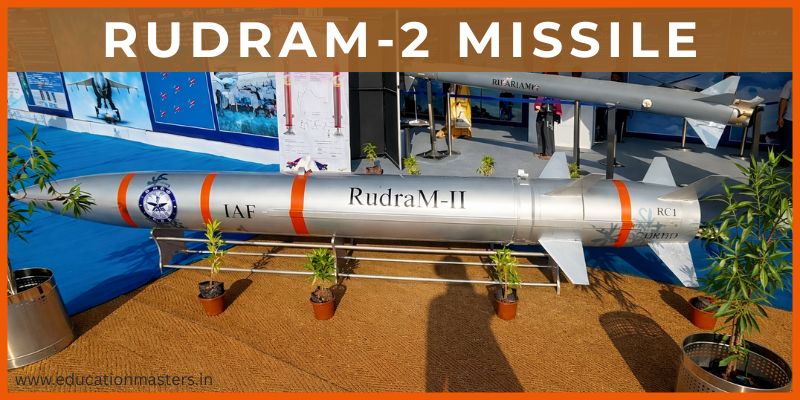
Rudram-2 missile is India’s advanced hypersonic air-launched strike weapon, developed by the Defence Research and Development Organisation (DRDO) as part of the country’s growing focus on next-generation warfare technologies. Designed to be launched from frontline fighter aircraft of the Indian Air Force, Rudram-2 is engineered to travel at hypersonic speeds, enabling rapid deep-strike missions against heavily defended enemy targets. The missile is specifically intended for Suppression and Destruction of Enemy Air Defences (SEAD/DEAD), allowing it to neutralize critical assets such as radar stations, surface-to-air missile systems, communication nodes, and command centers. Its combination of extreme speed, high maneuverability, and precision guidance makes interception extremely difficult.
As a key component of India’s indigenous hypersonic weapons program, the Rudram-2 missile represents a major leap in strategic deterrence and air-power dominance. The missile strengthens India’s ability to conduct precision strikes in modern high-threat environments while reducing dependence on foreign defense systems. With its long-range capability, survivability against advanced air-defense networks, and integration with existing and future fighter platforms, Rudram-2 significantly enhances India’s combat readiness. Its development places India among a select group of nations possessing advanced hypersonic strike capabilities, reinforcing national security, regional military balance, and India’s position as a rising global defense power.
Overview of RUDRAM-2 Missile of India
|
Category
|
Details
|
|
Missile Name
|
Rudram-2
|
|
Missile Type
|
Hypersonic Air-to-Surface Strike Missile
|
|
Primary Role
|
Suppression & Destruction of Enemy Air Defenses (SEAD / DEAD)
|
|
Purpose
|
Rapid neutralization of advanced enemy air-defense networks
|
|
Developer
|
Defence Research and Development Organisation
|
|
Operator
|
Indian Air Force (IAF).
|
|
Guidance System
|
Advanced inertial navigation with precision targeting
|
|
Attack Capability
|
High-speed penetration; difficult to detect and intercept
|
|
Launch Platform
|
Fighter aircraft
|
|
Platforms Integrated
|
IAF frontline fighter jets (integration ongoing / planned)
|
|
Engagement Type
|
Long-range stand-off air-to-surface strike
|
|
Target Types
|
Air-defense radars, SAM sites, command & control centers
|
|
Speed Class
|
Hypersonic (Mach 5+)
|
|
Operational Range
|
Long-range (classified)
|
|
Flight Profile
|
High-speed, high-maneuverability trajectory
|
|
Countermeasure Resistance
|
Highly resistant to modern air-defense interception
|
|
Combat Advantage
|
Minimal enemy reaction time; deep-strike capability
|
|
Operational Role
|
First-day-of-war strike an
|
Key Features of RUDRAM-2 Missile of India
RUDRAM-2 is an advanced Indian anti-radiation air-to-surface missile developed to counter modern, layered, and highly protected enemy air-defense systems. It is optimized for long-range standoff attacks, very high-speed engagement, and precise neutralization of critical radar nodes that form the backbone of an adversary’s Integrated Air Defense System (IADS). By combining speed, accuracy, and survivability, RUDRAM-2 significantly enhances the Indian Air Force’s ability to achieve air superiority in contested battlespaces.
1. Long-range standoff capability
Allows launch aircraft to engage enemy radars from well outside hostile surface-to-air missile engagement zones, reducing operational risk.
2. Supersonic–hypersonic speed profile
Very high speed drastically reduces enemy reaction time and limits opportunities for radar shutdown, relocation, or interception.
3. Advanced anti-radiation guidance
Detects, locks onto, and homes in on hostile radar emissions, including surveillance, tracking, and fire-control radars.
4. Home-on-last-location mode
Ensures continued target engagement even if enemy radar systems are switched off after missile launch.
5. Effectiveness against modern radar systems
Designed to counter mobile, frequency-hopping, and technologically advanced radar networks.
6. Precision-optimized warhead
Specially configured to destroy radar antennas, transmitters, and associated command elements with high effectiveness.
7. IADS disruption capability
Targets critical radar and sensor nodes to break the sensor–shooter–command loop of enemy air defenses.
8. High survivability design
Speed, flight profile, and guidance logic minimize vulnerability to enemy interceptors and point-defense systems.
Development Background of RUDRAM-2 Missile
The Rudram-2 missile was developed by the Defence Research and Development Organisation (DRDO) to strengthen India’s indigenous hypersonic strike and air-defense suppression capabilities. Building on the success of the Rudram-1 program, the missile was designed to counter modern, layered enemy air-defense systems by delivering extremely high speed, precision, and survivability in contested environments.
Rudram-2 reflects India’s shift toward next-generation air-launched weapons that enable long-range stand-off strikes while reducing pilot risk. As part of India’s broader hypersonic weapons initiative, the missile enhances SEAD/DEAD operations, improves first-day-of-war effectiveness, and reinforces India’s strategic deterrence and air-power dominance.
Operational Roles of RUDRAM-2 Missiles of India
RUDRAM-2 plays a critical operational role in modern air warfare by providing the Indian Air Force with a long-range, high-speed capability to suppress and destroy advanced enemy air-defense systems. Designed for operations in heavily contested airspace, it enables early neutralization of radar-based threats, disrupts integrated air-defense networks, and creates favorable conditions for follow-on air operations, electronic warfare, and deep precision strikes.
1. Long-range suppression of enemy air defenses (SEAD)
Suppresses hostile surveillance and fire-control radars from standoff distances, reducing enemy radar coverage and tracking capability.
2. Destruction of enemy air defenses (DEAD)
Physically destroys critical radar installations and associated air-defense nodes to permanently degrade enemy air-defense effectiveness.
3. Deep strike against protected radar targets
Engages well-defended and deep-seated radar systems positioned far inside enemy territory.
4. First-wave / first-day-of-war weapon
Deployed in the opening phase of conflict to rapidly weaken enemy air-defense networks before conventional strike missions.
5. Disruption of integrated air defense systems (IADS)
Breaks the sensor–shooter–command link by neutralizing key radar and command elements.
6. Enabling safe penetration of hostile airspace
Creates corridors that allow strike aircraft and support platforms to operate with reduced risk.
7. Protection of high-value aerial assets
Enhances survivability of AWACS, tankers, ISR platforms, and strike packages by reducing long-range SAM threats.
8. Support to electronic warfare operations
Works in coordination with jamming, decoys, and electronic attack systems to overwhelm enemy air defenses.

Advantages of RUDRAM-2 Missile of india
RUDRAM-2 offers decisive advantages in modern air combat by combining long-range standoff launch, very high speed, and advanced anti-radiation guidance. These strengths allow the Indian Air Force to counter sophisticated, networked air-defense systems with reduced risk to pilots and aircraft, while achieving faster and more reliable suppression of enemy radar threats in contested airspace.
1. Standoff launch advantage
Allows fighter aircraft to engage enemy radars from outside hostile SAM engagement zones, improving aircraft survivability.
2. Extremely short enemy reaction time
High-speed flight drastically reduces the time available for radar shutdown, relocation, or defensive response.
3. High survivability against interception
Speed and flight profile make it difficult for enemy air-defense systems to track and intercept the missile.
4. Effective against advanced radar technologies
Capable of countering modern, mobile, and frequency-agile radar systems used in contemporary IADS.
5. Maintains lethality even after radar shutdown
Home-on-last-location capability ensures target engagement despite enemy countermeasures.
6. Reduces pilot and mission risk
Minimizes exposure of manned aircraft to radar-guided surface-to-air missiles during SEAD/DEAD missions.
7. Rapid collapse of enemy air-defense networks
Neutralizing key radar nodes disrupts the sensor–shooter–command chain of IADS.
8. Enhances success of follow-on air operations
Creates safer conditions for strike aircraft, bombers, ISR, and electronic warfare platforms.
9. Fewer assets required for SEAD missions
High effectiveness reduces the need for repeated sorties or large strike packages.
Limitations of RUDRAM-2 Missiles of India
Despite its advanced capabilities, RUDRAM-2 has certain operational and tactical limitations that are inherent to anti-radiation missiles and high-speed SEAD weapons. These constraints influence mission planning, target selection, and coordination with other air and electronic warfare assets in complex combat environments.
1. Dependence on enemy radar emissions
Primary effectiveness relies on hostile radars being active; completely silent air-defense networks reduce immediate targeting opportunities.
2. Reduced effectiveness against passive sensors
Cannot directly target passive detection systems that do not emit radar signals.
3. Radar shutdown counter-tactic
Enemy operators may switch off radars to break lock, forcing reliance on last-known-location guidance with reduced precision.
4. Limited target set
Optimized mainly for radar and air-defense nodes; less suitable for non-emitting or hardened ground targets.
5. Cost, high unit
Advanced speed, guidance, and materials increase cost, limiting large-scale or routine use.
6. Finite missile inventory
Operational availability depends on production and stock levels, affecting sustained high-intensity campaigns.
7. Requires accurate pre-mission intelligence
Effective employment depends on up-to-date ISR data on radar locations, types, and operating patterns.
8. Vulnerability to layered countermeasures
Modern IADS may use decoys, mobility, redundancy, and rapid relocation to dilute missile effectiveness.
9. Platform integration constraints
Full operational use depends on seamless integration with compatible fighter aircraft and avionics.
CONCLUSION
The Rudram missile program, including the advanced Rudram-2, represents a significant milestone in India’s indigenous precision-strike and air-defense suppression capabilities. Developed by the Defence Research and Development Organisation (DRDO), the missile series strengthens the Indian Air Force’s ability to conduct Suppression and Destruction of Enemy Air Defenses (SEAD/DEAD) with greater speed, accuracy, and survivability. By combining stand-off launch capability, advanced guidance, and high-speed strike performance, Rudram missiles reduce pilot risk while ensuring effective neutralization of enemy radar and air-defense networks in modern combat environments.
With the evolution from Rudram-1 to the hypersonic-class Rudram-2, India has taken a decisive step toward next-generation aerial warfare and strategic deterrence. The program supports India’s self-reliance in defense technology while positioning the country among a select group of nations developing advanced air-launched strike weapons. As regional threats continue to evolve, the Rudram missile family will play a critical role in maintaining air superiority, enhancing first-day-of-war effectiveness, and reinforcing India’s long-term national security objectives. For more informationn about missiles you can visit our site Education Masters.
सरकारी नौकरियों, जीके अपडेट्स और करेंट अफेयर्स की ताज़ा जानकारी सबसे पहले पाने के लिए:





.png)
.png)
.png)
.jpg)
.jpg)