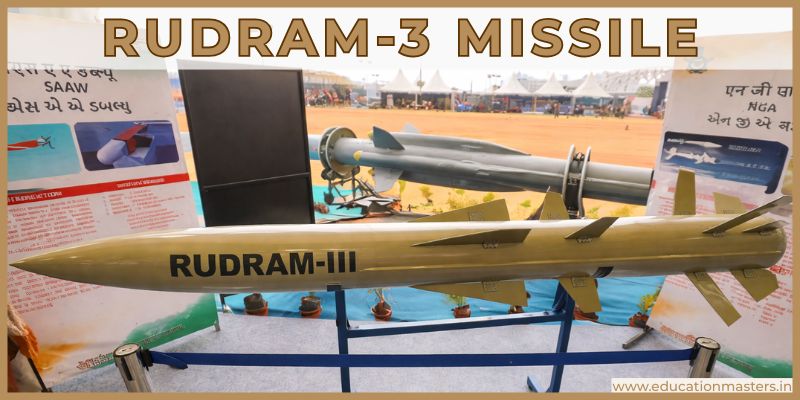
Rudram-3 missile is India’s upcoming next-generation air-launched strike weapon, being developed to substantially enhance the country’s Suppression and Destruction of Enemy Air Defenses (SEAD/DEAD) capability in modern warfare. As the most advanced evolution of the indigenous Rudram missile family, Rudram-3 is intended to counter sophisticated, network-centric, and layered enemy air-defense systems that rely on long-range surveillance radars, fire-control radars, and advanced surface-to-air missile networks. The missile reflects India’s growing emphasis on high-speed, long-range, precision-guided stand-off weapons capable of penetrating heavily defended airspace, reducing enemy reaction time, and ensuring dominance during the critical opening phase of aerial operations.
The development of Rudram-3 by the Defence Research and Development Organisation (DRDO) aligns closely with India’s broader hypersonic weapons roadmap, indigenous defense manufacturing goals, and future-ready air-power doctrine. Designed for deployment from Indian Air Force fighter aircraft, Rudram-3 is expected to deliver deep-strike capability while minimizing pilot exposure through stand-off engagement. With its focus on advanced guidance systems, resistance to electronic warfare, high survivability against interception, and rapid target neutralization, Rudram-3 is poised to significantly strengthen India’s air superiority, enhance strategic deterrence, and play a decisive role in shaping the future of Indian aerial warfare and national security strategy.
Overview of RUDRAM-2 Missile of India
|
Category
|
Details
|
|
Missile Name
|
Rudram-3
|
|
Missile Family
|
Rudram series
|
|
Missile Type
|
Advanced air-launched strike missile
|
|
Primary Role
|
Suppression & Destruction of Enemy Air Defenses (SEAD / DEAD)
|
|
Developer
|
Defence Research and Development Organisation
|
|
Country of Origin
|
India
|
|
Operator
|
IAF (Indian Air Force)
|
|
Launch Mode
|
Air-launched
|
|
Launch Platform
|
Fighter aircraft
|
|
Engagement Type
|
Long-range stand-off air-to-surface strike
|
|
Target Types
|
Enemy radars, SAM systems, air-defense networks, command & control centers
|
|
Speed Class
|
High-speed / next-generation (details classified)
|
|
Operational Range
|
Long-range (classified)
|
|
Guidance System
|
Advanced precision guidance (details not publicly disclosed)
|
|
Survivability
|
High resistance to interception and electronic countermeasures
|
|
Operational Role
|
First-day-of-war strike, air-defense suppression
|
|
Combat Advantage
|
Reduces pilot risk; rapid neutralization of enemy defenses
|
|
Indigenous Status
|
Fully indigenous development
|
|
Strategic Importance
|
Strengthens air superiority and strategic deterrence
|
|
Program Status
|
Under development / future deployment
|
Key Features of RUDRAM-3 Missile of India
RUDRAM-3 is envisioned as a future-generation anti-radiation missile designed to counter next-level, highly networked, and resilient air-defense systems. Building on the evolution from earlier RUDRAM variants, it is expected to focus on greater range, smarter guidance, enhanced survivability, and deeper integration with network-centric and electronic warfare operations, enabling dominance in extremely contested airspace.
1. Extended ultra-long-range standoff capability
Expected to engage enemy radar and air-defense nodes from very long distances, keeping launch aircraft far outside threat envelopes.
2. Sustained hypersonic speed regime
Designed to maintain hypersonic speeds for most of the flight, leaving minimal reaction time for enemy defenses.
3. Multi-mode guidance architecture
Likely to combine anti-radiation homing with inertial, satellite-aided, and terminal guidance for higher hit probability.
4. Advanced home-on-last-and-next-location logic
Improved ability to strike targets even after radar shutdown, relocation, or emission switching.
5. Designed for next-generation radar threats
Optimized to counter AI-assisted, frequency-agile, low-probability-of-intercept (LPI) and distributed radar systems.
6. Smart, high-effect warhead
Expected to use an optimized or programmable warhead to neutralize radar arrays, electronics, and command elements efficiently.
Development Background of RUDRAM-2 Missile
The Rudram-3 missile is being developed as part of India’s long-term strategy to strengthen indigenous air-launched precision strike and Suppression and Destruction of Enemy Air Defenses (SEAD/DEAD) capabilities. Building on the operational experience of earlier Rudram variants, the program was initiated to address the growing threat of advanced, network-centric air-defense systems deployed in modern warfare. The missile reflects India’s shift toward high-speed, long-range stand-off weapons designed to operate effectively in heavily contested airspace.
The development of Rudram-3 by the Defence Research and Development Organisation (DRDO) aligns with India’s broader hypersonic technology roadmap and defense self-reliance initiatives. Designed for integration with Indian Air Force fighter aircraft, Rudram-3 aims to reduce pilot risk while delivering rapid, high-impact strikes against critical enemy air-defense assets, reinforcing India’s air superiority and strategic deterrence.
Operational Background of RUDRAM-3 Missile of India
RUDRAM-3 is conceptualized against the backdrop of rapidly evolving air-defense environments where adversaries employ highly networked, mobile, emission-controlled, and AI-assisted Integrated Air Defense Systems (IADS). Traditional SEAD weapons face increasing challenges due to radar shutdown tactics, distributed sensors, and layered interception systems. The operational background of RUDRAM-3 is therefore shaped by the need for a future-proof, strategic-level anti-radiation weapon capable of operating in extremely contested airspace, supporting first-day-of-war missions, and enabling long-term air superiority in high-intensity conflicts.
1. Emergence of advanced IADS threats
Developed in response to modern air-defense networks that integrate surveillance radars, fire-control radars, command centers, and interceptors into a single resilient system.
2. Increasing use of radar shutdown and emission control
Addresses the operational challenge posed by adversaries switching off or intermittently operating radars to evade anti-radiation attacks.
3. Requirement for ultra-long standoff engagement
Driven by the need to neutralize air-defense systems from distances far beyond enemy SAM engagement envelopes.
4. Shift toward first-day, first-hour operations
Intended to support early conflict phases where rapid degradation of enemy air defenses is critical for follow-on operations.
5. Protection of high-value air assets
Operationally motivated by the need to safeguard AWACS, tankers, ISR platforms, and strike aircraft in heavily defended airspace.
6. Growth of mobile and relocatable radar systems
Designed to counter air-defense elements that frequently change position to avoid detection and targeting.
7. Integration with network-centric warfare doctrine
Reflects the requirement to operate alongside ISR, electronic warfare, cyber, and space-based assets.
8. Need to overwhelm layered air defenses
Accounts for adversaries deploying multiple layers of SAMs, interceptors, and point-defense systems.
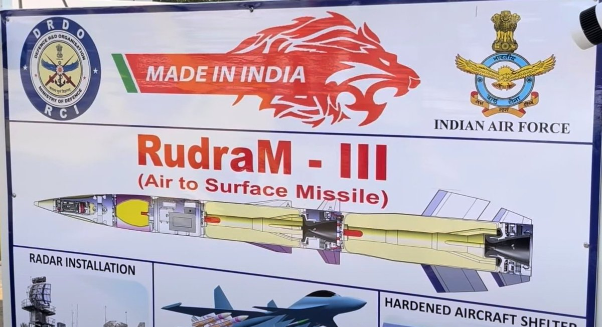
Advantages of RUDRAM-3 Missile of India
RUDRAM-3 is envisioned as a future-generation anti-radiation missile developed to dominate extremely contested airspace. Its advantages are centered on ultra-long-range engagement, extreme speed, intelligent guidance, and deep integration with network-centric warfare, enabling decisive suppression of next-generation Integrated Air Defense Systems (IADS).
1. Ultra-long-range standoff capability
Allows engagement of enemy air-defense nodes from very large distances, keeping launch aircraft far outside threat envelopes.
2. Extremely short enemy reaction time
Sustained hypersonic speeds sharply reduce the ability of radar operators to respond, relocate, or counter the attack.
3. High survivability in layered defenses
Speed, maneuverability, and advanced guidance reduce vulnerability to modern interceptors.
4. Effective against next-generation radar systems
Designed to counter LPI, frequency-agile, AI-assisted, and distributed radar networks.
5. Reduced dependence on continuous radar emissions
Advanced guidance logic improves effectiveness against intermittent or emission-controlled radars.
6. Deep IADS disruption capability
Targets critical nodes to cause cascading failure across the entire air-defense network.
7. Strong network-centric warfare integration
Expected to operate seamlessly with ISR, AWACS, electronic warfare, cyber, and space-based assets.
8. Enhanced protection of high-value air assets
Improves survivability of tankers, AWACS, ISR platforms, and strike aircraft.
9. Reduced pilot and platform risk
Standoff employment minimizes exposure of manned aircraft in high-threat zones.
10. First-day, first-hour dominance enabler
Ideal for early conflict phases to rapidly weaken enemy air defenses.
Limitations of RUDRAM-3 Missile of India
Despite its projected strengths, RUDRAM-3 is expected to face operational and technological limitations inherent to advanced anti-radiation and hypersonic weapon systems. These constraints influence deployment scale, mission planning, and dependency on supporting assets.
1. Conceptual and developmental uncertainty
As a future system, final specifications, timelines, and performance may evolve.
2. Very high development and unit cost
Advanced propulsion, materials, and guidance systems significantly increase costs.
3. Limited inventory in early induction
Initial deployment is likely to involve small numbers, limiting mass employment.
4. Heavy reliance on high-quality intelligence
Accurate ISR and real-time targeting data remain essential for effectiveness.
5. Susceptibility to decoys and deception
Adversaries may deploy false emitters and decoy radars to dilute impact.
6. Limited effectiveness against passive sensors
Non-emitting detection systems remain difficult to target directly.
7. Complex system integration requirements
Requires seamless networking with aircraft, sensors, and command systems.
8. Potential emergence of counter-hypersonic defenses
Future adversaries may field specialized sensors and interceptors.
9. Limited flexibility after launch
Dynamic re-tasking options may remain constrained once committed to a target.
10. Terrain and clutter effects
Mountains and complex geography can affect engagement geometry.
CONCLUSION
The Rudram-3 missile marks a significant advancement in India’s indigenous air-launched strike and Suppression and Destruction of Enemy Air Defenses (SEAD/DEAD) capabilities. As the most advanced member of the Rudram missile family, Rudram-3 is designed to counter sophisticated, layered, and network-centric enemy air-defense systems that rely on long-range surveillance radars, fire-control radars, and surface-to-air missile networks. By emphasizing high-speed performance, extended stand-off range, and high survivability, Rudram-3 enhances India’s ability to conduct effective first-day-of-war operations while maintaining air dominance in heavily contested combat environments.
Developed by the Defence Research and Development Organisation (DRDO), Rudram-3 also reinforces India’s defense self-reliance and long-term modernization goals. Designed for integration with Indian Air Force fighter aircraft, the missile is expected to reduce pilot risk while delivering rapid, precision strikes against critical enemy air-defense assets. As future warfare increasingly depends on neutralizing air defenses at the earliest stages of conflict, Rudram-3 is poised to play a decisive role in strengthening India’s air superiority, strategic deterrence, and overall national security posture. For more information about missiles you can visit our site Education Masters.
सरकारी नौकरियों, जीके अपडेट्स और करेंट अफेयर्स की ताज़ा जानकारी सबसे पहले पाने के लिए:




.png)
.png)
.png)
.jpg)
.jpg)