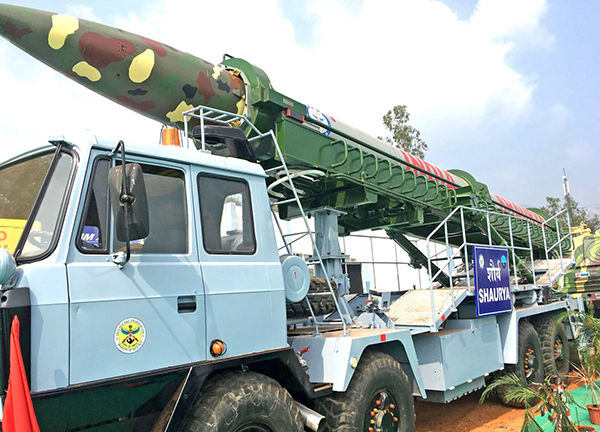
The Shaurya missile is one of India’s most advanced, canister-launched, surface-to-surface ballistic missiles, developed by the Defence Research and Development Organisation (DRDO) to strengthen the nation’s strategic deterrence architecture. Known for its hypersonic speed, exceptional manoeuvrability, and high accuracy, Shaurya missile represents a significant technological achievement in India’s missile development program. With a range of around 700 to 1,000 kilometres, the missile is capable of delivering conventional or strategic payloads with a reduced launch signature, making it difficult for adversaries to detect or intercept.
What sets Shaurya missile apart is its quasi-ballistic, high-altitude, and highly manoeuvrable flight profile, which enables it to evade missile defence systems and maintain stable control even at extreme velocities. Its canister zed, road-mobile design ensures rapid deployment, minimal preparation time, and enhanced survivability during a conflict. Often regarded as the land-based counterpart of the K-15 SLBM, the Shaurya missile contributes to India’s ability to maintain a credible, flexible, and resilient deterrent across multiple delivery platforms. By combining speed, mobility, precision, and advanced guidance technologies, Shaurya missile stands as a modern testament to India’s growing self-reliance and sophistication in strategic missile development.
Overview Table of Shaurya Missile
|
Parameter
|
Details (Public Information)
|
|
Name
|
Shaurya missile
|
|
Type
|
Surface-to-surface ballistic missile
|
|
Class
|
Hypersonic-capable, quasi-ballistic
|
|
Developer
|
DRDO (India)
|
|
Range
|
700–1,000 km
|
|
Speed
|
Up to Mach 7+
|
|
Propulsion
|
Two-stage solid-fuel propulsion
|
|
Fuel Type
|
Solid fuel (composite solid propellant)
|
|
Launch Platform
|
Road-mobile canister launcher
|
|
Launch Method
|
Canister zed, quick-reaction
|
|
Guidance
|
Advanced inertial + terminal guidance (public info only)
|
|
Flight Path
|
High-altitude, manoeuvring, quasi-ballistic
|
|
Accuracy
|
High (exact figures not public)
|
|
Warhead Type
|
Conventional / strategic (no sensitive details)
|
|
Purpose
|
Strategic deterrence, survivable land-based strike
|
|
Relationship
|
Land-based variant related to K-15 SLBM
|
|
First Test
|
2008
|
|
Other Tests
|
2011, 2016, later validation tests
|
|
Special Features
|
Hypersonic manoeuvres, low launch signature, all-weather
|
Development Background of Shaurya Missile
Shaurya’s development began as part of India’s efforts to modernize its missile inventory with quick-reaction, survivable systems.
Design and Structure of Shaurya Missile
Shaurya missile is engineered with:
-
A two-stage solid-fuel propulsion system
-
A canister zed launch architecture
-
A compact and lightweight structure that enhances mobility
Its aerodynamic shape and materials allow it to handle high thermal and mechanical stress during hypersonic flight.
Flight Profile of Shaurya Missile
Shaurya’s flight path is one of its most notable attributes:
-
Quasi-ballistic trajectory
-
Capable of performing random high-speed manoeuvres
-
Flies at high altitudes, making interception difficult
-
Low radar visibility thanks to its reduced launch signature
Guidance and Accuracy of Shaurya Missile
While detailed specifications are not public, Shaurya Missile uses:
-
Advanced inertial navigation systems
-
Precision terminal guidance
-
Flight-control systems designed for manoeuvring at high speeds
These features contribute to high accuracy in the terminal phase.
Strategic Roles and Importance of Shaurya Missile
Shaurya missile plays an important role in India’s defence strategy:
-
Enhances second-strike capability
-
Provides a survivable land-based system complementing sea-based deterrence
-
Adds to India’s credible minimum deterrence posture
-
Strengthens diversified launch platforms (land and sea)
Key Features at a Glance
Performed Operations / Tests of Shaurya Missile
|
Year
|
Operation / Test Details (Public Information)
|
|
2008
|
First successful test launch conducted from Integrated Test Range (ITR), Balasore, Odisha. Demonstrated canister zed launch capability and quasi-ballistic flight.
|
|
2011
|
Successfully tested to validate high-speed manoeuvres and flight trajectory accuracy.
|
|
2016
|
Flight trial to test advanced guidance systems and operational readiness.
|
|
2018–2020
|
Multiple test launches conducted to verify canister zed mobile launch system, solid-fuel reliability, and terminal phase accuracy.
|
|
2021–2023
|
Periodic validation and user trials (public reports indicate continued operational readiness and deployment drills).
|
Advantages of Shaurya Missile
-
Hypersonic Speed
-
High Manoeuvrability
-
Canister-Launched System
-
Road Mobility
-
Solid-Fuel Propulsion
-
Low Launch Signature
-
High Accuracy
-
All-Weather Capability
-
Strategic Versatility
Limitations of Shaurya Missile
-
Limited Range Compared to Larger Missiles
-
Not a Sea-Based System
-
High Operational Cost
-
Limited Public Information
-
Infrastructure Requirements
-
Overlap With Other Missile Systems
Conclusion
The Shaurya missile represents a significant milestone in India’s strategic missile program, combining hypersonic speed, high manoeuvrability, and advanced guidance systems to enhance the nation’s rapid-response and deterrence capabilities. Its canister zed, mobile launch system ensures quick deployment and high survivability, while its precision and versatility make it a reliable component of India’s tactical and strategic arsenal. Although Shaurya missile has certain limitations, such as a relatively shorter range compared to larger missiles, Shaurya’s speed, mobility, and stealth make it a formidable and modern missile system that strengthens India’s overall defence posture and reinforces its commitment to a credible, flexible, and survivable deterrence strategy. To know more about missiles visit Education Masters.
सरकारी नौकरियों, जीके अपडेट्स और करेंट अफेयर्स की ताज़ा जानकारी सबसे पहले पाने के लिए:

.jpg)





.png)
.jpg)
.jpg)