Ship-Launched Cruise Missiles are advanced long-range, precision-guided weapons deployed from surface warships such as destroyers, frigates, and corvettes. Launched through vertical launch systems (VLS) or inclined deck launchers, these missiles allow navies to engage enemy warships, coastal infrastructure, and high-value land targets from secure standoff distances, well beyond hostile shores. Their integration into modern naval platforms enables rapid response, sustained sea control, and effective power projection. By combining extended range, high speed, pinpoint accuracy, and operational flexibility, ship-launched cruise missiles form a critical pillar of contemporary naval warfare and play a decisive role in achieving and maintaining maritime dominance.
Ship-Launched Cruise Missiles – Overview
|
Parameter
|
Details
|
|
Category
|
Ship-Launched Cruise Missiles
|
|
Launch Platform
|
Destroyers, frigates, corvettes, missile boats
|
|
Launch Method
|
Vertical Launch System (VLS) or inclined deck launchers
|
|
Primary Role
|
Long-range precision strikes against naval and land targets
|
|
Target Types
|
Enemy warships, coastal installations, ports, radar sites, strategic land targets
|
|
Flight Profile
|
Sea-skimming and terrain-following for radar evasion
|
|
Speed
|
Subsonic to supersonic (missile-dependent)
|
|
Range
|
Hundreds of kilometers, depending on missile type
|
|
Guidance System
|
INS + GPS/GLONASS/NavIC with active radar/terminal seeker
|
|
Key Advantages
|
Maritime dominance, standoff strike, rapid response, multi-role capability
|
|
Operational Use
|
Sea control, sea denial, power projection, joint operations
|
|
Indian Example
|
BrahMos (Ship-Launched Variant)
|
|
Strategic Importance
|
Enhances naval strike power and protects maritime interests
|
Launch Platforms of Ship-Launched Cruise Missiles
Launch methods include:
Key Characteristics of Ship-Launched Cruise Missiles
-
Long-Range Precision Strike Capability
Enables effective engagement of both naval and land-based targets from standoff distances, allowing ships to operate safely beyond enemy threat zones.
-
Sea-Skimming Flight Profile
Flies at extremely low altitudes over the sea surface, significantly reducing radar detection and making interception by air-defence systems highly challenging.
-
High Accuracy and Reliable Guidance
Employs advanced navigation and terminal seeker technologies to deliver pinpoint strikes, even in electronically contested environments.
-
Multi-Role Operational Capability
Designed to perform anti-ship as well as land-attack missions, offering tactical flexibility and reducing the need for multiple specialized weapon systems.
-
Rapid Reaction from Mobile Sea Platforms
Launched from highly mobile warships, enabling quick response to emerging threats and dynamic combat situations across vast maritime areas.
Guidance & Navigation of Ship-Launched Cruise Missiles
Ship-launched cruise missiles typically use:
-
INS (Inertial Navigation System)
-
GPS / GLONASS / NavIC
-
Active radar or terminal seekers
-
Mid-course updates from ship sensors
This ensures high accuracy even in contested electronic environments.
Ship-Launched Cruise Missiles of India
|
Missile Name
|
Type
|
Range
|
Speed
|
Key Features
|
|
BrahMos (Ship Variant)
|
Supersonic ASCM/LACM
|
290–450+ km
|
Mach 2.8–3.0
|
Primary naval strike weapon of Indian Navy
|
|
91RE1 (Klub Family ASW Missile)
|
ASW missile
|
50 km
|
Supersonic terminal
|
Rocket-propelled torpedo delivery system
|
BrahMos (Ship Variant)
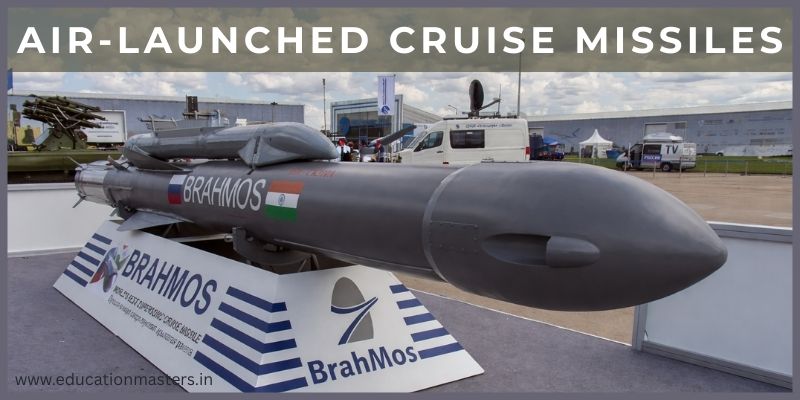
BrahMos (Ship Variant) is a supersonic cruise missile deployed on Indian Navy warships such as destroyers and frigates, designed to strike enemy warships and land targets with high precision. Launched from vertical or inclined ship-based launchers, it travels at Mach 2.8–3 using a sea-skimming flight profile that makes interception extremely difficult. With its long standoff range, multi-role capability, and rapid response, the ship-launched BrahMos is a key weapon for maritime dominance, sea denial, and power projection.

91RE1 (Klub Family ASW Missile)
91RE1, part of the Klub missile family, is a submarine-launched anti-submarine warfare (ASW) missile developed by Russia and used by navies including India. Launched from a submarine’s torpedo tube, the missile travels at high speed to the target area and releases a lightweight torpedo by parachute, which then homes in on enemy submarines. With a range of around 40–50 km, 91RE1 significantly extends a submarine’s ASW reach, enabling rapid and precise engagement of hostile submarines while keeping the launch platform concealed.
Operational Role of Ship-Launched Cruise Missiles
-
Anti-ship warfare against enemy surface vessels
-
Precision strikes on coastal infrastructure and ports
-
Sea control and sea denial operations
-
Power projection beyond national waters
Joint operations supporting air and land forces
Advantages of Ship-Launched Cruise Missiles
-
Ensures Maritime Dominance and Long-Range Strike Capability
Empowers naval forces to control sea lanes and project power over long distances, reinforcing dominance across critical maritime regions.
-
Enables Safe Standoff Attacks
Allows warships to strike enemy vessels and coastal targets from beyond hostile defence ranges, minimizing risk to naval platforms and crew.
-
Offers High Operational Flexibility at Sea
Ship-based deployment enables rapid repositioning and sustained operations across vast ocean areas, adapting quickly to evolving threats.
-
Acts as a Powerful Deterrent
The presence of long-range, high-precision cruise missiles aboard warships deters hostile naval forces by signaling the capability for swift and decisive retaliation.
Strategic Importance of Ship-Launched Cruise Missiles
Ship-launched cruise missiles allow a navy to:
Limitations of Ship-Launched Cruise Missiles
• Detectable Launch Platforms
Despite advanced stealth and electronic countermeasures, warships remain relatively large and detectable assets, making them potential targets for enemy submarines, aircraft, and long-range missiles.
• Limited Missile Load Capacity
Compared to land-based missile systems, ships can carry only a finite number of cruise missiles due to space and weight constraints, limiting sustained strike capability during prolonged operations.
• Dependence on Protective Support
Effective deployment requires robust air cover, anti-submarine warfare (ASW) support, and escort vessels, increasing operational complexity and reliance on coordinated fleet protection.
Conclusion
Ship-Launched Cruise Missiles are a vital component of modern naval power, delivering precise, long-range, and highly flexible strike capability from mobile sea-based platforms. Their ability to conduct rapid-response attacks, establish sea control and sea denial, and execute deep-strike missions against maritime and coastal targets makes them essential for protecting critical sea lanes and national maritime interests. By combining mobility, accuracy, and standoff reach, ship-launched cruise missiles play a decisive role in projecting power across oceans and maintaining naval dominance in both regional and global waters. For more information about missiles visit Education Masters.
सरकारी नौकरियों, जीके अपडेट्स और करेंट अफेयर्स की ताज़ा जानकारी सबसे पहले पाने के लिए:

.jpg)






.jpg)
.jpg)