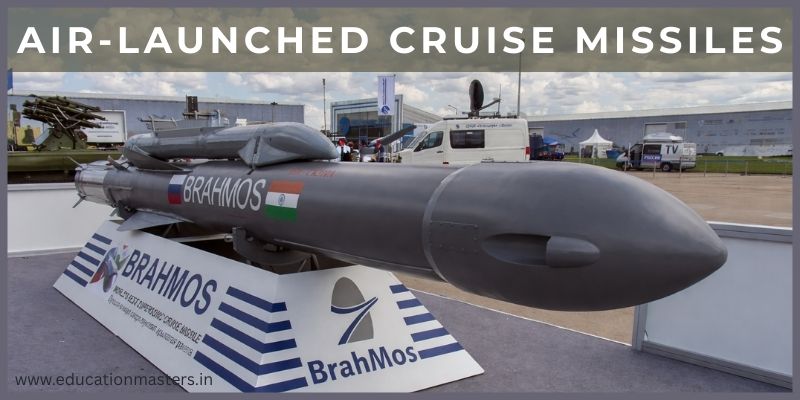
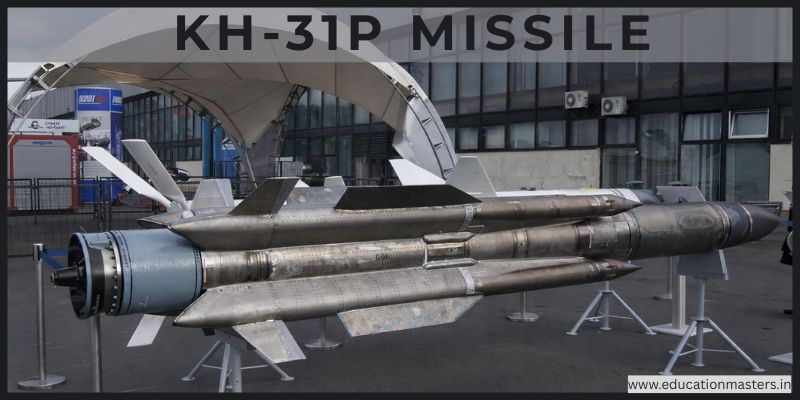
Submarine-Launched Cruise Missiles (SLCMs) are long-range, precision-guided weapons launched from submerged submarines, using either torpedo tubes or vertical launch systems. They represent the stealthiest form of cruise missile deployment, allowing submarines to strike land or maritime targets without revealing their position. Because submarines operate covertly beneath the sea, SLCMs provide a powerful tool for surprise attacks, deterrence, and deep-strike missions in modern naval warfare.
SLCMs combine stealth, precision, and long-range strike capability, making them ideal for high-value strategic missions where survivability and secrecy are critical.
Submarine-Launched Cruise Missiles – Overview
|
Parameter
|
Details
|
|
Category
|
Submarine-Launched Cruise Missiles (SLCM)
|
|
Launch Platform
|
Conventional & nuclear-powered submarines
|
|
Launch Method
|
Torpedo tubes or vertical launch systems
|
|
Primary Role
|
Stealthy long-range strikes against land and sea targets
|
|
Targets
|
Enemy warships, coastal infrastructure, ports, command centers
|
|
Flight Profile
|
Sea-skimming / terrain-following after surfacing
|
|
Speed
|
Subsonic to supersonic (missile dependent)
|
|
Range
|
Hundreds to 1,000+ km
|
|
Guidance System
|
INS + GPS/GLONASS/NavIC + terminal seekers
|
|
Key Strength
|
Maximum stealth and surprise
|
|
Operational Use
|
Covert strike, sea denial, deterrence, first-strike capability
|
|
Indian Examples
|
BrahMos-SLCM (planned), Nirbhay-SLCM (future)
|
|
Global Examples
|
Tomahawk (USA), Kalibr (Russia), Babur-3 (Pakistan)
|
|
Strategic Importance
|
Enhances survivability and second-strike capability
|
Key Features of SLCMs
• Extreme Stealth
SLCMs are launched from fully submerged submarines, allowing strikes to be carried out without revealing the submarine’s position. This makes detection, tracking, and interception extremely difficult for enemy forces.
• Surprise Attack Capability
The covert nature of submarine operations enables SLCMs to conduct first-strike or surprise retaliation missions, catching adversaries off guard and disrupting their command and response systems.
• High Precision Strike
Equipped with advanced navigation and terminal guidance systems, SLCMs can accurately engage high-value targets, minimizing collateral damage while maximizing mission effectiveness.
• Multi-Role Operational Use
SLCMs are capable of engaging both maritime targets (such as warships and carrier groups) and land-based targets (including ports, command centers, and infrastructure), offering exceptional mission flexibility.
• Extended Engagement Range
By delivering strikes far beyond the limited reach of torpedoes, SLCMs significantly expand a submarine’s offensive envelope, enabling long-range power projection from undersea platforms.
Submarine-Launched Cruise Missiles (SLCMs) of India
|
Missile
|
Type
|
Range
|
Status
|
Notes
|
|
BrahMos-SLCM
|
Supersonic Cruise Missile
|
290–450 km
|
Proven
|
Anti-ship + Land attack
|
|
Nirbhay-SLCM
|
Subsonic Cruise Missile
|
800–1000+ km
|
Under Development
|
Long-range land-attack
|
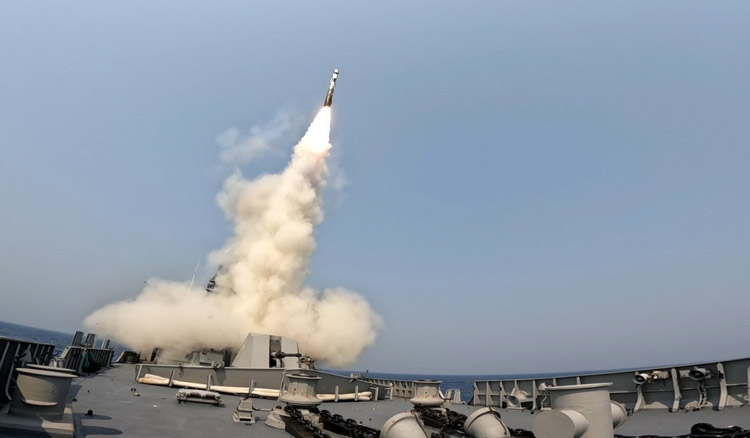
BrahMos-Submarine-Launched Cruise Missiles (SLCMs)
BrahMos-SLCM is the submarine-launched variant of the BrahMos supersonic cruise missile, designed to give the Indian Navy a stealthy, long-range strike capability from submerged submarines. Retaining speeds of Mach 2.8 – 3, high precision, and sea-skimming flight, it can engage maritime and land targets with minimal chance of interception. By combining supersonic lethality with underwater stealth, BrahMos-SLCM strengthens sea denial, deterrence, and India’s undersea power projection.
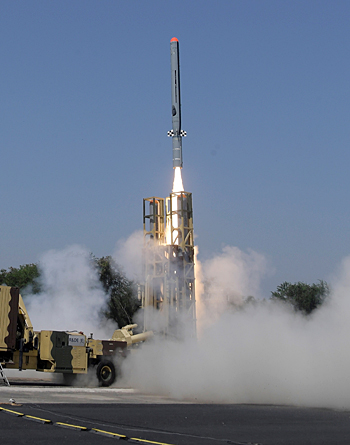
Nirbhay-Submarine-Launched Cruise Missiles (SLCMs)
Nirbhay-SLCM is the submarine-launched version of India’s Nirbhay subsonic land-attack cruise missile, being developed to provide the Indian Navy with a stealthy, long-range precision strike capability from submerged submarines. Launched from torpedo tubes, it is designed to fly at low altitude using terrain-hugging profiles and advanced navigation systems to evade radar and air defences while striking strategic land targets deep inside enemy territory. By combining the covert nature of submarine operations with long endurance and high accuracy, Nirbhay-SLCM strengthens India’s sea-based deterrence, second-strike capability, and overall undersea warfare posture.
Operational Role of SLCMs
-
Covert attacks on high-value land targets
-
Anti-ship warfare against surface combatants
-
Sea denial and maritime interdiction
-
Strategic deterrence and second-strike capability
-
Support to joint naval, air, and land operations
Advantages of SLCMs
• Highest Survivability Among Cruise Missile Platforms
Launched from submerged submarines, SLCMs benefit from the inherent stealth and mobility of undersea platforms, making them the most survivable cruise missile systems in modern warfare.
• Extremely Difficult to Detect, Track, or Intercept
The combination of underwater launch, low-observable missile profiles, and sea-skimming or terrain-following flight paths makes SLCMs exceptionally challenging for enemy sensors and air-defence systems to counter.
• Ideal for Strategic Deterrence
SLCMs provide a credible and survivable strike option, supporting both first-strike and assured second-strike capabilities, which are essential for maintaining strategic deterrence.
• Enhances Undersea Warfare Dominance
By extending a submarine’s offensive reach far beyond torpedo range, SLCMs strengthen undersea dominance and significantly increase the combat effectiveness of submarine forces.
Limitations of SLCMs
• Limited Missile Load Capacity
Submarines have restricted space and payload capacity, limiting the number of cruise missiles they can carry and reducing sustained strike capability during extended operations.
• High Cost of Platforms and Integration
The development, acquisition, and maintenance of submarines, along with the integration of advanced cruise missile systems, involve significant financial and technological investment.
• Complex Command-and-Control Requirements
Effective employment of SLCMs requires highly secure, reliable, and sophisticated command-and-control networks to ensure accurate targeting, coordination, and authorization while maintaining submarine stealth.
Conclusion
Submarine-Launched Cruise Missiles rank among the most formidable and survivable strike weapons in modern warfare. Their unparalleled stealth, high precision, and extended reach enable navies to conduct covert, high-impact operations while preserving a credible deterrent posture. By allowing submarines to strike strategic land and maritime targets without revealing their position, SLCMs ensure operational surprise and survivability. As undersea warfare continues to advance, these missiles will remain a cornerstone of naval power projection, sea denial, and long-term maritime security. To know more about missiles visit Education Masters.
सरकारी नौकरियों, जीके अपडेट्स और करेंट अफेयर्स की ताज़ा जानकारी सबसे पहले पाने के लिए:





.png)
.jpg)
.jpg)