
42 common Mistakes in English we always use in daily life
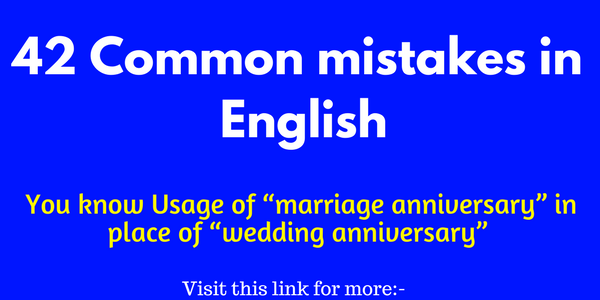
- Usage of “marriage anniversary” in place of “wedding anniversary”
- Usage of “doubt” in place of “question”
- Usage of “have/had had”
- Confusion between usage of “there”, “their” and “they’re”
- Confusion between usage of “loose” and “lose”
- Usage of “cope up with” instead of “cope with”
- Usage of “my/your/our-self/selves” after resist.
- Usage of “take out” instead of “find/calculate”
- Usage of “How is [x] like?” instead of “What is [x] like?”
- Usage of “Many a times” instead of “many times/many a time/a lot of times”
- Usage of ‘You need not to [do x]’ instead of ‘you need not [do x]’ or ‘you do
not need to [do x]’ - Usage of “return back”, “revert back”, “reply back”, etc. instead of “return”
“revert”, “reply”, etc. - Usage of “competition” after debate or quiz.
- Usage of plurals after “doesn’t” such as ‘doesn’t fits‘, ‘doesn’t matters‘ instead
of ‘doesn’t fit’, ‘doesn’t matter’ - Addition of “about” like in ‘Discussing about [x]’ instead of ‘discussing [x]’
- “Commonsensical” instead of “matter of common sense”. Commonsensical is
not a word. - “Be rest assured” instead of “rest assured” or “be assured”.
- Usage of “but” along with “although”
- Usage of “if yes/not” instead of “if your answer is yes/no”
- Usage of “know more” instead of “find out more”
- Usage of standalone “basis” instead of “on the basis of” in a sentence.
- Usage of “equally as [adjective] as” instead of “as [adjective] as”
- Usage of “did” instead of “made” as in “I did a mistake”
- Usage of “me” right after “suggest/recommend”
- Usage of “off” instead of “of”
- Usage of a negative condition with “until/till”
- Using ‘Myself [so-and-so]’ in place of ‘I’m [so-and-so]’.
- Usage of “I don’t think so that..” instead of “I don’t think that..”
Usage of [verb in the past tense] after “didn’t”
Usage of plural form instead of singular form like alumni instead of alumnus.
- Usage of “was” with “if/wish”
- Usage of “Who” with a relative pronoun
- Usage of between instead of among.
- When using or, either, neither, nor the succeeding verb would follow the form
nearest to it. - Usage of two comparative terms together.
- Usage of suffixes with Roman numerals.
- Usage of “pass out/away” instead of “graduate”
- Usage of goggles/shades/glasses-spectacles. (Correct: “… a pair of goggles…”)
- Usage of ‘only’ to emphasize actions.
- More better instead of “better” or even “better”.
- Usage of has/have; for example ‘I has/You has’ instead of I have/ You have’
सरकारी नौकरियों, जीके अपडेट्स और करेंट अफेयर्स की ताज़ा जानकारी सबसे पहले पाने के लिए:
हमारे WhatsApp चैनल को फॉलो करें:
https://whatsapp.com/channel/0029Vb6sjZz0wajwDXcd5B0Uहमारे Telegram चैनल को फॉलो करें:
https://t.me/educationmastersinहमारे Facebook Page को फॉलो करें:
https://www.facebook.com/educationmastersindiaFREE CLASSIFIED INDIA • POST FREE AD • LOCAL DIRECTORY
Share this Post
(इस पोस्ट को अपने दोस्तों के साथ शेयर करना ना भूले)

Vikash Sharma is an education expert and digital learning strategist with over 10 years of experience in the Indian education ecosystem.rnAs the founder of EducationMasters.in, he is dedicated to helping students and job aspirants stay updated with the latest government exams, results, and career guidance.rnHis articles combine verified information, real-world insights, and easy-to-understand explanations — empowering readers to make informed academic and career decisions.rnrnVikash strongly believes in the mission “Education for Everyone” and continuously works to make reliable educational updates accessible to students across India.rnrn📍 Based in Dehradun, Uttarakhand