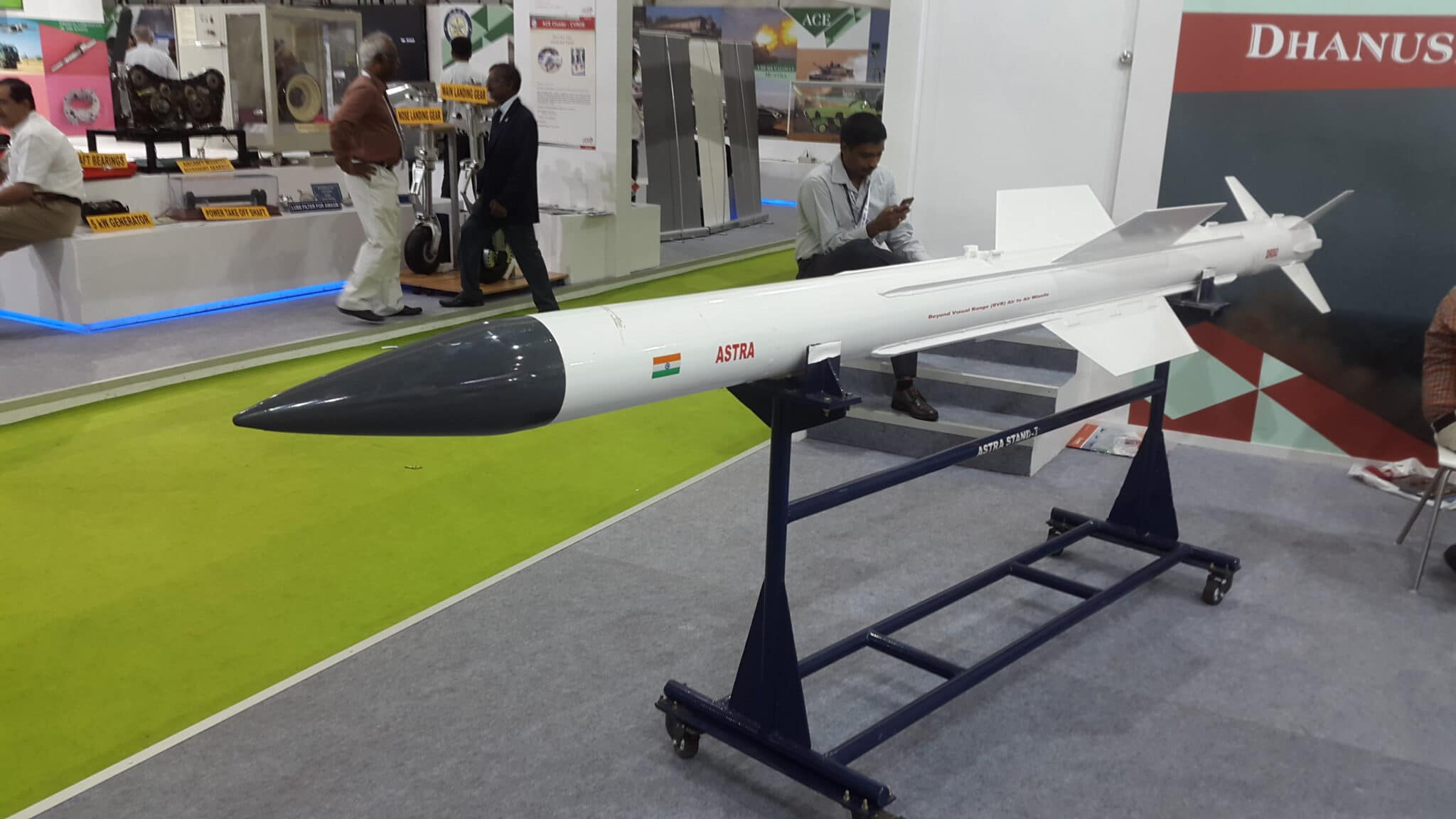
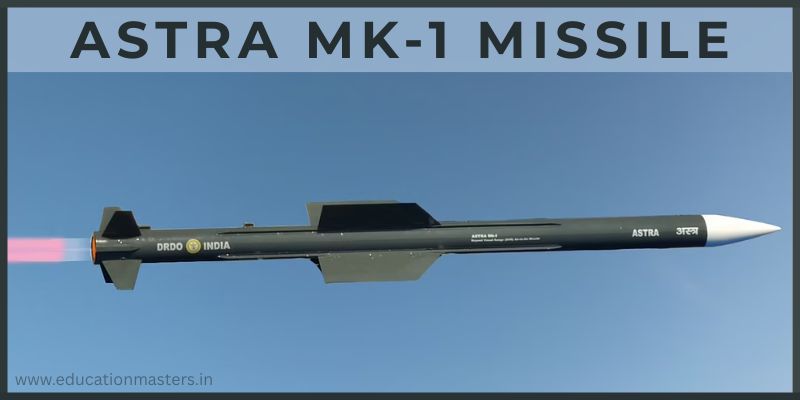
The Astra Mk-1 is India’s indigenous Beyond Visual Range (BVR) air to air missile, developed by the Defence Research and Development Organisation (DRDO) to strengthen the Indian Air Force’s long-range air combat capability. Designed to engage enemy aircraft before visual contact, Astra Mk-1 provides India with a modern, high-speed missile solution capable of neutralizing fast and maneuverable aerial targets in all weather conditions. Its development marks a major milestone in India’s defense self-reliance and indigenous missile technology program.
Equipped with advanced guidance, mid-course data-link updates, and an active radar seeker in the terminal phase, Astra Mk-1 delivers high accuracy and strong resistance against electronic countermeasures. The missile is compatible with multiple fighter aircraft and significantly enhances India’s air dominance by enabling long-range engagements. With Astra Mk-1 entering operational service, India has reduced dependence on imported BVR missiles while improving its strategic aerial deterrence in modern air warfare.
Overview of Astra-Mk-1 Missile of India
|
Category
|
Details
|
|
Missile Name
|
Astra Mk-1
|
|
Country of Origin
|
India
|
|
Developer
|
DRDO
|
|
Type
|
BVR Air to Air Missile
|
|
Primary Role
|
Long-range aerial combat and air superiority
|
|
Target Types
|
Enemy fighter aircraft and high-speed maneuverable aerial threats
|
|
Engagement Range
|
Long-range BVR class (100+ km)
|
|
Speed Class
|
High supersonic
|
|
Launch Platforms
|
HAL Tejas, MiG-29, Su-30MKI
|
|
Combat Capability
|
All-weather, day & night operations with strong ECCM
|
|
Key Strength
|
Indigenous design, high accuracy, resistance to jamming
|
|
Strategic Purpose
|
Strengthen India’s air dominance and reduce foreign dependence
|
|
Indigenous Focus
|
First indigenous operational BVR AAM of India
|
|
Current Status
|
Operational
|
Key Features of Astra Mk-1 Missile of India
Astra Mk-1 is India’s indigenous Beyond Visual Range (BVR) air to air missile, developed for long-range aerial combat where targets are engaged well before visual contact. Designed for modern network-centric warfare, it combines long reach, high speed, advanced guidance, and strong resistance to electronic countermeasures, giving the Indian Air Force a decisive first-strike advantage.
1. Beyond Visual Range (BVR) Engagement Capability
Astra Mk-1 is designed to destroy enemy aircraft at long distances beyond visual range.
This allows Indian fighter jets to neutralize hostile targets before close-range dogfights begin, reducing risk to the pilot and aircraft.
2. AR Homing Seeker
The missile uses an indigenous active radar seeker in the terminal phase for autonomous target tracking.
Once the seeker activates, the missile independently homes in on the target without further guidance from the launch aircraft.
3. Inertial Navigation with Mid-Course Data-Link Updates
During the mid-flight phase, Astra Mk-1 follows inertial navigation supported by real-time data-link updates from the launching fighter.
This ensures accurate trajectory correction if the target changes speed, altitude, or direction.
4. Fire-and-Forget Operational Capability
After launch, Astra Mk-1 does not require continuous radar illumination from the aircraft.
This allows pilots to maneuver defensively, disengage, or engage additional targets immediately after firing.
5. High-Speed Supersonic Interception
Astra Mk-1 operates at high supersonic speeds, enabling rapid closure on enemy aircraft.
The high speed reduces enemy reaction time and increases kill probability against fast, evasive targets.
Operational Roles Of The Astra Mk-1 Missile of India
The Astra Mk-1 missile is used for beyond-visual-range air combat, enabling Indian Air Force fighters to engage enemy aircraft before visual contact. It supports air superiority, interception, and all-weather operations with strong ECCM and fire-and-forget capability.
-
Beyond Visual Range (BVR) Air Combat
Astra Mk-1 is used to engage enemy aircraft beyond visual range, allowing Indian fighters to strike targets before close combat.
-
Air Superiority Missions
Supports the Indian Air Force in gaining and maintaining control of airspace against hostile fighters.
-
Early Interception Role
Employed to intercept enemy fighters, bombers, and UAVs at medium BVR distances before they reach protected zones.
-
Fire-and-Forget Engagements
Active radar homing allows pilots to launch and maneuver immediately, improving survivability in contested airspace.
-
Air Defense Operations
Used for point and area air defense to counter incoming aerial threats during defensive missions.
-
Operations in Electronic Warfare Environments
Designed with ECCM features to operate effectively in jamming and ECM-heavy scenarios.
-
All-Weather, Day-Night Capability
Radar guidance enables effective operation in clouds, rain, fog, and darkness without dependence on visual conditions.
-
Integration with Indian Fighters
Optimized for platforms like Su-30MKI, Tejas Mk-1/Mk-1A, and MiG-29, supporting indigenous combat capability.
Advantages of Astra Mk-1 Missile of India
Astra Mk-1 provides the Indian Air Force with a modern long-range air combat advantage by combining indigenous technology, advanced guidance, and operational flexibility. Its design improves survivability, increases kill probability, and strengthens India’s air dominance in beyond-visual-range engagements.
1. First-Shot Advantage in Aerial Combat
Astra Mk-1 enables pilots to engage enemy aircraft well before visual contact.
This allows Indian fighters to strike first, forcing adversaries into defensive maneuvers or disengagement before they can launch their own weapons.
2. Reduced Pilot Workload After Launch
With true fire-and-forget capability, the missile guides itself once fired.
Pilots can focus on evasive maneuvers, situational awareness, or engaging additional targets without maintaining missile guidance.
3. High Kill Probability Against Modern Fighters
Advanced guidance and mid-course updates improve interception accuracy.
This increases effectiveness against fast, agile, and electronically protected enemy aircraft.
4. Strong Resistance to Electronic Warfare
Astra Mk-1 is built to operate in heavy electronic countermeasure environments.
This ensures reliable target tracking even when adversaries use jamming or radar deception techniques.
5. Flexibility Across Multiple Combat Scenarios
The missile can engage targets at different altitudes and ranges.
This allows effective use in both defensive air patrols and offensive counter-air missions.
6. Multi-Target Engagement Capability
A single aircraft can launch multiple Astra Mk-1 missiles in one mission.
This enhances combat efficiency during large-scale aerial engagements.
7. All-Weather, Day and Night Readiness
Astra Mk-1 maintains operational performance regardless of visibility or weather conditions.
This guarantees continuous combat availability in real-world operational environments.
8. Faster Reaction and Shorter Engagement Time
High supersonic speed reduces the time between launch and interception.
This limits enemy reaction time and improves mission success rates.
Limitations of Astra Mk-1 Missile of India
While Astra Mk-1 significantly improves India’s beyond-visual-range air combat capability, it also has certain limitations when compared with newer or next-generation BVR missiles. These limitations are largely addressed in follow-on variants such as Astra Mk-2 and future long-range systems.
1. Limited Range Compared to Advanced BVR Missiles
Astra Mk-1 offers long-range engagement but has a shorter reach compared to next-generation BVR missiles used by some advanced air forces.
This may limit engagement distance against adversaries equipped with ultra-long-range air-to-air missiles.
2. Solid Rocket Motor Constraints
The missile uses a solid-fuel rocket motor, which provides strong initial acceleration but limited sustained propulsion.
This can reduce energy retention at extreme ranges compared to ramjet-powered missiles.
3. Dependence on Launch Aircraft for Mid-Course Updates
Astra Mk-1 relies on mid-course guidance updates from the launching aircraft.
If the launch aircraft is forced to disengage early due to threats, guidance updates may be reduced.
4. Lower No-Escape Zone Than Newer Designs
Compared to more advanced BVR missiles, Astra Mk-1 has a smaller no-escape zone.
Highly maneuverable targets at long distances may still have some ability to evade interception.
5. Limited Against High-Value Support Aircraft at Extreme Ranges
Astra Mk-1 is optimized primarily for fighter-to-fighter engagements.
It is less suited for engaging large support platforms like AWACS or aerial refuelers at very long ranges.
6. Integration Still Platform-Specific
Although integrated with key Indian Air Force fighters, full operational integration across all platforms takes time.
This can temporarily limit universal deployment across the entire fleet.
7. Performance Affected by Electronic Warfare Intensity
Despite strong ECCM features, extremely advanced electronic warfare environments can still challenge seeker performance.
This is a common limitation across most radar-guided BVR missiles.
8. Not Designed for Networked Multi-Platform Launches
Astra Mk-1 primarily relies on the launching aircraft’s sensors.
It lacks advanced cooperative engagement capability using third-party targeting from multiple platforms.
CONCLUSION
The Astra Mk-1 stands as a landmark achievement in India’s indigenous defence and missile development journey, providing the Indian Air Force with a reliable and combat-ready Beyond Visual Range (BVR) air to air missile capability. By combining long-range engagement, active radar homing guidance, high supersonic speed, and strong electronic counter-countermeasure resistance, Astra Mk-1 significantly enhances India’s ability to conduct modern aerial warfare. Its operational induction has strengthened air dominance, improved first-shot advantage, and increased survivability of Indian fighter aircraft in contested airspace.
Although Astra Mk-1 has certain limitations when compared to newer global BVR systems, it successfully fulfills its intended role as India’s first indigenous operational BVR missile and serves as a strong foundation for future advancements. The missile has reduced India’s dependence on imported air-to-air weapons while establishing critical technological expertise within the domestic defence ecosystem. With follow-on variants like Astra Mk-2 and next-generation long-range missiles under development, Astra Mk-1 remains a crucial stepping stone in building a self-reliant, modern, and resilient Indian air combat capability. For more information about missiles you can visit our site Education Masters.
सरकारी नौकरियों, जीके अपडेट्स और करेंट अफेयर्स की ताज़ा जानकारी सबसे पहले पाने के लिए:



.png)
.png)
.png)
.jpg)
.jpg)