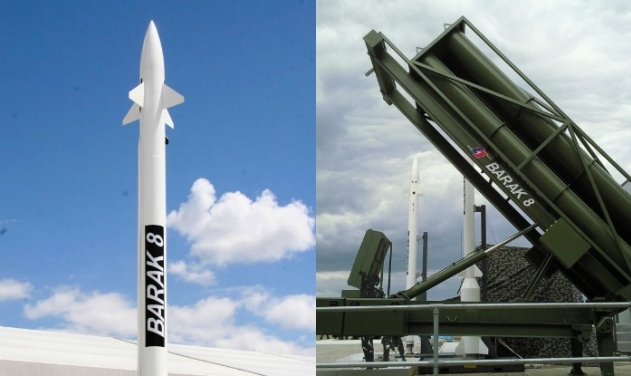
Barak-8 (Short-Range Variant) is a highly advanced surface-to-air missile (SAM) system jointly developed by India and Israel, designed to deliver quick-reaction, high-precision air defence against a broad spectrum of modern aerial threats. Although the Barak-8 family is widely recognized for its medium-range air-defence capability, the short-range variant is specifically optimized for point and close-area defence, where rapid response and accuracy are critical. It is particularly effective against low-flying, fast, and highly maneuverable targets that attempt to penetrate defended airspace using terrain masking or surprise attack profiles.
The Barak-8 SR is engineered to protect high-value military assets such as airbases, airfields, radar and command installations, naval vessels, and forward-deployed formations. It is capable of intercepting fighter aircraft, attack helicopters, UAVs and drone swarms, and sea-skimming cruise missiles, even in cluttered and electronically contested environments. Equipped with an active radar homing seeker, a vertical launch system providing 360-degree coverage, and advanced guidance and control technologies, the system offers exceptionally fast reaction time, high kill probability, and strong resistance to electronic countermeasures. These features make Barak-8 (Short-Range Variant) a critical component of integrated and layered air-defence networks, enhancing
Overview of Barak-8 Missile
|
Aspect
|
Details
|
|
System Name
|
Barak-8 (Short-Range Variant)
|
|
Category
|
(SR-SAM) Short-Range Surface-to-Air Missile
|
|
Role
|
Close-area air defence Point
|
|
Typical Range
|
Short range (approx. 15–35 km, role-dependent)
|
|
Targets
|
Aircraft, helicopters, cruise missiles, UAVs/drones
|
|
Guidance System
|
(Fire-and-Forget) Active Radar Homing
|
|
Launch Method
|
Vertical Launch (360° coverage)
|
|
Deployment Platforms
|
Ground-based systems and naval ships
|
|
Reaction Time
|
Very fast
|
|
Operational Capability
|
All-weather operation, day & night
|
|
Key Strength
|
High accuracy against low-altitude, fast threats
|
|
Role in Layered AD
|
Bridges VSHORAD and MR-SAM systems
|
Development Background of Barak-8 Missile
The Barak-8 missile system, including its short-range variant, was developed through a joint collaboration between India and Israel to counter modern aerial threats such as low-flying aircraft, UAVs, and cruise missiles. The programme was led by DRDO (India) and Israel Aerospace Industries (IAI), combining advanced radar, guidance, and missile technologies.
The short-range variant was specifically designed to strengthen point and close-area air defence for critical military and naval assets, offering fast reaction and high accuracy. The project also supports Atmanirbhar Bharat by promoting indigenous production, technology transfer, and long-term self-reliance in air-defence systems.
Operational Role of Barak-8 Missile
The Barak-8 short-range variant plays a crucial operational role by providing rapid and precise point defence for both land-based and naval assets. Its ability to counter low-altitude, fast, and maneuvering threats—including drones and sea-skimming missiles—makes it a vital element of layered air-defence networks, significantly improving asset protection and operational resilience.
-
Point defence of high-value strategic assets, including airbases, ports, command and control centers, radar installations, and critical infrastructure.
-
Protection of naval ships and fleets against hostile aircraft and sea-skimming anti-ship cruise missiles, ensuring maritime survivability.
-
Effective counter-UAV and anti-drone capability, including engagement of multiple drones and swarm threats in complex environments.
-
Low-altitude air defence against terrain-hugging cruise missiles and helicopters attempting surprise penetration.
-
Integral component of a layered air-defence architecture, operating alongside VSHORAD and Medium-Range SAM (MR-SAM) systems to close coverage gaps and enhance interception success.
Advantages of Barak-8 Missile
-
High interception accuracy, enabled by an active radar homing seeker that provides fire-and-forget capability and precise terminal guidance.
-
Very short reaction time, making it highly effective against close-in, sudden, and time-critical threats such as drones and sea-skimming missiles.
-
Multi-target engagement capability, allowing the system to track and intercept multiple aerial threats simultaneously.
-
Compact and flexible deployment, suitable for both land-based installations and naval platforms, including frontline warships.
-
Enhanced survivability, achieved through a vertical launch system offering 360-degree coverage and distributed deployment that reduces vulnerability to enemy strikes.
Importance of Barak-8 Missile
-
Strengthens point and close-area air defence, providing reliable protection to high-value assets such as airbases, ports, command centers, radar sites, and naval vessels.
-
Highly effective against modern low-altitude threats, including UAVs, drone swarms, attack helicopters, and sea-skimming cruise missiles.
-
Enhances reaction speed and interception success, which is critical in dense and time-sensitive threat environments.
-
Plays a key role in layered air-defence architecture, complementing VSHORAD and MR-SAM systems by closing coverage gaps.
-
Improves naval survivability, safeguarding warships and fleets against sudden aerial and missile attacks.
-
Boosts operational confidence and deterrence, reducing the effectiveness of enemy air and missile strikes.
-
Supports network-centric warfare, integrating seamlessly with modern C2 systems for coordinated, multi-target engagements.
Overall, the Barak-8 (Short-Range Variant) is a crucial force multiplier for both land and naval air defence, ensuring rapid, precise, and resilient protection against evolving aerial threats.
Limitations of Barak-8 Missile
-
Shorter engagement range when compared to medium-range (MR-SAM) and long-range (LR-SAM) air-defence systems, limiting its coverage area.
-
Higher system cost, primarily due to the use of advanced active radar seekers, sophisticated guidance electronics, and modern sensor integration.
-
Optimized mainly for point and close-area defence, making it less suitable for wide-area or strategic air-defence roles without support from longer-range systems.
Conclusion
The Barak-8 Short-Range Variant is a highly advanced and combat-ready air-defence missile system that excels in rapid reaction, precision interception, and reliable close-range protection against modern aerial threats. Its ability to effectively counter UAVs and drone swarms, fighter aircraft, helicopters, and low-flying cruise missiles makes it particularly valuable in dense and time-critical threat environments. Equipped with an active radar seeker, vertical launch capability, and 360-degree engagement coverage, the system delivers a high kill probability even against fast and maneuvering targets.
By providing robust point and close-area defence for high-value military and naval assets, the Barak-8 SR significantly enhances battlefield survivability and operational freedom. When integrated into a layered, network-centric air-defence framework, it closes critical gaps between very short- and medium-range systems, strengthening India’s overall air-defence posture. As a result, the Barak-8 Short-Range Variant stands as a key force multiplier in maintaining tactical air-defence dominance and safeguarding national security in the face of evolving aerial threats. To know more about missiles visit Education Masters.
सरकारी नौकरियों, जीके अपडेट्स और करेंट अफेयर्स की ताज़ा जानकारी सबसे पहले पाने के लिए:

 Missile.jpg)



.png)
.png)
.png)
.jpg)
.jpg)