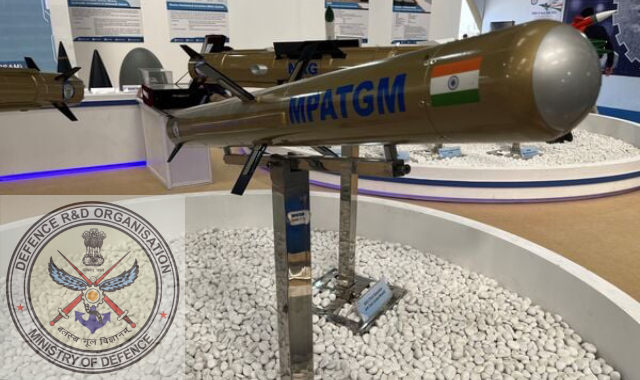
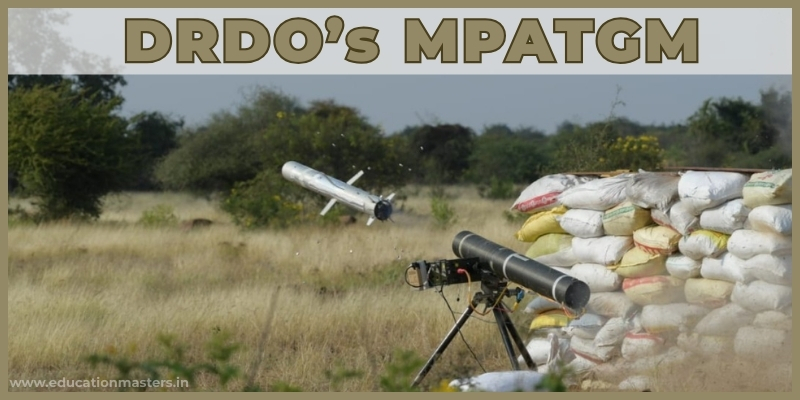
MPATGM (Man-Portable Anti-Tank Guided Missile) is an indigenously developed third-generation anti-tank missile system designed by India’s Defence Research and Development Organisation (DRDO) to meet the Indian Army’s requirement for a modern, infantry-carried anti-armor weapon. Engineered to provide frontline soldiers with a lightweight, highly accurate, and fire-and-forget capability, MPATGM enables infantry units to independently engage and destroy modern main battle tanks and armored vehicles equipped with advanced defensive measures such as Explosive Reactive Armor (ERA). The missile employs an advanced imaging infrared (IIR) seeker, allowing it to lock onto targets before launch and strike them with high precision, even in low-visibility or night-time conditions.
MPATGM has been developed as a replacement for older second-generation man-portable ATGMs that require continuous operator guidance, which exposes soldiers to enemy fire. By eliminating this limitation, MPATGM significantly enhances infantry survivability and operational effectiveness. Its indigenous development reduces India’s reliance on imported anti-tank systems and aligns with the country’s broader goal of defence self-reliance. As part of India’s layered anti-tank warfare architecture, MPATGM complements heavier systems such as Nag, HELINA, and Dhruvastra, ensuring a comprehensive and modern response to evolving armored threats on the battlefield.
Technical Characteristics (Approximate)
|
Parameter
|
Details
|
|
Type
|
Anti-Tank Guided Missile - Man-Portable
|
|
Generation
|
Third-generation
|
|
Guidance
|
Fire-and-Forget (Imaging Infrared)
|
|
Attack Mode
|
Top-attack
|
|
Range
|
2.5 kilometers
|
|
Warhead
|
Tandem HEAT
|
|
Target Type
|
Primary battle tanks, armored vehicles
|
|
Operator
|
Infantry units
|
|
Mobility
|
Tripod-mounted or Shoulder-launched
|
Development Background
MPATGM was developed by DRDO in response to the Indian Army’s requirement for a next-generation infantry anti-tank weapon comparable to global systems such as Javelin and Spike. The program focuses on indigenous technologies, particularly in imaging infrared (IIR) seeker systems, guidance electronics, and propulsion. Successful flight trials validated its accuracy, guidance reliability, and top-attack capability.
Key Features of MPATGM
• Fire-and-Forget Ability
MPATGM uses an advanced Imaging Infrared (IIR) seeker, allowing the operator to lock onto the target before launch and quickly relocate after firing.
• Mode of Attack- Top Attack
The missile attacks enemy tanks from the top, where armor is weakest, enabling effective defeat of modern main battle tanks, including those equipped with Explosive Reactive Armor (ER54A).
• High Accuracy
Advanced guidance and seeker technology provide high hit probability against both stationary and moving armored targets.
• Man-Portable Design
Lightweight and compact, MPATGM can be carried and operated by infantry soldiers without vehicle support.
• All-Weather Capability
The IIR seeker allows operation in low visibility, night conditions, and adverse weather.
Operational Role of MPATGM
• Infantry of Anti-Tank Warfare
MPATGM provides infantry units with a dedicated, independent anti-tank capability, enabling soldiers to counter armored threats without relying on heavy platforms or air support.
• Neutralization of Enemy Tanks and Armored Vehicles
Designed to defeat modern main battle tanks and armored fighting vehicles, MPATGM delivers precise and lethal strikes against high-value armored targets.
• Defensive Operations and Ambush
Its portability and fire-and-forget guidance make MPATGM ideal for ambush tactics and defensive deployments, allowing infantry to engage enemy armor from hidden positions.
• Support to Mechanized and Infantry Formations
MPATGM complements mechanized forces by protecting infantry units from enemy armor and enhancing overall battlefield coordination and effectiveness.
• Urban and Close-Terrain Combat
Well-suited for urban warfare and confined terrain, MPATGM enables effective engagement of armored threats in cities, forests, and mountainous regions where mobility and rapid response are critical.
MPATGM enables infantry units to counter armored threats without reliance on tanks or helicopters, increasing battlefield flexibility.
Advantages of MPATGM
• High Lethality Against Today’s Armored Vehicles
MPATGM is designed to defeat modern main battle tanks equipped with advanced armor and Explosive Reactive Armor (ERA), ensuring successful neutralization of armored threats.
• Fire-and-Forget Capability Enhances Soldier Survivability
Once launched, the missile autonomously tracks and engages the target, allowing the operator to immediately take cover or reposition, significantly reducing battlefield exposure.
• Highly Portable and Lightweight
Its compact, man-portable design allows infantry units to carry and deploy the system quickly across varied terrains, including mountainous, urban and jungle environments.
• Indigenous Development Strengthens Defence Self-Reliance
As a domestically developed weapon system, MPATGM reduces reliance on foreign imports and supports India’s long-term goal of defence indigenization.
• Effective in Offensive as well as Defensive Operations
MPATGM can be employed in ambushes, defensive positions, and offensive advances, offering tactical flexibility across a wide range of combat scenarios.
Limitations of MPATGM
• Engagement Range is Limited
As a man-portable system, MPATGM has a shorter effective range compared to vehicle-mounted or helicopter-launched ATGMs, restricting its use to close- and medium-range engagements.
• Warhead Payload is Smaller
The missile carries a lighter warhead than heavier ATGM systems, which may limit its effectiveness against extremely well-protected or heavily fortified armored targets.
• Requirement for Target Lock Before Launch
Successful engagement depends on achieving a clear pre-launch target lock using the imaging infrared seeker, which may be difficult in dynamic combat situations.
• Sensitivity to Battlefield Obscurants
Environmental factors such as smoke, dust, fog, and thermal clutter can affect seeker performance and reduce target detection and tracking accuracy.
Strategic Importance of MPATGM
• Strengthens Infantry-Level Anti-Tank Capability
MPATGM empowers frontline infantry units with an independent and highly effective anti-armor weapon, reducing reliance on tanks, helicopters, or external fire support during combat.
• Enhances Survivability of Battlefield
Its fire-and-forget capability allows soldiers to engage armored threats and immediately relocate, minimizing exposure to enemy fire and increasing high-threat environments survivability.
• Supports Defence Self-Reliance (Atmanirbharta)
As an indigenously developed system, MPATGM reduces dependence on imported anti-tank weapons and strengthens India’s domestic defence manufacturing and technological base.
• Improves Readiness for Modern Warfare
Designed to counter advanced main battle tanks equipped with Explosive Reactive Armor (ERA), MPATGM ensures the Indian Army remains prepared for modern, high-intensity combat scenarios.
• Complements India’s Layered Anti-Tank Doctrine
MPATGM integrates seamlessly with heavier ATGMs such as Nag, HELINA, and Dhruvastra, creating a multi-tiered anti-armor defence architecture across infantry, mechanized, and aerial platforms.
Conclusion
MPATGM represents a crucial advancement in India’s modern infantry weapon systems, delivering a highly mobile, precise, and lethal anti-tank capability at the soldier level. Its fire-and-forget guidance, top-attack strike profile, and advanced imaging infrared seeker enable infantry units to effectively defeat modern armored threats while minimizing exposure on the battlefield. Being an indigenous system, MPATGM significantly reduces dependence on foreign suppliers and strengthens India’s defence self-reliance. As the Indian Armed Forces continue to modernize and adapt to evolving combat environments, MPATGM will play a pivotal role in enhancing infantry survivability, improving battlefield dominance, and reinforcing India’s long-term strategic and technological autonomy. To know more about missiles visit Education Masters.
सरकारी नौकरियों, जीके अपडेट्स और करेंट अफेयर्स की ताज़ा जानकारी सबसे पहले पाने के लिए:




.png)
.png)
.png)
.jpg)
.jpg)